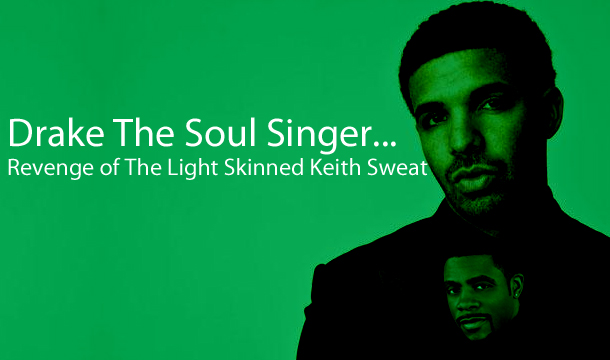

Revenge of The Light Skinned Keith Sweat
Hold On Were Going Home
This joint is a feel good joint that just makes you want to dance. It hooks you as soon as the beat drops and Drake let’s his voice glide over the production. It seems like Drake has his eyes on R&B as well as the Hip Hop crown. He is sounding more and more like a crooner then a lyricist. Some may say R&B is died but it doesn’t seem like it when you have rappers singing more then rapping. This song is soft but still got that knock that will rock at a get together or a club. Go Drake.Â
Are you ready to experience Drake like never before? The Canadian rapper has evolved into a soulful crooner, earning him the nickname ‘the soul singer.’
Drake’s music has always had elements of R&B, but his recent releases have taken it to a whole new level. In this article, we’ll explore Drake’s musical journey and how he went from being known as just a rapper to a soulful artist reminiscent of 90s R&B legends like Keith Sweat.
We’ll also examine the significance of being a ‘light skinned’ artist in today’s music industry and how it has influenced Drake’s career. Get ready for the revenge of the light skinned Keith Sweat as we dive into the world of Drake ‘the soul singer.’
Drake’s Musical Evolution: From Rapper to Soul Singer
You’ve probably noticed how Drake’s music has evolved from just rapping to including more soulful singing, and that transformation speaks to his growth as an artist. It’s clear that he’s not content with sticking to one sound or style, but instead wants to explore different genres and techniques. This willingness to experiment is what sets Drake apart from other artists in the hip-hop world.
As Drake’s career has progressed, we’ve seen him incorporate more and more singing into his music. He started out as a rapper, but now he’s fully embraced his soulful side. His voice is smooth and emotive, conveying deep emotion with every note he sings. It’s this vulnerability that draws fans in and keeps them coming back for more.
Perhaps one of the most notable examples of Drake’s evolution towards a more soulful sound is his album ‘Take Care.’ The album features collaborations with R&B singers like The Weeknd and Rihanna, showcasing his ability to blend rap and soul seamlessly.
With each new release, it seems like Drake is pushing himself further musically, challenging himself to create something fresh and innovative while still staying true to his roots in hip-hop.
Drake’s Comparison to Keith Sweat and the Significance of Being a “Light Skinned”Artist
Imagine being a smooth-talking crooner with a voice that could melt butter, and your appearance is as irresistible as your sound. That’s the image of Keith Sweat, a soul singer who rose to fame in the late ’80s and early ’90s.
Drake, on the other hand, has been compared to Sweat for his soulful singing style and light-skinned complexion. This comparison may seem trivial, but it speaks volumes about how race affects music.
Being light-skinned has historically been an advantage in the entertainment industry because it aligns with Eurocentric beauty standards. Lighter skin is seen as more desirable and marketable than darker skin.
In music specifically, lighter-skinned artists have often been pigeonholed into certain genres such as R&B or pop, while darker-skinned artists are expected to stick to hip-hop or rap. Drake’s success as a ‘light-skinned’ soul singer challenges these stereotypes and shows that talent should be the only factor determining an artist’s success.
Of course, this isn’t to say that Drake hasn’t faced criticism for appropriating black culture or profiting off of his biracial identity. But there is something significant about him being able to occupy space as a successful ‘light-skinned’ soul singer in an industry that has historically limited opportunities for black artists based on their skin color.
It remains to be seen how much progress will be made towards true representation and inclusivity in music, but artists like Drake are paving the way for future generations of musicians regardless of their skin tone.
Conclusion
Now that you’ve learned about Drake’s musical evolution from rapper to soul singer, and his comparison to Keith Sweat as a light-skinned artist, it’s clear that he has faced criticism and challenges throughout his career. However, he has also found success and popularity among fans of all backgrounds.
As an artist, Drake continues to push boundaries and experiment with different genres in his music. Whether it’s rap or soul, he brings his own unique style and perspective to each song.
So, next time you listen to one of his tracks, take a moment to appreciate the artistry behind it and the journey that brought him there.