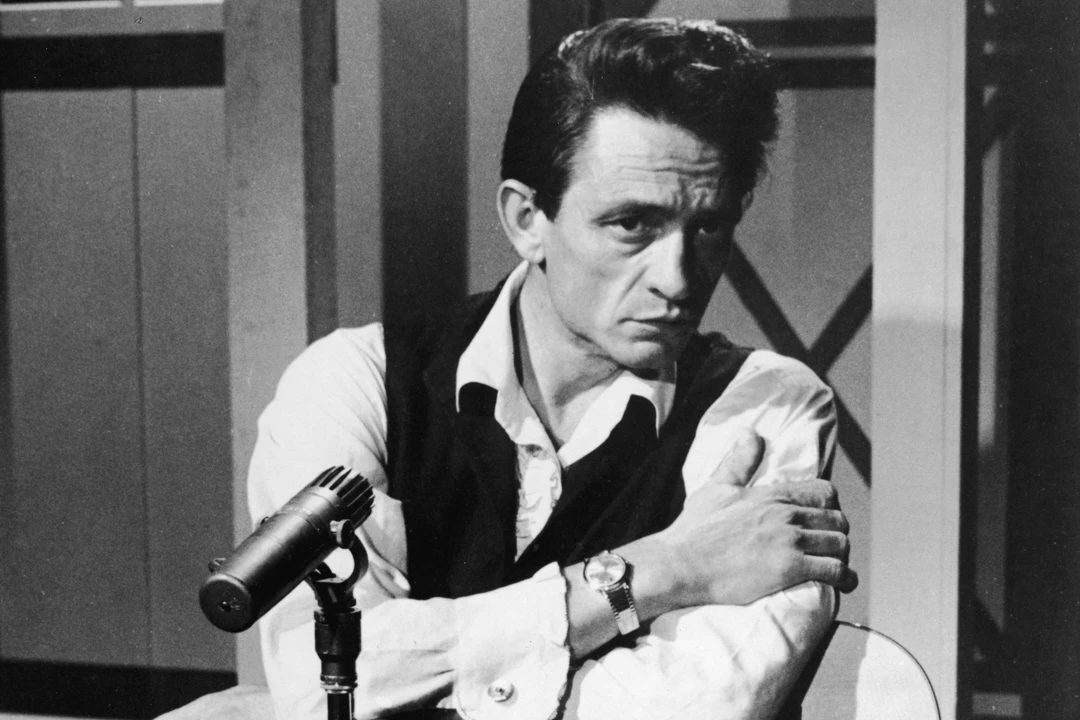
Few voices in American music carry the weight, grit, and unmistakable presence of Johnny Cash. With a deep baritone that feels carved from lived experience, he transformed country, folk, and rock into something stark, honest, and profoundly human. His songs walk through prison walls, dusty highways, heartbreak, redemption, and faith, often blurring the line between sinner and storyteller. What makes Cash timeless is his ability to strip a song down to its core truth, letting emotion stand unguarded. Whether delivering haunting ballads or defiant anthems, he sang with a conviction that made every word feel earned. This collection highlights the most popular Johnny Cash songs of all time, celebrating the recordings that continue to echo with raw authenticity and enduring power.
1. Ring Of Fire
“Ring Of Fire” is one of Johnny Cash’s most instantly recognizable songs, a recording that transforms romantic obsession into something fiery, dangerous, and strangely majestic. The mariachi style horns give the track a bold flavor unlike almost anything else in classic country at the time, while Cash’s deep baritone grounds the whole performance in unmistakable authority. What makes the song so powerful is its simplicity. Love is not described as soft comfort or sweet escape. It is a burning circle, a force that surrounds, consumes, and changes the person caught inside it. Cash sings with remarkable control, never needing to exaggerate the feeling because the imagery and arrangement already carry such intensity. The rhythm moves with a steady, almost hypnotic pulse, making the song feel ceremonial as much as romantic. “Ring Of Fire” became a defining Cash classic because it captures passion with both heat and restraint. It is brief, unforgettable, and completely singular, a song that sounds like love as warning, confession, and destiny all at once.
2. Folsom Prison Blues
“Folsom Prison Blues” is one of Johnny Cash’s most essential recordings, a song that helped define his image as the voice of prisoners, wanderers, sinners, and men haunted by their own choices. The famous train rhythm gives the track its unstoppable movement, evoking steel wheels, distance, and the cruel freedom of a world passing outside prison walls. Cash’s vocal is calm, almost conversational, which makes the darkness of the lyric even more striking. He does not sound like an actor playing a criminal. He sounds like a man reporting from inside the consequences. That sense of emotional proximity is what gives the song its lasting force. The narrator hears a train and imagines people moving freely while he remains trapped, creating one of country music’s great images of confinement and longing. “Folsom Prison Blues” became even more legendary through Cash’s prison performances, where the song’s tension between entertainment and empathy took on extraordinary weight. It remains popular because it is raw, direct, and morally complicated. Cash does not excuse the narrator, but he gives him a voice, and that voice still echoes with loneliness.
3. I Walk The Line
“I Walk The Line” is one of Johnny Cash’s purest statements of discipline, devotion, and self control. Built around a distinctive boom chick rhythm and a melody that seems to turn in circles like a private vow being repeated, the song is both simple and hypnotic. Cash sings not as a man overwhelmed by romance, but as someone actively choosing loyalty, day after day, temptation after temptation. That tension is what makes the recording so fascinating. Beneath the steady rhythm is the awareness that faithfulness requires effort. The narrator walks the line because he knows there is another side he could cross into. Cash’s voice gives the song its gravity. His baritone sounds firm, intimate, and slightly shadowed, suggesting both sincerity and struggle. “I Walk The Line” became a signature song because it captures the central drama of Cash’s persona: the pull between darkness and duty, desire and restraint, wandering and commitment. Its popularity has endured because the promise at its center feels timeless. It is not showy, sentimental, or ornate. It is a pledge set to rhythm, and Cash makes every word feel carved in stone.
4. Hurt
“Hurt” is one of the most devastating late career recordings in popular music, a song that Johnny Cash transformed into a meditation on age, regret, memory, and mortality. Originally written by Trent Reznor, the song became something entirely different in Cash’s hands. His voice, weathered and fragile, carries the full weight of a life already lived. Every crack in the vocal becomes part of the meaning. The arrangement is sparse and solemn, allowing silence to gather around the words like dust in an empty room. What makes “Hurt” so overwhelming is the sense of final reckoning. Cash sounds as though he is looking back across fame, love, failure, faith, and loss with brutal honesty. The performance does not seek pity. It offers witness. The famous video deepened the song’s impact, but even without images, the recording feels starkly visual. You can hear history in his breath. For a man known for strength, rebellion, and moral force, this version revealed a different kind of courage: the willingness to sound frail, exposed, and truthful. It remains one of Cash’s most profound artistic statements.
5. A Boy Named Sue
“A Boy Named Sue” is Johnny Cash at his funniest, sharpest, and most theatrical, a live performance that turns a comic revenge tale into a roaring piece of country storytelling. Written by Shel Silverstein, the song gives Cash a perfect narrative vehicle: a man hardened by a humiliating name spends his life searching for the father who gave it to him. The story is outrageous, but Cash sells it with complete conviction. His timing is impeccable, letting the humor land while keeping the emotional stakes alive. The San Quentin audience response adds electricity, making the track feel less like a polished studio single and more like a shared event unfolding in real time. What makes “A Boy Named Sue” so enduring is the way it balances comedy with a strange kind of wisdom. The father’s explanation is brutal, absurd, and oddly practical, suggesting that toughness can come from wounds no child should have to carry. Cash understands the contradiction and plays it brilliantly. The result is a song that remains hilarious, memorable, and surprisingly rich, proof that Cash could command laughter as powerfully as sorrow.
6. Man In Black
“Man In Black” is Johnny Cash’s clearest statement of conscience, a song that explains his famous image not as fashion, but as moral identification. The black clothing becomes a symbol of solidarity with the poor, the imprisoned, the lonely, the addicted, the grieving, and the forgotten. Cash sings with plainspoken conviction, refusing poetic disguise in favor of direct testimony. That directness is exactly what gives the song its force. He does not claim to solve suffering by wearing black, but he uses the image to keep suffering visible. The arrangement is steady and unadorned, allowing the words to carry the weight. What makes “Man In Black” so important is that it connects Cash’s public persona to a broader ethical vision. He was never simply an outlaw figure for style’s sake. His darkness had empathy inside it. The song stands as a reminder that country music can speak for people pushed to the margins, and that protest does not always need slogans shouted over noise. Sometimes it arrives in a deep voice, a black suit, and a promise not to look away.
7. Jackson
“Jackson” is one of the most beloved duets in country music, and Johnny Cash’s chemistry with June Carter Cash gives the song its irresistible spark. The lyric presents a couple locked in playful combat, each one trying to outwit and outswagger the other as the fantasy of going to Jackson becomes a symbol of escape, temptation, and comic marital warfare. Cash’s deep, confident delivery contrasts beautifully with June’s sharp, spirited responses, creating a performance that feels alive with personality. The song works because it is not merely sung. It is acted. Every line sounds like a glance, a smirk, or a challenge tossed across the room. The arrangement has a bright country drive, but the heart of the track is the dialogue between the two voices. “Jackson” remains popular because it captures romance as friction, humor, and performance. This is love with sparks flying, not soft candlelight. Cash brings the swagger, June brings the fire, and together they create something far more vivid than either character would be alone. It is funny, stylish, and endlessly replayable, a perfect showcase of country music’s duet tradition at its most charismatic.
8. Sunday Morning Coming Down
“Sunday Morning Coming Down” is one of Johnny Cash’s most deeply felt interpretations, a song that captures loneliness with almost unbearable clarity. Written by Kris Kristofferson, it gives Cash a perfect landscape of empty streets, stale regret, and spiritual hunger. The narrator wakes into the kind of Sunday where ordinary sounds become painful: church bells, children playing, someone frying chicken, a city moving gently around a man who feels cut off from grace. Cash sings it with profound empathy, never turning the narrator into a caricature of drunken sadness. Instead, he finds dignity in the desolation. His voice carries the ache of someone who understands how silence can become heavy after a night of distraction wears off. What makes “Sunday Morning Coming Down” so powerful is its attention to small details. The song does not need melodrama because the emptiness is already present in every image. Cash’s performance turns it into a hymn for people who feel furthest from church when the bells are ringing. It remains one of his greatest songs because it speaks to solitude, regret, and the human need for mercy with extraordinary tenderness.
9. God’s Gonna Cut You Down
“God’s Gonna Cut You Down” is one of Johnny Cash’s most powerful late period recordings, a stark spiritual warning delivered with the authority of an Old Testament prophet. The song is built on a stomping rhythm that feels almost ancient, as if a congregation, a chain gang, and a funeral procession have all joined the same march. Cash’s voice is aged but commanding, carrying the weight of judgment without theatrical excess. He does not need to shout. The gravity is already there. The lyric warns liars, gamblers, backbiters, and hidden sinners that no one outruns reckoning forever. In Cash’s hands, that message feels both universal and personal. He had spent a lifetime singing about guilt, temptation, punishment, and redemption, so this song arrives with unusual credibility. “God’s Gonna Cut You Down” became a modern Cash classic because it connects his final creative era to the deepest roots of American folk, gospel, and blues. The production is lean, dark, and unforgettable, emphasizing rhythm and voice above ornament. It remains gripping because it sounds less like a performance than a final warning from a man who knew the shadows well.
10. Get Rhythm
“Get Rhythm” is Johnny Cash in bright rockabilly motion, a compact burst of energy that shows the lighter, more swinging side of his early Sun Records sound. The song moves with irresistible bounce, driven by the trademark boom chick rhythm that made Cash’s early recordings so distinctive. Its story centers on a shoeshine boy who uses rhythm to rise above the grind of work, turning hardship into movement and spirit. Cash sings with an easy grin in his voice, clearly enjoying the song’s snap and momentum. What makes “Get Rhythm” so appealing is its belief in music as survival. The lyric suggests that rhythm can change the body before it changes the circumstances, giving a person enough lift to keep going. The guitar work is crisp, the groove is lean, and the whole track has the stripped down electricity of early rock and country colliding in real time. It remains popular because it captures Cash before the myth became heavy, when his music still had the quick shine of Memphis invention. The song is joyful without being empty, simple without being dull, and proof that Cash could make resilience dance.

Samuel Moore is a frequent contributor to Singers Room. Since 2005, Singersroom has been the voice of R&B around the world. Connect with us via social media below.