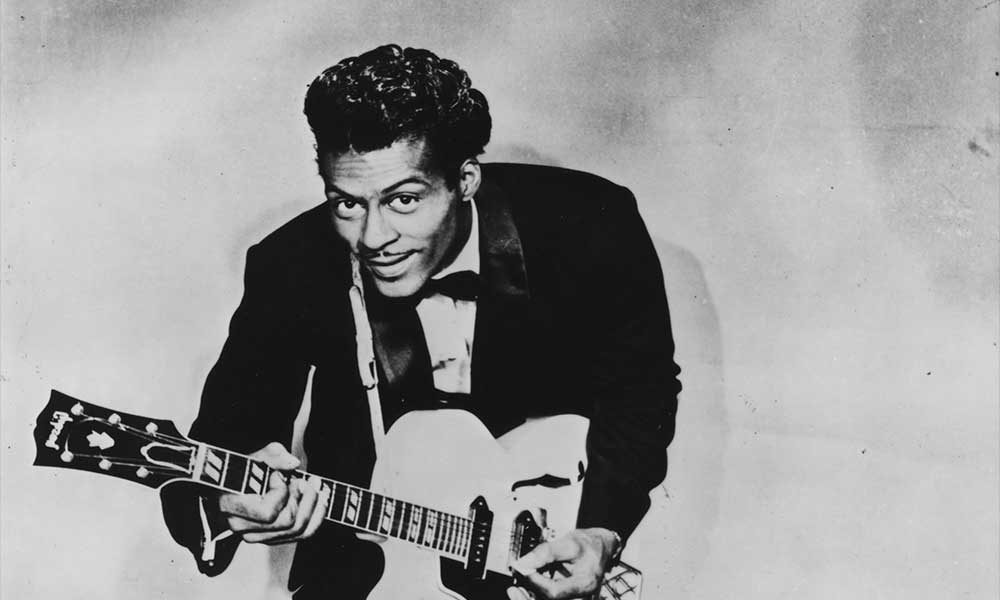
Few artists shaped the sound and spirit of rock and roll quite like Chuck Berry. With his electrifying guitar riffs, sharp storytelling, and irresistible sense of rhythm, Berry didn’t just perform songs, he defined an entire musical language that generations would follow. His music captured youth, rebellion, humor, and everyday life with a clarity that felt both fresh and timeless. From high energy anthems to clever lyrical snapshots, his catalog remains a cornerstone of modern music. This collection of his most popular songs celebrates the genius of an artist whose influence echoes through nearly every rock record ever made, still sounding as vibrant and groundbreaking today as it did at the very beginning.
1. Johnny B. Goode
Johnny B. Goode is more than one of Chuck Berry’s most popular songs. It is one of the central texts of rock and roll itself, a blazing self mythologizing anthem that made the electric guitar sound like destiny. From the opening riff, Berry creates a musical language that countless players would spend decades studying, copying, and chasing. The guitar does not simply introduce the song. It announces a new cultural figure, the young dreamer with rhythm in his hands and a future waiting beyond the limits of his hometown.
The story of Johnny is simple, but Berry fills it with cinematic confidence. A country boy plays guitar with dazzling skill, and the world eventually notices. That idea became one of rock music’s founding dreams, the belief that raw talent, drive, and style could lift a person out of obscurity. Berry sings with sharp diction and conversational swagger, making the tale feel both playful and prophetic. The rhythm swings with unstoppable ease, while the guitar break practically invents a vocabulary for generations of rock performers. Johnny B. Goode remains irresistible because it captures ambition without bitterness, virtuosity without heaviness, and rebellion without losing its grin. It is the sound of rock and roll recognizing itself in the mirror and liking what it sees.
2. Maybellene
Maybellene is the sound of rock and roll bursting out of the garage before anyone had fully decided what to call it. Chuck Berry took blues, country flavor, driving rhythm, and teenage storytelling, then fused them into a record that still feels thrillingly alive. The song is built around speed, suspicion, and pursuit. A car chase becomes a romantic crisis, and Berry delivers the story with the quick eyed wit of a writer who understood that modern youth culture was moving fast and needed music that could keep up.
The guitar tone has a sharp, wiry brightness that cuts through the track like sunlight flashing off chrome. Berry’s vocal is full of humor and urgency, never sounding stiff or staged. He turns each line into forward motion, as if the listener is riding in the passenger seat while the engine screams and the emotional stakes rise. The rhythm section gives the song its pounding heart, but Berry’s imagination gives it style. Maybellene became one of the foundational rock and roll records because it made cars, romance, rivalry, and electric guitar feel like parts of the same American dream. It is compact, witty, and explosive, a song that transformed everyday teenage drama into a new kind of musical poetry.
3. Roll Over Beethoven
Roll Over Beethoven is one of Chuck Berry’s boldest declarations of musical revolution, a song that joyfully tells the old order to make room for something louder, faster, and more alive. The title alone is a masterstroke. Berry is not rejecting classical music out of ignorance. He is announcing that a new popular language has arrived with its own authority, its own rhythms, and its own cultural force. The song has the wit of a manifesto and the kick of a jukebox favorite.
The guitar riff jumps out with clean confidence, while the rhythm pushes forward with the kind of unstoppable energy that made Berry’s records feel so modern. His vocal performance is sly, bright, and perfectly timed. He sounds like a man delighted by the changing world, fully aware that rock and roll is not a passing fad but a generational shift. The lyric references rhythm and blues with pride, placing the new sound in a living tradition rather than treating it as a novelty. Roll Over Beethoven remains popular because it captures the excitement of cultural change in under three minutes. It is witty without being smug, rebellious without being crude, and musically precise without losing its wild spark. Few songs have ever made a revolution sound this much fun.
4. Sweet Little Sixteen
Sweet Little Sixteen is one of Chuck Berry’s great portraits of teenage excitement, a song packed with movement, regional detail, and the electric charge of youth culture discovering itself. Berry had a remarkable gift for writing about young people without sounding like an outsider. He understood the rituals, the fashions, the radio dreams, the dances, the idols, and the feverish need to belong to something bigger than home. In this song, the teenage fan becomes almost heroic, traveling emotionally through the expanding map of rock and roll America.
The rhythm is buoyant and relentless, driven by Berry’s crisp guitar and bright vocal delivery. He lists cities with the excitement of a touring musician and the precision of a reporter, turning the song into a national roll call of teenage devotion. What makes the record so enduring is its sense of empathy. Berry does not mock the young girl at the center of the story. He understands her hunger for glamour, music, and identity. The song also shows Berry’s genius for making geography musical. Every place name becomes part of the groove. Sweet Little Sixteen remains one of his most popular songs because it captures the moment when rock and roll stopped being local and became a coast to coast phenomenon, carried by young listeners who felt it as their own private language.
5. Rock And Roll Music
Rock And Roll Music is Chuck Berry’s joyous statement of purpose, a song that explains exactly what he loves and why it matters. The lyric is direct, but that directness is part of its brilliance. Berry is not trying to hide behind metaphor or complication. He wants the music that moves the body, sparks the room, and makes ordinary troubles vanish for a few minutes. It is one of the clearest expressions of rock and roll as pleasure, release, and identity.
The performance has a lean, confident swing that shows Berry’s deep understanding of rhythm. His guitar lines snap and shimmer, while his voice carries the easy authority of someone who knows the truth of what he is singing. The song celebrates rhythm and blues, dance halls, radios, and the democratic thrill of music that does not require permission from cultural gatekeepers. Berry’s humor is present, but so is his seriousness. He is making a case for popular music as something vital, not disposable. Rock And Roll Music became an anthem because it names the feeling at the center of Berry’s art. It is not merely about a genre. It is about the hunger for sound that feels alive, immediate, and honest. Few artists ever described their own musical world with such clarity and charm.
6. School Day
School Day is one of Chuck Berry’s sharpest snapshots of teenage life, a song that understands both the boredom of routine and the explosive freedom that music can offer. The track begins with the familiar grind of school, bells, books, classes, and authority figures, then moves toward the great release waiting after hours. Berry turns the daily schedule of a student into a miniature drama, where the classroom feels like confinement and the jukebox becomes salvation.
The phrase that calls for hail to rock and roll became one of Berry’s defining rallying cries because it captures how music functioned for young listeners in the nineteen fifties. It was not background noise. It was escape, identity, motion, and community. Berry sings with knowing humor, never sounding preachy or detached. He writes from inside the teenage imagination, where small freedoms feel enormous and every record can change the temperature of the room. The guitar work is crisp and lively, while the rhythm keeps the song moving with bright confidence. School Day remains popular because it captures a universal rhythm of youth: obligation by day, music by night, and the hope that a good beat can shake loose everything dull and restrictive. It is one of Berry’s finest examples of everyday life turned into rock and roll myth.
7. Memphis Tennessee
Memphis Tennessee reveals Chuck Berry’s brilliance as a storyteller in a more tender and surprising form. At first, the song seems like a familiar tale of a man trying to reach a lost romantic love. Berry’s vocal is calm, measured, and conversational, drawing the listener into the details without revealing too much too soon. Then the emotional twist arrives, and the song becomes something deeper: a father trying to contact his young daughter after separation. That revelation gives the entire record a quiet ache that lingers long after the music ends.
The arrangement is relatively restrained compared with Berry’s more explosive guitar anthems, which allows the narrative to take center stage. His voice carries just enough sadness to make the story believable, but he avoids melodrama. The genius is in the plainness of the telling. Berry names places, operators, phone calls, and distance with a novelist’s eye for everyday detail. The listener feels the emotional geography as much as the physical one. Memphis Tennessee remains one of his most admired songs because it proves he was far more than a riff maker. He could write compact stories with real emotional architecture, using simple language to create surprise, compassion, and lasting resonance. It is one of rock and roll’s great narrative miniatures.
8. No Particular Place To Go
No Particular Place To Go is Chuck Berry’s comic genius in full motion, a song that turns teenage romance, automobile freedom, and mechanical frustration into one irresistible rock and roll scene. The setup is classic Berry: a couple cruising in a car, the radio playing, the mood rising, and the open road promising possibility. Then a stubborn seat belt turns the fantasy into farce. That simple twist gives the song its humor, but Berry’s delivery gives it lasting charm.
The music rolls with easy confidence, borrowing the feel of earlier Berry road songs while sharpening the wit. His guitar has that familiar bright bite, and the rhythm moves like a car gliding through city streets after dark. Berry sings with perfect comic timing. He never overplays the joke. Instead, he lets the details build naturally, making the listener smile at the awkwardness of desire interrupted by modern technology. Beneath the humor is a brilliant portrait of changing youth culture, where cars became private spaces, music became the soundtrack to romance, and ordinary objects could become obstacles in the great pursuit of freedom. No Particular Place To Go remains popular because it is funny, clever, and rhythmically infectious. It shows Berry as both rocker and playwright, turning a small mishap into a perfectly polished cultural vignette.
9. You Never Can Tell
You Never Can Tell is one of Chuck Berry’s most charming story songs, a playful and wonderfully detailed portrait of young love making a life for itself. The song follows a teenage couple through marriage, furniture, music, meals, and domestic optimism, all told with Berry’s unmistakable eye for comic detail. Rather than treating youth romance as foolish or doomed, he presents it with affectionate curiosity. The couple may be young, but their little world has texture, rhythm, and style.
The music has a bright, rolling feel that gives the song a different flavor from Berry’s guitar driven rave ups. Its piano led groove and relaxed swing make it feel almost conversational, as if the story is being told across a kitchen table by someone who has seen enough life to be amused by its surprises. Berry’s vocal is warm, witty, and precise, landing each detail with the timing of a born storyteller. The famous refrain carries a gentle philosophical wisdom: life does not always follow expectation. You Never Can Tell remains beloved because it shows Berry’s softer humor and narrative elegance. It is a song about ordinary happiness, but in Berry’s hands, ordinary happiness becomes vivid, stylish, and deeply musical. Few rock and roll writers could make domestic detail sparkle with such personality.
10. Carol
Carol is one of Chuck Berry’s great dance floor invitations, a song that blends romance, rhythm, and guitar swagger into a compact burst of rock and roll confidence. The lyric is addressed directly to Carol, but the energy is big enough to include everyone in the room. Berry is not simply asking for affection. He is promising movement, excitement, and the kind of musical experience that might win someone over through sheer style. The song captures courtship as performance, with the dance floor as the stage.
Berry’s guitar work is central to the song’s appeal. The riff has a teasing quality, quick and sharp, while the soloing adds flashes of personality without distracting from the groove. His vocal performance is playful and persuasive, full of that sly confidence that made him such a compelling figure. He sounds amused, determined, and completely at home inside the beat. The rhythm section keeps everything lean and lively, giving the song the kind of forward motion that made Berry’s records essential to bands that followed. Carol remains popular because it captures rock and roll as social magic. It is about dancing, flirting, showing off, and letting the music become the argument. In just a few minutes, Berry creates a world where charm has a backbeat and romance rides on electric guitar.

Edward Tomlin is a frequent contributor to Singers Room. Since 2005, Singersroom has been the voice of R&B around the world. Connect with us via social media below.