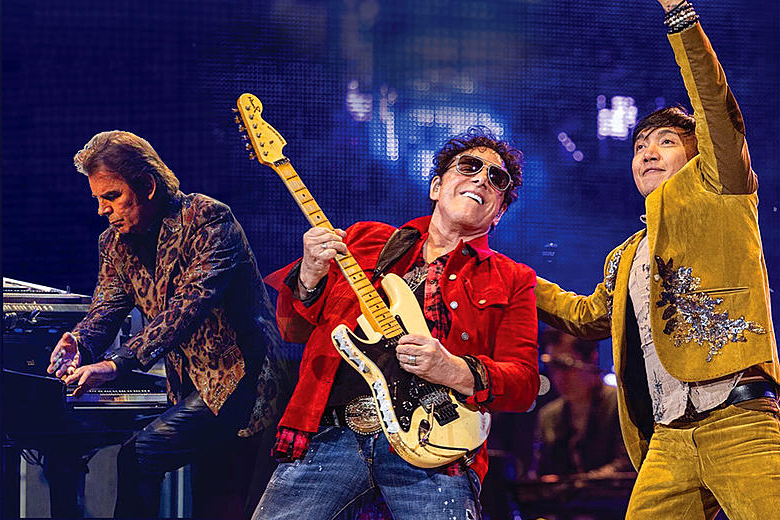
Few bands mastered the art of arena rock emotion quite like Journey. With soaring vocals, unforgettable choruses, and melodies built for massive singalongs, Journey created some of the most enduring rock songs of the late 1970s and 1980s. Steve Perry’s powerful and deeply emotional voice became the heart of the band’s sound, while Neal Schon’s expressive guitar work and the group’s polished musicianship gave their music both energy and elegance. Journey could deliver uplifting anthems filled with hope and ambition one moment, then shift into heartfelt ballads overflowing with longing and vulnerability the next. Their songs became staples of radio, sports arenas, movies, and popular culture, connecting with generations of listeners through themes of love, perseverance, heartbreak, and escape. Decades later, Journey’s greatest hits still feel larger than life, instantly recognizable from the very first note.
1. Don’t Stop Believin’
Don’t Stop Believin’ is the Journey song that became larger than the band itself, a timeless anthem of hope, escape, and emotional endurance. Built around Jonathan Cain’s instantly recognizable piano figure, the track unfolds with unusual patience, introducing its characters and atmosphere before finally reaching one of rock’s most famous choruses. Steve Perry’s vocal performance is central to its power. He sings with soaring conviction, but also with warmth and humanity, making the song feel less like a slogan and more like a shared promise. His voice gives the lyrics a sense of open road possibility, turning small town dreams and midnight trains into symbols of perseverance.
What makes Don’t Stop Believin’ so enduring is its perfect balance of storytelling and arena sized release. Neal Schon’s guitar work adds lift and fire without overpowering the song’s melodic heart, while Ross Valory and Steve Smith provide a rhythm foundation that lets the track build naturally. The chorus arrives late, which makes its impact even greater. By the time the title phrase finally appears, it feels earned, almost cathartic. The song has crossed generations through radio, television, sports arenas, weddings, karaoke nights, and countless shared moments because it speaks to something universal. It is not merely about optimism. It is about holding on when life is uncertain. Few rock songs have carried that message with such melodic force, emotional clarity, and lasting cultural power.
2. Open Arms
Open Arms is one of Journey’s most beloved ballads, a song that transformed vulnerability into a grand emotional statement. At its heart is Steve Perry’s extraordinary vocal performance, which begins with tenderness and gradually rises into sweeping romantic intensity. The song is simple in structure, but that simplicity allows every emotional detail to shine. Perry sings as though each line is a direct confession, balancing fragility and power in a way few rock vocalists could match. His voice gives the song its warmth, ache, and unmistakable sincerity.
The arrangement of Open Arms is built with remarkable restraint. The piano and soft instrumental textures create an intimate foundation before the song expands into a fuller arena rock ballad. Neal Schon’s guitar presence is subtle but effective, adding feeling without disrupting the vocal focus. The lyric centers on reunion, forgiveness, and the desire to be emotionally available after distance or conflict. That theme helped the song become a favorite for romantic moments, but it also carries a wider emotional resonance. It is about lowering defenses and choosing connection. Journey had many songs filled with speed, energy, and escape, but Open Arms proved they could command just as much power through stillness and vulnerability. Its popularity endures because it captures love at its most honest: uncertain, hopeful, and brave enough to stand exposed.
3. Separate Ways
Separate Ways is Journey at their most dramatic and hard hitting, a song that turns heartbreak into a thunderous arena rock attack. From the opening keyboard riff, the track announces itself with urgency and tension. Jonathan Cain’s synthesizer line is sharp and unforgettable, while the rhythm section drives the song forward with a powerful pulse that gives it an almost militant force. Steve Perry sings with emotional intensity, portraying romantic separation not as quiet sadness, but as a storm of pride, pain, and unresolved devotion.
The greatness of Separate Ways lies in its combination of melodic grandeur and muscular rock energy. Neal Schon’s guitar work cuts through the polished production with fire, adding grit to the song’s sleek 1980s atmosphere. Perry’s vocal is explosive, especially in the chorus, where longing and defiance collide. The lyrics suggest two people moving apart while still emotionally tied to one another, and the music magnifies that conflict with every pounding beat. Though the music video later became famous for its intense visual style, the song itself remains one of Journey’s strongest performances. It captures the band at a point where they could blend pop accessibility, rock power, and emotional melodrama with complete confidence. Separate Ways remains a fan favorite because it does not simply mourn a breakup. It makes heartbreak sound enormous, cinematic, and impossible to ignore.
4. Any Way You Want It
Any Way You Want It is one of Journey’s most joyful rock songs, a burst of melody, speed, and pure feel good energy. The track opens with immediate momentum, driven by Neal Schon’s bright guitar attack and Steve Perry’s high flying vocal entrance. Unlike some of Journey’s more dramatic ballads or emotional anthems, this song thrives on simplicity and excitement. It is built for movement, celebration, and instant recognition. Perry sings with effortless enthusiasm, turning the title phrase into an invitation that feels open, playful, and impossible to resist.
Any Way You Want It remains popular because it captures Journey’s ability to make arena rock feel light on its feet. The rhythm section keeps the song charging forward, while the harmonies add sparkle and lift. Schon’s guitar work provides both edge and brightness, giving the track enough rock muscle to balance its pop sweetness. There is no heavy concept or complicated emotional story here, and that is part of the charm. The song is about energy, attraction, and the thrill of letting the music carry the moment. Its use in films, commercials, sporting events, and live performances has kept it deeply embedded in popular culture. Any Way You Want It is one of those songs that feels instantly familiar even before the chorus fully arrives. It is compact, upbeat, and full of the infectious confidence that made Journey masters of crowd pleasing rock.
5. Faithfully
Faithfully is one of Journey’s most emotionally resonant ballads, a song that captures the loneliness and devotion of life on the road. Written from the perspective of a touring musician trying to maintain love across distance, the track feels intimate even as it grows into a sweeping arena classic. Steve Perry’s vocal is stunning in its emotional control. He sings with tenderness, longing, and a sense of weary commitment, making the listener believe every word. The song does not romanticize separation in a shallow way. It acknowledges the strain while still honoring the promise to remain faithful.
The arrangement of Faithfully is beautifully crafted. Jonathan Cain’s keyboard foundation gives the song a soft, reflective glow, while Neal Schon’s guitar textures add emotional lift as the track builds. The drums enter with measured power, guiding the song from private confession to communal anthem. What makes the song so enduring is its sincerity. It speaks to anyone who has tried to preserve love across distance, pressure, and time. Perry’s delivery gives the chorus a sense of soaring release, but the song never loses its human center. It is both grand and deeply personal. Faithfully remains one of Journey’s defining songs because it turns the realities of touring, sacrifice, and longing into a universal expression of commitment. Few rock ballads have ever sounded this honest while still feeling so majestic.
6. Wheel in the Sky
Wheel in the Sky is one of Journey’s most important early classics, a song that helped establish the band’s shift from progressive rock roots toward a more melodic arena sound. The track carries a sense of motion and uncertainty, driven by a memorable guitar figure and Steve Perry’s soaring vocal presence. Perry had recently joined the band, and his voice brought a new emotional accessibility to Journey’s music. On this song, he sounds urgent, soulful, and restless, perfectly suited to lyrics about travel, time, and the unknown path ahead.
The appeal of Wheel in the Sky comes from its balance of atmosphere and drive. Neal Schon’s guitar work is expressive and slightly mysterious, giving the track a road worn mood that fits the title beautifully. The rhythm section keeps the song moving with steady force, while the chorus opens into one of the band’s earliest great singalong moments. There is a feeling of searching embedded in the music, as though the band is looking toward something just beyond the horizon. That sense of forward movement became central to Journey’s identity. The song has remained a concert favorite because it captures the emotional pull of life in motion: distance, anticipation, fatigue, and hope all turning together like the wheel in the title. Wheel in the Sky remains essential because it marks the moment Journey’s sound truly began to take flight.
7. Who’s Crying Now
Who’s Crying Now is one of Journey’s most elegant and emotionally complex hits, a song that explores romantic conflict with smooth restraint rather than explosive drama. The track opens with a moody keyboard figure that immediately establishes a late night atmosphere. Steve Perry’s vocal enters with controlled intensity, bringing pain and sophistication to lyrics about love that has turned into hurt, accusation, and emotional imbalance. He does not oversell the sadness. Instead, he lets the melody carry the ache, making the performance feel mature and deeply felt.
Who’s Crying Now stands out because it blends pop polish with rock musicianship so gracefully. Jonathan Cain’s keyboards create a sleek foundation, while Ross Valory and Steve Smith keep the rhythm steady and refined. Neal Schon’s guitar solo near the end is one of the song’s most memorable elements, gradually raising the emotional temperature until the track reaches a powerful release. The song’s title suggests reversal and consequence, asking who is left wounded after love becomes a battleground. That emotional ambiguity gives it lasting depth. Journey could write huge, uplifting anthems, but this track shows their gift for moodier storytelling. Who’s Crying Now remains popular because it feels polished without being hollow, emotional without being overwrought, and memorable without sacrificing musical sophistication. It is one of the band’s finest examples of romantic tension set to arena ready melody.
8. Lights
Lights is one of Journey’s most heartfelt early signature songs, a warm tribute to home, memory, and the emotional pull of a city seen from afar. Although its origins are tied to a broader idea of returning to a beloved place, the song became closely associated with San Francisco, giving it a special place in the band’s identity. Steve Perry’s vocal is tender and relaxed, capturing the feeling of someone reflecting on distance with affection rather than despair. His voice glows with sincerity, making the song feel personal and welcoming.
The beauty of Lights lies in its gentle confidence. Neal Schon’s guitar lines are smooth and melodic, adding warmth without overpowering the song’s soft emotional center. The arrangement is less explosive than Journey’s later arena anthems, but it has a charm that feels timeless. The harmonies add a sense of comfort, while the melody unfolds with easy grace. The lyrics capture a universal experience: missing the lights, streets, people, and atmosphere of a place that feels like home. That emotional accessibility helped the song remain beloved long after its release. It is a quieter Journey classic, but no less important. Lights shows the band’s ability to create connection through warmth and nostalgia rather than sheer volume. It remains one of their most enduring songs because it feels like a homecoming set to music.
9. Lovin’, Touchin’, Squeezin’
Lovin’, Touchin’, Squeezin’ is one of Journey’s most soulful and blues influenced hits, a song that shows the band could slow the tempo and still deliver major emotional impact. Steve Perry’s vocal performance is full of pain, attitude, and wounded pride. He sings like someone caught in the sting of betrayal, turning heartbreak into a performance that feels both personal and theatrical. The song’s groove is deliberate and heavy, allowing each phrase to land with weight. Rather than rushing through the emotion, Journey lets the hurt simmer.
Lovin’, Touchin’, Squeezin’ stands apart from many of the band’s more polished arena rock songs because of its rawer R&B flavor. The piano and guitar elements support a slow burning arrangement, while the rhythm section gives the song a steady, almost swaggering pulse. Perry’s voice is the undeniable centerpiece, rising from bitterness into full emotional release. The famous closing chant became one of Journey’s most memorable audience participation moments, transforming romantic pain into a communal singalong. That contrast is part of the song’s magic. It begins as a wounded confession and ends as something almost celebratory. Lovin’, Touchin’, Squeezin’ remains popular because it captures betrayal with soul, style, and unforgettable vocal power. It is proof that Journey’s greatness was not limited to glossy anthems. They could also dig into heartache with grit and groove.
10. Stone in Love
Stone in Love is one of Journey’s most beloved deep cut classics, a thrilling blend of nostalgic romance, driving rock energy, and outstanding musicianship. The song captures the feeling of youthful love remembered through time, with lyrics that suggest summer nights, emotional intensity, and memories that never quite fade. Steve Perry sings with a bright, open tone, giving the track both excitement and tenderness. His performance feels joyful but not shallow, as though he is reliving a moment that still carries emotional electricity years later.
The musical strength of Stone in Love is enormous. Neal Schon’s guitar work is especially dazzling, from the driving riffs to the soaring lead lines that give the song its lift. The rhythm section pushes with confidence, creating a fast moving foundation that makes the track feel alive from start to finish. Jonathan Cain’s keyboards add depth without softening the rock edge. Although it was not released as one of the band’s biggest pop singles, it has become a favorite among serious Journey fans because it represents the group at full power. The song has the hooks, the energy, and the emotional clarity that define the band’s best work. Stone in Love remains an essential Journey track because it captures memory as motion, turning youthful passion into a rush of melody, guitar fire, and arena rock exhilaration.

Samuel Moore is a frequent contributor to Singers Room. Since 2005, Singersroom has been the voice of R&B around the world. Connect with us via social media below.