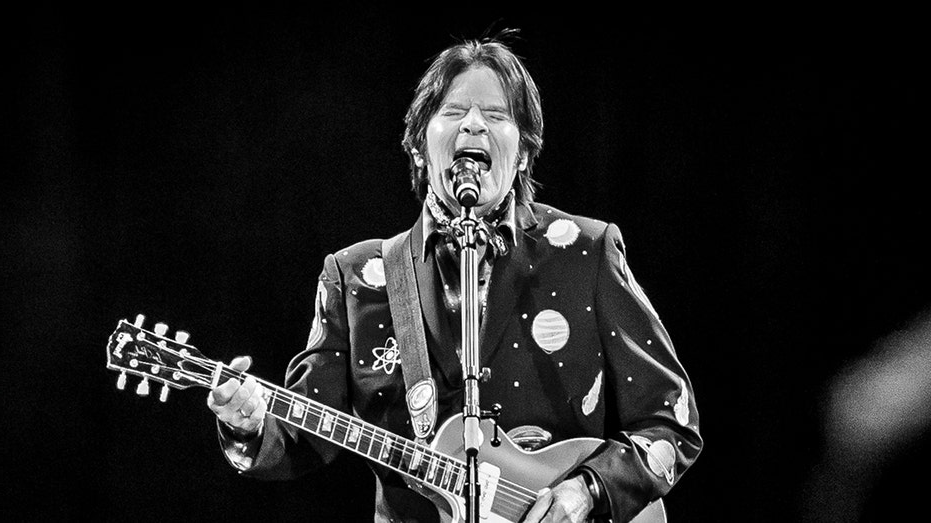
Few voices in rock carry the raw grit and swampy soul of John Fogerty. As the driving force behind Creedence Clearwater Revival and a powerful solo artist, he crafted songs that feel rooted in American soil, blending blues, country, and rock into something unmistakably his own. His music captures rolling rivers, backroad tension, and working class resilience with a directness that never feels forced. What sets Fogerty apart is his ability to turn simple riffs and plainspoken lyrics into songs that feel larger than life, filled with urgency, atmosphere, and truth. Whether roaring through a protest anthem or leaning into reflective storytelling, his voice remains instantly recognizable. This collection highlights the most popular John Fogerty songs of all time.
1. Fortunate Son
“Fortunate Son” is one of John Fogerty’s most explosive and enduring statements, a rock song that still sounds like it was written with smoke in the air and fury in the bloodstream. Recorded with Creedence Clearwater Revival, the track captures Fogerty’s rare ability to turn political outrage into something lean, direct, and unforgettable. The guitar riff strikes immediately, sharp and urgent, while the rhythm section drives forward with no wasted motion. Fogerty’s vocal is the real weapon: raspy, biting, and full of righteous anger. He does not sing from a distance. He sounds like a man calling out hypocrisy in real time. What makes “Fortunate Son” so powerful is that it never becomes abstract. It takes aim at privilege, class protection, and the way ordinary people are often asked to bear the cost of decisions made by the powerful. Yet the song is also thrilling as rock and roll. Its protest message rides inside a groove so fierce that it can shake a room before the listener even unpacks the meaning. Decades later, “Fortunate Son” remains essential because it proves that a great protest song can be both morally clear and musically unstoppable.
2. Proud Mary
“Proud Mary” is one of John Fogerty’s most beloved creations, a song that rolls with the steady grace of a riverboat and the timeless pull of American roots music. Written and performed with Creedence Clearwater Revival, it captures Fogerty’s extraordinary gift for imagining places so vividly that they feel lived in, even when they come from myth, memory, records, and instinct. The song begins with a clean, rolling guitar figure that immediately suggests movement, release, and transformation. The lyric tells of leaving a weary working life behind and finding rhythm, freedom, and renewal on the river. Fogerty’s voice brings grit and brightness together, making the journey feel both physical and spiritual. What makes “Proud Mary” endure is its simplicity and depth. It is easy to sing, easy to remember, and impossible to mistake, yet it carries a larger dream of escape from grind and confinement. The song has been reinterpreted countless ways, but the Creedence version remains the source: compact, earthy, and full of forward motion. It is one of Fogerty’s greatest examples of turning plain language and roots rock feeling into something mythic.
3. Bad Moon Rising
“Bad Moon Rising” is a masterclass in contrast, pairing one of John Fogerty’s brightest melodies with one of his darkest warnings. The song sounds cheerful at first glance, driven by a crisp country rock rhythm and a hook so immediate that it feels almost playful. Yet the words point toward disaster, fear, storms, trouble, and a sense that something dangerous is approaching. That tension is exactly what makes the recording unforgettable. Fogerty understood that dread can be more powerful when wrapped in a tune people cannot stop singing. His vocal has a sharp, prophetic edge, but the band keeps the track moving with a buoyant confidence that makes the warning even stranger. “Bad Moon Rising” became one of Creedence Clearwater Revival’s biggest and most enduring songs because it captures a mood that never really disappears: the feeling that the sky is clear for now, but danger is gathering just beyond the horizon. The guitar tone is clean and biting, the rhythm is economical, and every second feels purposeful. As a John Fogerty composition, it shows his genius for compression. In barely a few minutes, he creates a whole world of sunshine, unease, and apocalyptic folk wisdom.
4. Have You Ever Seen The Rain
“Have You Ever Seen The Rain” is one of John Fogerty’s most emotionally resonant songs, a deceptively simple ballad that carries a deep current of melancholy beneath its polished surface. Recorded with Creedence Clearwater Revival, the track has often been heard as a song about emotional contradiction: rain falling while the sun is shining, sadness arriving in the middle of success, trouble appearing when everything should feel bright. That central image gives the song its timeless beauty. Fogerty’s vocal is weathered and sincere, carrying the ache of someone trying to understand why joy and sorrow often arrive together. The arrangement is spare but warm, built around gentle rhythm, clean guitar, and a melody that feels instantly familiar. Unlike some of Fogerty’s more fiery rockers, “Have You Ever Seen The Rain” works through restraint. It does not rage. It wonders. It asks a question that listeners can fill with their own losses, memories, and private meanings. The song remains one of his most popular because it speaks to a universal emotional truth: life can look golden from the outside while something inside is quietly breaking. Few songs make that feeling sound so graceful and enduring.
5. Centerfield
“Centerfield” is John Fogerty’s great American comeback anthem, a joyful, guitar ringing celebration of baseball, renewal, and the thrill of being ready for one more chance. Released as a solo recording, the song captures the sound of an artist returning to the field with energy, confidence, and unmistakable personality. From the opening handclaps and bright guitar rhythm, it feels like sunshine on fresh grass. Fogerty uses baseball not merely as a sport, but as a metaphor for readiness, hope, and the hunger to contribute. The famous refrain has become part of ballpark culture because it speaks to something larger than the game. Everyone knows the feeling of wanting to be called upon, wanting to prove they still have something left, wanting to step into the light and swing. Fogerty’s vocal is spirited and direct, filled with the youthful enthusiasm of someone who never lost touch with rock and roll’s simplest pleasures. “Centerfield” remains one of his most beloved solo songs because it is pure uplift without cynicism. It is nostalgic, but not trapped in the past. It turns memory into momentum, making the listener feel that the next inning might still belong to them.
6. The Old Man Down The Road
“The Old Man Down The Road” is one of John Fogerty’s strongest solo recordings, a swampy, ominous rocker that proved his signature sound still had plenty of bite outside Creedence Clearwater Revival. The song immediately evokes shadowy backroads, whispered warnings, and the uneasy feeling of being watched by a figure who seems part human, part legend. Fogerty’s guitar work is sharp and coiled, built around a groove that feels both familiar and threatening. His vocal carries the same raspy authority that made his earlier classics so distinctive, but here it is darker, more mysterious, and almost supernatural. What makes “The Old Man Down The Road” so compelling is its atmosphere. The lyrics do not explain too much, which allows the character at the center of the song to become larger in the imagination. He could be a memory, a warning, a ghost, or a symbol of trouble that never stays buried. The track became a major solo success because it reconnected listeners with Fogerty’s roots rock intensity while showing that he could still write with freshness and command. It is lean, hypnotic, and full of menace, a reminder that Fogerty’s swamp rock language belongs to him alone.
7. Born On The Bayou
“Born On The Bayou” is one of John Fogerty’s greatest achievements in atmosphere, a song that sounds like humid air, dark water, and childhood memory filtered through electric guitar. Recorded with Creedence Clearwater Revival, it helped define the swamp rock identity that became central to the band’s legend. The opening guitar tone is unforgettable, thick with tremolo and mystery, immediately placing the listener in a world of moss, mud, moonlight, and myth. Fogerty’s voice enters with a wild, weathered authority that seems far older than his years. He sings not like a tourist describing a place, but like a storyteller conjuring a dream version of the American South from blues records, imagination, and emotional instinct. What makes “Born On The Bayou” so powerful is that it is less about geography than feeling. It creates a sense of origin, danger, freedom, and ancestral memory. The groove is slow and heavy, allowing every guitar phrase and vocal line to hang in the air. As a John Fogerty composition, it shows his ability to build an entire mythology from sound alone. The song remains popular because it feels primal, cinematic, and completely unlike anything else in mainstream rock of its era.
8. Who’ll Stop The Rain
“Who’ll Stop The Rain” is one of John Fogerty’s most poetic and quietly devastating songs, a compact meditation on confusion, disillusionment, and the search for relief in troubled times. Recorded with Creedence Clearwater Revival, the track uses rain as a symbol of endless difficulty, social unrest, political uncertainty, and emotional fatigue. Unlike the explosive anger of “Fortunate Son”, this song moves with weary reflection. The acoustic texture gives it a folk like intimacy, while Fogerty’s voice carries a sense of hard earned skepticism. He sounds like someone who has heard too many promises and watched too many storms continue anyway. What makes the song so enduring is its open meaning. It can be heard as a response to war, generational unrest, personal sadness, or the broader human condition. The question at the center remains unanswered, which is why it continues to resonate. “Who’ll Stop The Rain” became one of Fogerty’s most beloved works because it pairs simplicity with emotional depth. The melody is gentle and memorable, but the feeling behind it is heavy. It is a song for anyone who has looked at a troubled world and wondered when, or whether, the clouds will finally break.
9. Up Around The Bend
“Up Around The Bend” is John Fogerty’s road song of optimism, a fast moving Creedence Clearwater Revival classic that turns escape into celebration. The opening guitar riff is pure forward motion, bright, ringing, and instantly energizing. It feels like a car door slamming, an engine catching, and the road opening all at once. Fogerty’s vocal is urgent but joyful, calling listeners toward a place just out of sight where the air is better and possibility still exists. What makes the song so effective is its sense of momentum. It does not dwell on what is being left behind. It focuses on what might be waiting ahead. The rhythm section pushes with clean, muscular drive, while the guitars create a sense of sunlight flashing across motion. “Up Around The Bend” became one of Fogerty’s most popular songs because it captures a deeply American fantasy: if life feels narrow, move. Find the road, follow the sound, and trust that somewhere beyond the next turn, things may open up. Yet the song is not naive. Its joy feels earned because Fogerty’s voice always carries grit. It is freedom with dust on its boots, and that is why it still feels alive.
10. Down On The Corner
“Down On The Corner” is one of John Fogerty’s most cheerful and inviting songs, a Creedence Clearwater Revival favorite that celebrates street music, community, and the simple magic of a band playing for anyone who happens to pass by. The track introduces the fictional group Willy and the Poor Boys, turning a corner performance into a miniature world of rhythm, character, and everyday joy. The groove is relaxed but irresistible, built from bright guitar, playful percussion, and a melody that feels immediately communal. Fogerty’s vocal has a smiling quality, less fiery than his protest songs but just as distinctive. He sounds like a storyteller inviting the listener into the scene, where music belongs not to elites or grand stages, but to sidewalks, neighborhoods, and ordinary people. What makes “Down On The Corner” endure is its generosity. It imagines music as something shared freely, passed hand to hand, carried by rhythm and human presence. The song’s charm lies in its lack of pretension. It is not trying to be monumental, yet it becomes memorable through craft, warmth, and character. In Fogerty’s catalog, it stands as a reminder that roots rock can be socially aware, mysterious, fierce, and also wonderfully fun.

Edward Tomlin is a frequent contributor to Singers Room. Since 2005, Singersroom has been the voice of R&B around the world. Connect with us via social media below.