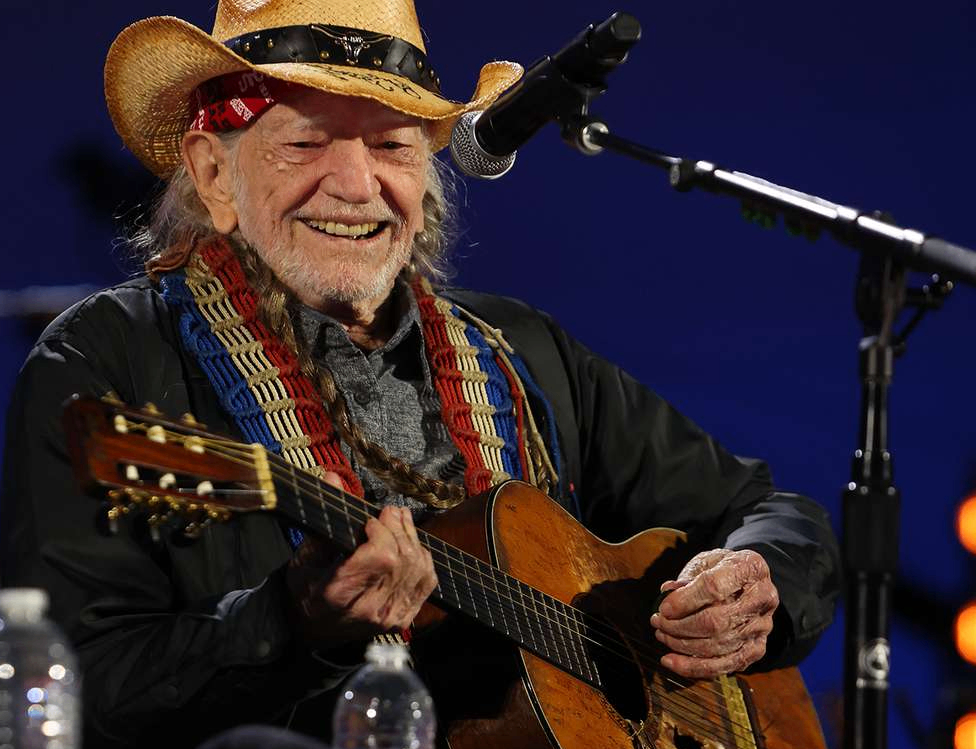
With his unmistakable voice, poetic songwriting, and deeply human storytelling, Willie Nelson became one of the most beloved and influential figures in country music history. Blending outlaw country spirit with folk, jazz, blues, and traditional honky tonk roots, Willie created songs that feel timeless, honest, and emotionally rich. Whether delivering heartbreak ballads, reflective road songs, or warmhearted classics about love and freedom, he sings with a relaxed sincerity that instantly feels genuine. His music carries the wisdom of experience, the loneliness of open highways, and the comfort of familiar melodies shared late at night. Songs like “On the Road Again,” “Always on My Mind,” and “Blue Eyes Crying in the Rain” helped define not only Willie Nelson’s legendary career, but the sound and soul of modern country music itself. These unforgettable songs celebrate an artist whose voice and songwriting continue to resonate across generations.
1. On the Road Again
On the Road Again is the Willie Nelson song that most perfectly captures his wandering spirit, his love of performance, and his lifelong connection to the highway. Written for the film Honeysuckle Rose, the song became much more than a movie tune. It became Willie’s musical calling card, a cheerful anthem for musicians, travelers, dreamers, and anyone who feels most alive while moving from one place to another. Its melody is simple and instantly memorable, but that simplicity is part of its genius. Willie does not dress the idea up with unnecessary drama. He makes life on the road sound like a natural state of being.
The recording moves with easy country swing, carried by Willie’s relaxed vocal phrasing and the unmistakable sound of his guitar, Trigger. His voice has that conversational quality that makes the listener feel as if he is sitting across the table, smiling as he explains why touring still matters. The song’s popularity comes from its pure sense of freedom. It is not about escape in a desperate sense. It is about community, music, motion, and the joy of doing what one was born to do. Decades later, On the Road Again remains one of country music’s most beloved road songs because it turns a traveling musician’s routine into a universal celebration of purpose, friendship, and open possibility.
2. Always on My Mind
Always on My Mind is one of Willie Nelson’s most emotionally devastating performances, a song that turns regret into something tender, humble, and unforgettable. Though recorded by other artists before him, Willie’s version became definitive because he approached it with such quiet honesty. The lyric is built around apology, missed chances, and the painful realization that love was not expressed as fully as it should have been. In Willie’s hands, the song does not feel theatrical or overly polished. It feels like a late night confession from someone who understands the weight of what cannot be changed.
His vocal phrasing is the heart of the recording. Willie sings slightly behind the beat, stretching certain lines as if memory itself is slowing him down. That loose timing gives the song its aching humanity. The arrangement is gentle and spacious, allowing the emotional meaning to settle naturally. The power of Always on My Mind lies in its restraint. Willie does not beg loudly. He admits quietly. That difference makes the performance far more moving. The song became a massive crossover success because its message is universal: people often love imperfectly, and regret can linger long after the moment has passed. Willie Nelson’s version remains timeless because it captures remorse without bitterness, love without possession, and sorrow without melodrama.
3. Blue Eyes Crying in the Rain
Blue Eyes Crying in the Rain is one of Willie Nelson’s most essential recordings, a spare and haunting ballad that helped redefine his career and the sound of outlaw country. Featured on the landmark album Red Headed Stranger, the song is beautifully minimal, built around Willie’s voice, his guitar, and a mood of quiet heartbreak. Its lyric tells of a farewell, a memory, and the hope of reunion beyond this life, but Willie sings it with such restraint that the sadness becomes almost sacred. Nothing is overplayed. Nothing is forced. Every note feels necessary.
The beauty of the recording is in its open space. At a time when much country music leaned toward lush production, Willie trusted simplicity. That decision made the song feel intimate and timeless. His voice carries a cracked tenderness, and his phrasing gives the lyric the shape of remembered pain. Blue Eyes Crying in the Rain became a signature song because it proved that emotional power does not require volume or ornament. It only requires truth. The guitar lines are delicate, the tempo is patient, and the atmosphere feels like dusk settling over an old memory. The song remains one of Willie’s most beloved classics because it captures love, loss, and spiritual longing with extraordinary grace.
4. Whiskey River
Whiskey River is one of Willie Nelson’s great concert staples, a song that has opened countless live shows and become closely associated with his outlaw country identity. Written by Johnny Bush and Paul Stroud, the song found its most famous life through Willie’s performance style. Its lyric turns whiskey into a river of memory, pain, and escape, giving the singer a place to drown sorrow while still keeping the music lively. Willie’s version carries a rough honky tonk energy that makes sadness feel communal rather than solitary. It is heartbreak you can sing along with.
The track’s appeal lies in the way it balances ache and motion. The rhythm has a loose, rolling feel, while Willie’s vocal sounds relaxed, weathered, and completely at home. His delivery does not make drinking sound glamorous in a shallow way. Instead, it presents it as part of a larger emotional landscape of loss, coping, and country music tradition. Whiskey River remains beloved because it captures the spirit of the Willie Nelson live experience. When he sings it, the song feels like a doorway into his world: smoky stages, road worn musicianship, loyal crowds, and songs that turn personal trouble into shared release. Its continued popularity comes from that combination of honky tonk grit, memorable melody, and Willie’s unmistakable personality.
5. Crazy
Crazy is one of Willie Nelson’s greatest songwriting achievements, even though many listeners first came to know it through Patsy Cline’s legendary recording. Willie wrote the song early in his career, and its sophisticated melody helped reveal that he was never a conventional country writer. The composition moves with unusual grace, blending country heartbreak with pop and jazz influenced phrasing. The lyric is direct, but its emotional impact is enormous. It captures the helplessness of loving someone while knowing the feeling may not be returned in the same way. That emotional contradiction is what gives the song its timeless ache.
When Willie performs Crazy, he brings a different shade to it than Cline’s grand and polished version. His reading tends to feel more conversational, more fragile, and more reflective. The song’s greatness lies in the way it makes vulnerability sound musically elegant. Its melody does not move in the most predictable country pattern, which gives the lyric a drifting, wounded quality. Willie’s gift as a songwriter was his ability to make complex emotional states feel simple enough to sing and profound enough to last forever. Crazy remains one of the most popular songs connected to his name because it proves his genius extended far beyond performance. He wrote feelings into melodies with a sophistication that changed country music forever.
6. Georgia on My Mind
Georgia on My Mind gave Willie Nelson one of his most beautiful crossover moments, allowing him to interpret a classic American standard with the relaxed intimacy that defines his best vocal work. Most famously associated with Ray Charles, the song already carried enormous emotional history before Willie recorded it. Yet his version does not try to compete through force or grandeur. Instead, he draws the song inward, singing it with a gentle, reflective warmth that makes the familiar melody feel personal all over again. His phrasing bends around the beat in a way that feels almost conversational, bringing a country jazz sensibility to the standard.
The arrangement gives Willie space to breathe, and that space is essential. His voice carries nostalgia without overstatement, suggesting memory, longing, and affection with subtle touches rather than sweeping gestures. Willie’s version of Georgia on My Mind works because he treats the song as a living memory rather than a monument. He brings his own identity to it, blending country feeling with the elegance of classic American songwriting. The result is tender, understated, and deeply musical. It remains one of his most loved interpretations because it shows how naturally Willie could cross genre boundaries. Whether singing country, pop, jazz, or standards, he always sounded unmistakably himself, guided by feel, timing, and emotional truth.
7. Mammas Don’t Let Your Babies Grow Up to Be Cowboys
Mammas Don’t Let Your Babies Grow Up to Be Cowboys is one of Willie Nelson’s most famous collaborations with Waylon Jennings, a song that helped define the outlaw country era with humor, wisdom, and rough edged charm. The lyric presents the cowboy life not as clean romance, but as a difficult existence full of loneliness, stubbornness, pride, and emotional distance. Willie and Waylon sing it with the authority of men who understood the appeal and the cost of living outside the expected path. Their voices contrast beautifully, with Willie’s relaxed phrasing meeting Waylon’s deeper, tougher presence.
The song’s popularity comes from its blend of myth and warning. It acknowledges the allure of the cowboy figure while gently pulling back the curtain on what that life can mean. It is funny, affectionate, and quietly sad all at once. The melody is easy to remember, and the chorus has become one of the most recognizable in country music. Yet beneath the singalong quality is a clear understanding of loneliness and independence. Willie’s performance brings warmth and nuance, while Waylon adds grit and gravity. Together, they created a recording that feels like an outlaw country mission statement. Mammas Don’t Let Your Babies Grow Up to Be Cowboys remains beloved because it honors the legend while admitting that legends often come with a heavy price.
8. Funny How Time Slips Away
Funny How Time Slips Away is one of Willie Nelson’s finest early compositions, a deceptively simple song about memory, lost love, and the strange emotional distance created by time. The lyric sounds like a polite conversation between former lovers, but beneath the surface is a world of pain, irony, and unresolved feeling. Willie’s genius as a songwriter is evident in how little he needs to say. The narrator asks casual questions, makes small observations, and speaks with apparent calm, yet every line suggests deeper hurt. That quiet tension is what makes the song so powerful.
When Willie sings Funny How Time Slips Away, his phrasing gives the song an almost conversational realism. He stretches time inside the melody, allowing pauses and subtle shifts to carry emotional meaning. The song remains a classic because it understands that heartbreak is often most painful when spoken gently. There is no dramatic accusation, only the uneasy recognition that the past still matters even when people pretend it does not. The melody has a timeless quality, easily adaptable to country, soul, pop, and jazz interpretations, which explains why so many artists have recorded it. Willie’s own version remains essential because it reveals the writer’s original emotional intelligence: the ability to turn a brief encounter into a profound meditation on time, regret, and the memories that refuse to disappear.
9. Angel Flying Too Close to the Ground
Angel Flying Too Close to the Ground is one of Willie Nelson’s most tender and poetic ballads, a song that captures love as both healing and release. Written by Willie, it carries the feeling of someone caring deeply for a wounded person while understanding that love cannot become possession. The lyric is compassionate and bittersweet, built around the image of an angel who needs protection but also freedom. Willie sings it with extraordinary gentleness, allowing the emotion to unfold slowly. His voice does not impose itself on the song. It cradles it.
The arrangement is spare and graceful, centered around Willie’s delicate phrasing and the unmistakable tone of his guitar. The melody feels fragile but strong, much like the emotional situation it describes. The beauty of Angel Flying Too Close to the Ground lies in its wisdom about love. It recognizes that sometimes the deepest form of caring is letting someone go when they are ready to fly again. That idea gives the song a maturity that separates it from ordinary heartbreak ballads. Willie does not sing with bitterness. He sings with gratitude, sorrow, and acceptance. The song remains one of his most cherished works because it captures tenderness without sentimentality. It is intimate, poetic, and deeply humane, a perfect example of Willie Nelson’s gift for saying profound things in plain, beautiful language.
10. Pancho and Lefty
Pancho and Lefty is one of the most beloved story songs associated with Willie Nelson, especially through his unforgettable duet with Merle Haggard. Written by Townes Van Zandt, the song is a masterpiece of outlaw myth, betrayal, memory, and ambiguity. Willie and Merle bring two distinct voices into the tale, giving it the feeling of an old legend passed down by men who know more than they are willing to say. The story of Pancho, the bandit, and Lefty, the survivor, unfolds with cinematic restraint. It never explains too much, which is exactly why listeners keep returning to it.
Willie’s voice brings a reflective sadness to the song, while Merle adds a weathered gravity that deepens the drama. Together, they make the narrative feel both intimate and mythic. The power of Pancho and Lefty comes from its mystery. Is Lefty guilty, lucky, haunted, or all three? The song leaves room for interpretation, and that openness gives it lasting life. The melody is gentle, almost mournful, contrasting beautifully with the violence and loneliness beneath the story. Willie’s version with Merle became a country classic because it combines extraordinary songwriting with two legendary interpreters at the height of their storytelling powers. Pancho and Lefty endures as a song about loyalty, compromise, survival, and the uneasy price of living long enough to remember.

Edward Tomlin is a frequent contributor to Singers Room. Since 2005, Singersroom has been the voice of R&B around the world. Connect with us via social media below.