Before a single note is heard, the violin already carries centuries of emotion in its silent frame—stories of triumph, heartbreak, rebellion, and brilliance waiting to be awakened by the right hands. Across history, a rare group of artists has transformed this delicate instrument into a force of nature, bending time, redefining technique, and captivating audiences across generations. These are not merely musicians; they are visionaries who turned strings and wood into voices that echo far beyond concert halls. From fiery virtuosos who stunned the world with impossible speed to soulful interpreters who made a single phrase feel eternal, the greatest violinists have shaped not just music, but culture itself. In this exploration of the 15 best violin players of all time, prepare to encounter legends whose artistry continues to inspire, challenge, and mesmerize long after the final bow stroke fades.
1. Jascha Heifetz
Jascha Heifetz remains the violinist against whom nearly every virtuoso is measured. His famous performance of Hora Staccato is a thrilling example of why. The piece flashes by with razor clean articulation, glittering speed, and a kind of aristocratic fire that feels almost impossible to imitate. Heifetz did not merely play fast. He played with a frightening clarity, making each note sound inevitable.
Among his most admired recordings are Hora Staccato, Zigeunerweisen, the Tchaikovsky Violin Concerto, the Sibelius Violin Concerto, and his unforgettable interpretations of the Bach solo works. What makes Heifetz so compelling is the tension between emotional heat and technical discipline. He could sound icy to some listeners, but attentive ears hear a volcanic intensity held under perfect control.
Heifetz also helped define the modern idea of violin excellence. His tone was focused, silvery, and penetrating, with a vibrato that became a model for generations. In showpieces, he sounded superhuman. In lyrical music, he could reduce a phrase to its purest emotional line. His best recordings still feel less like historical documents and more like challenges thrown across time.
2. Itzhak Perlman
Itzhak Perlman is beloved not only for his technical command, but for the warmth and humanity of his sound. His performance of the Theme from Schindler’s List is one of the most recognized violin recordings of the late twentieth century, and it shows Perlman at his most poignant. The melody is simple on the page, but in his hands it becomes a prayer, a lament, and a memory all at once.
Perlman’s most celebrated performances include Schindler’s List, the Mendelssohn Violin Concerto, the Bruch Violin Concerto No. 1, the Tchaikovsky Violin Concerto, and the Beethoven Violin Concerto. He has a way of making great music feel approachable without ever reducing its depth. His playing is generous, glowing, and unmistakably vocal.
What separates Perlman from many virtuosos is his gift for communication. He never seems interested in impressing for its own sake. Even in brilliant passages, the listener hears character before mechanics. Schindler’s List remains a perfect entry point into his artistry because it captures his rare ability to make the violin speak with direct emotional truth. Few players have sounded so technically complete while remaining so profoundly human.
3. Niccolo Paganini
Niccolo Paganini changed the mythology of the violin forever. Long before recordings existed, he became a legend through accounts of performances that seemed to defy human limitation. His most famous works, including La Campanella, the Twenty Four Caprices, and the Violin Concerto No. 1, helped turn the violin into a theatrical instrument of dazzling danger.
La Campanella is among the most famous Paganini associated pieces because it captures his taste for sparkle, agility, and dramatic surprise. Its bell like theme dances through rapid leaps and glittering passagework, demanding not just accuracy but personality. Paganini understood that virtuosity could be more than athletic display. It could be storytelling, seduction, and spectacle.
His Caprice No. 24 is another towering creation, later inspiring composers from Liszt to Rachmaninoff. Caprice No. 5 became a symbol of relentless speed, while Caprice No. 1 tests bow control with ruthless elegance. Paganini’s art was so extreme that rumors surrounded him during his lifetime. Yet beneath the legend was a composer with a remarkable instinct for memorable musical ideas. He did not simply play the violin. He expanded what the world believed the violin could be.
4. Yehudi Menuhin
Yehudi Menuhin was one of the most spiritually searching violinists of the modern age. His reading of the Beethoven Violin Concerto reveals a musician more interested in inner meaning than surface polish. Menuhin’s tone could be luminous, fragile, noble, and deeply personal, often giving familiar works a sense of philosophical weight.
His most admired performances include the Beethoven Violin Concerto, the Elgar Violin Concerto, the Bach Sonatas and Partitas, the Brahms Violin Concerto, and his remarkable collaborations with Ravi Shankar. Menuhin’s artistry had an unusual range. He was a prodigy of astonishing natural gifts, then matured into an artist who treated music as a bridge between cultures, ideas, and inner lives.
The Beethoven Violin Concerto suited him especially well because it asks for nobility rather than mere brilliance. Menuhin could shape long lines with a meditative patience, allowing the listener to sense the silence around the notes. In Bach, he often sounded devotional. In Elgar, he found tenderness and English melancholy. Menuhin’s greatness lies in the way his violin seemed to search for truth, not applause.
5. Fritz Kreisler
Fritz Kreisler possessed one of the most immediately recognizable violin voices ever recorded. His own piece Liebesleid, often translated as Love’s Sorrow, is the perfect doorway into his world. It is elegant, nostalgic, and tender, filled with the kind of old Vienna charm that Kreisler made uniquely his own.
Kreisler’s top loved works include Liebesleid, Liebesfreud, Schon Rosmarin, Tambourin Chinois, and Praeludium and Allegro. Unlike many great violinists, he was also a composer of miniature masterpieces. His short pieces are not merely salon trifles. They are exquisitely crafted character portraits, full of melodic grace and emotional detail.
As a performer, Kreisler was admired for his sweet tone, relaxed phrasing, and conversational rubato. He could bend a line in a way that felt spontaneous yet perfectly judged. Liebesleid shows this beautifully. The melody seems to sigh, remember, and smile through tears. His best music does not overwhelm the listener with scale. Instead, it invites the listener close. Kreisler’s genius was intimacy, and his finest pieces still sound like private memories sung through the violin.
6. David Oistrakh
David Oistrakh brought a grand, humane authority to the violin. His performance tradition in the Tchaikovsky Violin Concerto is among the most admired in recorded history because it combines muscular command with deep Slavic lyricism. Oistrakh’s sound was broad, golden, and generous, never thin or mannered, even in the most demanding passages.
His essential recordings include the Tchaikovsky Violin Concerto, the Brahms Violin Concerto, the Shostakovich Violin Concerto No. 1, the Khachaturian Violin Concerto, and the Beethoven Violin Sonatas with Lev Oborin. He was especially important in Russian and Soviet repertoire, where his combination of strength and emotional dignity gave the music tremendous weight.
Oistrakh’s Tchaikovsky is not merely romantic. It has breadth, architecture, and a singing generosity that makes the concerto feel like a great human confession. In Shostakovich, he could sound haunted and monumental. In Brahms, he was noble without stiffness. What makes Oistrakh unforgettable is the scale of his sincerity. Every phrase seems built from experience, intelligence, and a profound respect for the music.
7. Hilary Hahn
Hilary Hahn is one of the defining violinists of her generation, admired for immaculate technique, intellectual clarity, and a tone that can seem both pure and intensely alive. Her performances of Bach, especially the Preludio from the Partita No. 3, have become modern reference points. She plays Bach with rhythmic lift, clean architecture, and a wonderful absence of vanity.
Her best known recordings include the Bach Sonatas and Partitas, the Sibelius Violin Concerto, the Barber Violin Concerto, the Mendelssohn Violin Concerto, and her adventurous encore project In 27 Pieces. Hahn’s artistry is often praised for precision, but precision alone does not explain her appeal. There is a quiet conviction in her playing that makes even familiar repertoire feel newly considered.
In the Bach Preludio, her bow seems to illuminate the music from within. Nothing is rushed for effect, yet the energy never flags. In Barber, she sings with luminous restraint. In Sibelius, she brings steel, frost, and emotional concentration. Hahn represents a modern ideal of violin playing, where technical perfection serves curiosity, depth, and musical honesty.
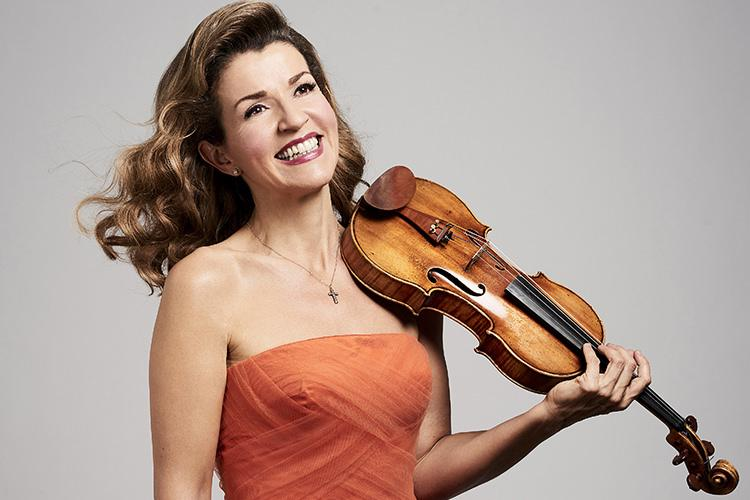
8. Anne Sophie Mutter
Anne Sophie Mutter is a violinist of glamour, intellect, and fearless individuality. Her performance of Massenet’s Meditation from Thais shows her gift for turning a familiar melody into a luxurious, breathing dramatic scene. Her tone is unmistakable, polished yet deeply expressive, capable of both satin beauty and fierce intensity.
Mutter’s most celebrated recordings include Meditation from Thais, the Beethoven Violin Concerto, the Brahms Violin Concerto, the Mendelssohn Violin Concerto, and contemporary works written for or championed by her. She has never been content to live only inside the standard repertory. Her career has included major advocacy for modern composers, which gives her profile unusual breadth among superstar violinists.
In Meditation, she leans into the line with operatic sensitivity. The violin becomes a voice suspended between longing and surrender. Her Beethoven can be bold and sculptural, while her Brahms often has an autumnal richness. Mutter’s artistry invites debate because she is never anonymous. Every phrase carries personality. That is precisely why she matters. She plays as an interpreter with a point of view, not as a museum guide.
9. Nathan Milstein
Nathan Milstein was a master of elegance, proportion, and aristocratic restraint. His performances of Bach’s Chaconne from the Partita No. 2 are treasured because they reveal a violinist who could make immense music sound inevitable. Milstein never needed exaggeration. His authority came from poise, line, and a seemingly effortless command of the instrument.
His most important recordings include the Bach solo works, the Chaconne, the Mendelssohn Violin Concerto, the Tchaikovsky Violin Concerto, the Brahms Violin Concerto, and his own arrangement titled Paganiniana. In each, Milstein displayed a rare combination of old world refinement and technical security. His bow arm was famously economical, producing clarity without strain.
The Chaconne is a summit for any violinist because it must suggest grandeur, grief, dance, and spiritual struggle on a single instrument. Milstein approached it with dignity. He allowed the structure to speak, trusting Bach’s architecture rather than imposing theatrical effects. His playing can seem understated at first, but repeated listening reveals extraordinary depth. Milstein’s greatness is the kind that grows larger the more closely one listens.
10. Isaac Stern
Isaac Stern was one of the great musical personalities of the twentieth century, a violinist whose playing combined strength, warmth, and unmistakable presence. His interpretation of the Mendelssohn Violin Concerto captures the qualities that made him so admired. The music sparkles, sings, and surges forward with a generous romantic spirit.
Stern’s most treasured performances include the Mendelssohn Violin Concerto, the Beethoven Violin Concerto, the Brahms Violin Concerto, the Prokofiev Violin Concertos, and his chamber music collaborations with artists such as Leonard Rose and Eugene Istomin. He was also a major cultural advocate, helping preserve Carnegie Hall and mentoring younger musicians.
In Mendelssohn, Stern brings an ideal balance of lyricism and energy. The concerto’s opening does not merely begin. It takes flight. Stern’s tone was not the glassy sort. It had grain, body, and a speaking quality that gave his phrasing human urgency. In chamber music, he was a powerful conversationalist, alert to drama and dialogue. Stern’s finest recordings remind us that violin playing is not only about beauty. It is also about conviction, leadership, and living musical speech.
11. Sarah Chang
Sarah Chang entered the classical world as a prodigy of astonishing confidence, then developed into a violinist known for passionate intensity and brilliant command. Her association with Sarasate’s Carmen Fantasy is especially fitting because the piece demands theatrical flair, technical glitter, and a fearless sense of character. Chang brings all three in abundance.
Her notable performances include Carmen Fantasy, the Sibelius Violin Concerto, the Bruch Violin Concerto No. 1, the Paganini Violin Concerto No. 1, and the Vivaldi Four Seasons. She has long been admired for a sound that can move from velvet lyricism to high voltage virtuosity in an instant. Her playing often feels direct, emotionally charged, and unapologetically vivid.
Carmen Fantasy suits her because it is not simply a technical vehicle. It is opera transformed into violin theater. The player must flirt, dazzle, sing, and dance. Chang’s approach emphasizes dramatic color, sharp rhythm, and a sense of dangerous fun. Her best performances show why prodigy status alone never defines a lasting artist. Sarah Chang’s appeal lies in the way she combines youthful fire with seasoned musical instinct.
12. Midori
Midori is one of the most thoughtful and disciplined violinists of the modern era. Her performance of Bach’s Chaconne from the Partita No. 2 shows an artist of immense concentration, seriousness, and spiritual poise. She became famous as a child prodigy, but her mature career has been defined by depth rather than spectacle.
Her essential performances include the Bach solo works, the Chaconne, the Tchaikovsky Violin Concerto, the Sibelius Violin Concerto, the Bruch Violin Concerto No. 1, and the Beethoven Violin Concerto. Midori’s sound is focused and deeply intentional. She rarely wastes a gesture, and her interpretations often feel carefully illuminated from the inside.
The Chaconne is a work that reveals a violinist’s entire artistic philosophy. Midori approaches it with reverence but not passivity. Her playing carries the listener through grief, grandeur, reflection, and renewal without turning the music into melodrama. She is also respected for her educational and humanitarian work, which reflects a broader belief in music as a serious social force. Midori’s artistry is powerful because it refuses superficial drama and instead searches patiently for meaning.
13. Maxim Vengerov
Maxim Vengerov is the kind of violinist who makes virtuosity feel dangerous again. His performance of Ravel’s Tzigane is a superb example of his temperament. The piece begins with a long, rhapsodic solo that seems to wander through smoke and memory before bursting into dazzling color. Vengerov gives it freedom, swagger, and explosive technical brilliance.
His most admired performances include Tzigane, the Sibelius Violin Concerto, the Shostakovich Violin Concerto No. 1, the Tchaikovsky Violin Concerto, and the Beethoven Violin Concerto. He is known for a rich, commanding tone and a stage presence that can feel almost volcanic. Yet beneath the electricity is a serious musician with strong structural instincts.
Tzigane allows Vengerov to display both fantasy and control. He can stretch phrases with improvisatory freedom, then snap into passagework with stunning precision. In Shostakovich, he can sound grim and monumental. In Tchaikovsky, he brings heat and grandeur. Vengerov’s finest playing reminds listeners that virtuosity is not empty display when it is powered by imagination, risk, and emotional appetite.
14. Joshua Bell
Joshua Bell is one of the most recognizable American violinists, admired for his lyrical tone, charismatic phrasing, and ability to reach listeners beyond the traditional concert audience. His performance of the main theme from Ladies in Lavender is one of his most popular crossover moments, showing his gift for melody that feels intimate and cinematic.
Bell’s best known performances include Ladies in Lavender, The Red Violin Chaconne, the Bruch Violin Concerto No. 1, the Mendelssohn Violin Concerto, and the Tchaikovsky Violin Concerto. He has a sound that often seems to glow at the center, with a natural singing quality that makes lyrical repertoire especially persuasive.
Ladies in Lavender is not a piece that hides behind complexity. Its success depends on sincerity, line, and emotional timing. Bell plays it with a tender directness that explains why it has become such a beloved selection among modern violin listeners. In concertos, he brings elegance and flair. In film music, he understands how to make the violin carry narrative emotion. Bell’s gift is accessibility without shallowness, beauty without blandness, and sentiment without excess.
15. Leonidas Kavakos
Leonidas Kavakos is revered by serious violin listeners for his intelligence, tonal purity, and unshowy mastery. His relationship with the Sibelius Violin Concerto is especially important, since his performances reveal the work’s icy atmosphere, volatile passion, and architectural strength. Kavakos does not merely play the concerto. He seems to inhabit its northern landscape.
His most respected recordings include the Sibelius Violin Concerto, the Beethoven Violin Concerto, the Brahms Violin Concerto, the Prokofiev Violin Sonatas, and the Beethoven Violin Sonatas. Kavakos is not a performer who relies on theatrical gestures. His authority comes from concentration, refinement, and a deep understanding of musical form.
In Sibelius, this approach is devastatingly effective. The opening feels suspended in cold air, intimate yet vast. As the concerto grows more turbulent, Kavakos maintains control without sacrificing intensity. His tone can be lean, luminous, and penetrating, perfectly suited to music that demands clarity as much as passion. Kavakos stands among the finest violinists of his time because he proves that restraint can be electrifying when guided by profound musical insight.

Edward Tomlin is a frequent contributor to Singers Room. Since 2005, Singersroom has been the voice of R&B around the world. Connect with us via social media below.