The harp, often regarded as the “queen of instruments,” boasts a rich history filled with enchanting melodies and captivating performances. From the celestial sounds of ancient times to contemporary compositions, harpists have played a pivotal role in shaping the musical landscape. In this article, we delve into the lives and legacies of the top 15 best harp players of all time, celebrating their extraordinary talent and unique contributions to music.
Imagine the delicate plucking of strings that can evoke profound emotions, transport listeners to otherworldly realms, and create a tapestry of sound that lingers in the air. Each of these virtuosos has mastered the art of the harp, bringing their own flair and creativity to the instrument. Whether through innovative techniques, groundbreaking compositions, or mesmerizing live performances, these artists have left an indelible mark on the world of music.
Join us as we explore the achievements of these remarkable musicians, uncover their stories, and appreciate the beauty of the harp through their eyes. From classical legends to modern trailblazers, this list promises to inspire and entertain, highlighting the timeless allure of this magnificent instrument.
1. Clara Haskil
Though best known as a pianist, Clara Haskil’s lesser-known harp performances revealed a rare sensitivity and poetic touch. Born in 1895 in Bucharest, Romania, she was a musical prodigy whose deep understanding of phrasing, tone, and emotion resonated in everything she played. While her reputation was built on her piano interpretations—especially of Mozart, Beethoven, and Schumann—those few times she engaged with the harp, audiences were struck by her lyrical style and gentle nuance. Haskil’s playing was never about showing off; instead, she drew listeners into the soul of the music. Her approach was all about honesty and emotional connection. Those who witnessed her live performances often described a sense of reverence in the room—she had a quiet power that captivated without fanfare. Despite chronic health issues and a life marked by struggle, Haskil left a deep legacy in the classical world. She collaborated with some of the most important musicians of her time, and her musical integrity still inspires generations. Though her work on the harp is less documented, her spirit as a musician—introspective, vulnerable, and sincere—translates beautifully across any instrument she touched.
2. Alice Coltrane
Alice Coltrane was a visionary who reimagined the role of the harp in jazz and spiritual music. Born in 1937 in Detroit, she began her career as a pianist, but after the death of her husband, legendary saxophonist John Coltrane, she turned to the harp to explore deeper spiritual expression. Her playing wasn’t bound by tradition—she carved out a new sonic landscape where jazz, classical, and Eastern spirituality blended into something entirely her own. On albums like Journey in Satchidananda, the harp floats through swirling improvisations and meditative textures, offering a sense of otherworldliness. Coltrane’s harp was never just an accompaniment; it was a voice of transcendence, guiding listeners through grief, healing, and cosmic exploration. Her style defied conventional technique, favoring emotion and intuition over formality. By making the harp a central figure in her genre-defying compositions, she helped expand its identity beyond the classical world. Coltrane didn’t just play the harp—she channeled something profound through it. Today, she remains an enduring symbol of artistic freedom and spiritual depth, influencing a new wave of musicians who seek to use their instruments for more than just sound—but for soul.
3. Harpo Marx
Harpo Marx, the silent comedic genius of the Marx Brothers, brought the harp into millions of homes through humor, charm, and unexpected beauty. Born in 1888, Harpo taught himself the harp without formal training, developing a completely unique style that matched his whimsical persona. Onscreen, his harp performances often came as a delightful surprise—amid the zany chaos of Marx Brothers films, Harpo would sit down, pluck the strings, and suddenly everything stilled. His playing wasn’t just technically impressive; it was deeply sincere. There was a sense of calm and wonder in those moments, as if the harp revealed a hidden side of his soul. Harpo made the instrument accessible and beloved to audiences who had never seen one before. He helped dispel the notion that the harp belonged only in concert halls, showing it could be funny, tender, and magical all at once. His legacy lives on not just in film, but in the way he broadened the public’s perception of what the harp could do. For many, Harpo Marx was their first introduction to the harp—and through him, it became something joyful and unforgettable.
4. Deborah Henson-Conant
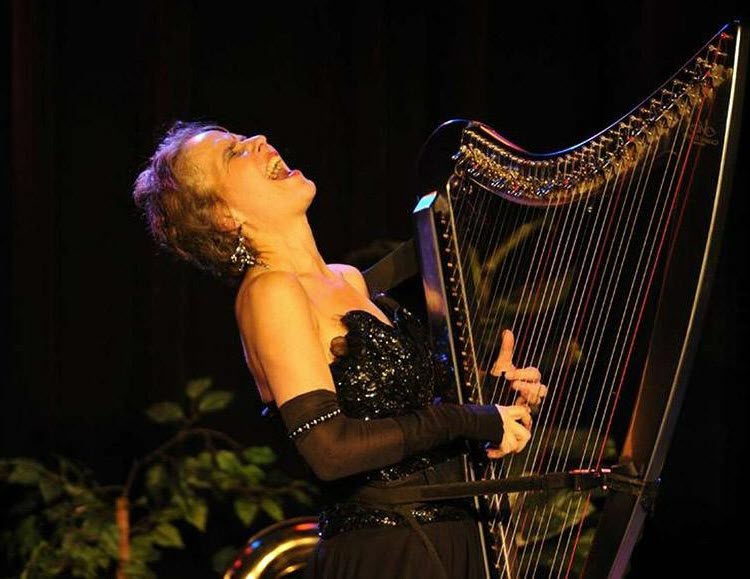
Deborah Henson-Conant is a fearless innovator who has transformed the harp from a delicate classical instrument into a bold, genre-defying force. Born in 1960, she’s a performer, composer, and storyteller who thrives on breaking rules and expectations. Known for her electric body harp and theatrical live shows, Henson-Conant blends classical music with jazz, blues, rock, and folk, delivering a sound that’s as dynamic as it is unconventional. Her stage presence is magnetic—full of energy, wit, and spontaneity. She doesn’t just play music; she performs stories, creating emotional journeys that resonate deeply with audiences. A pioneer of the “wearable” electric harp, she often performs standing, moving freely across the stage and bringing a rock-and-roll attitude to an instrument often seen as reserved or refined. Beyond performance, she’s a passionate advocate for music education and creativity. Through workshops, compositions, and online platforms, she’s empowered countless harpists to embrace their individuality and experiment beyond traditional boundaries. Henson-Conant’s influence goes beyond her virtuosity; it lies in her audacity to dream big and redefine what a harpist can be. She has made the harp bold, expressive, and powerfully personal.
5. Francesca DePasquale
While Francesca DePasquale is primarily celebrated as a violinist, her contributions to harp music, particularly through chamber music collaborations, have brought her into the orbit of great harpists. Born into a musical family, DePasquale has always emphasized expressive storytelling in her playing, a quality that resonates beautifully when paired with the harp’s warm, resonant tones. In performances alongside harpists, her intuitive musicality shines, creating lush soundscapes that feel both intimate and expansive. Though she is not a solo harpist herself, her artistry enhances and complements the harp’s delicate voice in ensemble settings. DePasquale’s sensitivity to tone and phrasing creates a rich dialogue between instruments, often highlighting the harp in fresh and compelling ways. Her collaborative spirit and dedication to musical expression bridge the gap between tradition and innovation. As an educator and performer, she continues to inspire a deep appreciation for chamber music that includes the harp—not as an afterthought, but as a vital, expressive force. Francesca DePasquale’s work reminds us that musical excellence isn’t limited to one instrument—it’s about how artists listen, respond, and elevate each other through the shared language of music.
6. Yolanda Kondonassis
Yolanda Kondonassis is one of the most accomplished and influential harpists of our time. Born in 1964, she began playing the harp at a young age and quickly rose to prominence through her extraordinary talent and dedication. Kondonassis is known not only for her technical brilliance but for her ability to bring deep emotional resonance to everything she plays. Her repertoire is wide-ranging, encompassing classical staples, contemporary pieces, and new commissions—many of which she helped bring into existence. One of her greatest contributions is her tireless work in expanding the harp’s role in modern music, ensuring the instrument is recognized as more than just ornamental. She’s also an advocate for environmental causes, often using her music to support conservation efforts. A recipient of the Avery Fisher Career Grant and a respected teacher, she has mentored countless young harpists through her teaching roles at top conservatories. Through recordings, live performances, and outreach, Kondonassis has reshaped what audiences expect from a harpist. Her artistry is at once elegant and commanding, and her influence continues to shape the future of harp performance. With every note, she reminds listeners that the harp is a powerful, expressive instrument capable of telling profound musical stories.
7. Marie-Claire Alain
Marie-Claire Alain is widely remembered as a virtuoso organist, but her legacy also touches the world of harp music, particularly through her deep engagement with Baroque repertoire. Born in 1926 in France into a highly musical family, Alain brought a scholarly approach to performance that influenced many instrumentalists—including harpists—who sought to interpret early music with authenticity and depth. While she didn’t perform as a harpist herself, her interpretations of J.S. Bach and other Baroque masters helped elevate the standard for performance practice, inspiring harpists to explore this rich musical period with renewed curiosity. Her detailed attention to phrasing, tempo, and ornamentation helped shape the way many musicians, including harpists, approach the delicate intricacies of Baroque music. Beyond her own performances, Alain was a prolific teacher and recording artist whose impact stretched across generations. Her artistic integrity and devotion to musical precision made her a beacon in the classical community. While not a harpist in the traditional sense, Alain’s influence radiates through the harp world in the way she revived interest in historical interpretation and musical clarity. Her life’s work enriched not just the organ world, but the entire classical music tradition, including that of the harp.
8. Niamh McGlinchey
Niamh McGlinchey is a fresh voice in the world of harp music, blending the beauty of traditional Irish melodies with a contemporary flair that feels both grounded and modern. Hailing from Northern Ireland, she brings a deep sense of cultural heritage to her music, often incorporating folk traditions that reflect her roots. But what makes McGlinchey truly stand out is her willingness to evolve those traditions, fusing them with pop, indie, and singer-songwriter elements to create a sound that is distinctly her own. Her harp playing is warm and expressive, acting as both a melodic anchor and a storytelling tool. She often accompanies herself while singing, weaving voice and harp together in a way that’s deeply personal and emotionally resonant. Whether performing original compositions or reimagined folk classics, McGlinchey has a gift for drawing listeners into her world—one filled with heartfelt stories, tender reflections, and musical beauty. Beyond performance, she’s also a passionate advocate for music education and Irish cultural preservation. Through her recordings and live shows, Niamh McGlinchey carries forward the harp’s rich legacy in Irish music while also pushing it into exciting new territory.
9. Ruth Inglefield
Ruth Inglefield is a pillar of the harp community whose contributions extend far beyond the concert stage. As a performer, composer, and educator, she has spent decades championing the harp in both traditional and contemporary settings. Known for her intellectual depth and artistic integrity, Inglefield brings a scholarly passion to her work that resonates with students and audiences alike. She has performed widely as a soloist and chamber musician, introducing audiences to both classical masterpieces and modern compositions that stretch the boundaries of what the harp can do. Her co-authored book Writing for the Pedal Harp is considered an essential resource for composers seeking to write authentically for the instrument—testament to her commitment to not just perform, but also to educate and guide the next generation. As a professor at institutions such as the Peabody Conservatory, Inglefield has mentored countless young harpists, many of whom have gone on to successful careers. Her influence is not just artistic, but deeply personal—she has built a legacy rooted in generosity, knowledge, and passion. Ruth Inglefield is a true steward of the harp’s legacy, continually working to expand its possibilities while nurturing its future.
10. Lavinia Meijer
Lavinia Meijer is a modern harpist who breaks boundaries and redefines expectations. Born in 1980 in South Korea and raised in the Netherlands, Meijer has become one of the most exciting and innovative harpists on the global stage. What sets her apart is her ability to bring the harp into new musical realms—bridging the gap between classical tradition and contemporary experimentation. Her interpretations of works by Philip Glass, Ludovico Einaudi, and other minimalist composers have drawn widespread acclaim, proving the harp can be just as powerful in modern music as in the classical canon. Meijer often performs amplified or with electronic enhancements, crafting immersive experiences that captivate both seasoned classical fans and younger, more eclectic audiences. She also collaborates across genres, working with electronic musicians and visual artists to create multidisciplinary performances. Beyond her technical skill, Meijer plays with emotional depth and fearless curiosity. Her mission seems clear: to show the world that the harp is not an antiquated relic, but a vibrant, expressive instrument with endless potential. Lavinia Meijer’s work is a testament to artistic innovation, and she continues to inspire a new generation to see the harp in a bold new light.
11. Ann Hobson Pilot
Ann Hobson Pilot is a groundbreaking figure in the classical music world and a true pioneer among harpists. Born in 1943, she broke significant racial barriers by becoming the first African American principal harpist in a major U.S. symphony orchestra—the Boston Symphony Orchestra. Her career spanned over four decades, during which she built a reputation for elegance, artistry, and precision. Pilot’s playing is marked by its expressive clarity and refined technique, qualities that captivated audiences and earned her widespread acclaim. But her influence extends far beyond performance. Through teaching, masterclasses, and outreach, she has mentored generations of young musicians and worked to make classical music more inclusive and accessible. Her journey was not without challenges, but her perseverance and excellence helped pave the way for greater diversity in elite orchestral settings. Pilot has also recorded extensively, bringing the harp into the spotlight as a solo instrument. Her legacy is not only musical—it’s cultural and inspirational. In every performance, she exemplified grace and resilience, and in doing so, she opened doors for those who came after her. Ann Hobson Pilot’s story is one of talent, determination, and trailblazing success that continues to inspire harpists and classical musicians around the world.
12. Kathleen Bride
Kathleen Bride is an esteemed harpist whose work bridges the classical tradition with a more modern, accessible sensibility. A respected performer and educator, she has spent decades sharing her love of the harp both on stage and in the classroom. Bride’s performances are distinguished by their musical sensitivity and her ability to communicate with warmth and elegance. Her repertoire spans centuries and styles—from delicate Baroque sonatas to lush Romantic pieces and contemporary works. What makes Bride stand out is her versatility; she’s equally comfortable performing in traditional concert halls, chamber ensembles, or alongside popular artists. She brings a fresh energy to everything she plays, often incorporating storytelling elements that deepen the listener’s connection to the music. As a teacher, Bride has mentored countless students, many of whom have gone on to successful careers themselves. Her work at institutions like the Eastman School of Music has helped shape the future of harp education in America. She’s also been involved in developing new compositions for the harp, working with composers to expand the instrument’s modern repertoire. Kathleen Bride is more than a performer—she’s a musical guide whose lifelong dedication continues to enrich the harp community.
13. Sylvia Woods
Sylvia Woods is a beloved and influential figure in the world of folk and Celtic harp music. She’s best known not only for her performances and recordings, but also for her enormous contribution to harp education and accessibility. Born in 1951, Woods helped spark the modern revival of interest in the Celtic harp, an instrument that had largely faded from popular consciousness. Her music is lyrical, whimsical, and deeply rooted in tradition, yet she always brings a modern touch that makes it approachable for today’s audiences. Beyond the stage, Woods is the founder of the Sylvia Woods Harp Center and the author of numerous instructional books and sheet music collections that have introduced thousands of people to the harp. Her arrangements are praised for their clarity and playability, making her a trusted guide for harpists of all skill levels. Sylvia’s mission has always been to make the harp more accessible and enjoyable, whether for hobbyists, students, or professionals. Through her publications, workshops, and unwavering passion, she has opened doors for people around the world to fall in love with this enchanting instrument. Sylvia Woods’s legacy is one of education, joy, and a deep love for the harp’s magical voice.
14. Myra Hess
Myra Hess is remembered as a heroic and deeply compassionate figure in classical music, though she is more widely recognized as a pianist than a harpist. Born in 1890 in London, Hess gained international fame for her brilliant piano interpretations, but her broader musical contributions also extended to the harp world in subtle yet meaningful ways. During World War II, when public concerts were canceled due to blackouts and bombing raids, Hess organized over 1,700 lunchtime concerts at the National Gallery in London. These events featured a variety of musicians and instruments, including harpists, offering solace and beauty during some of the darkest days in modern history. While she may not have been a harpist herself, her advocacy for live music and the healing power of performance helped sustain interest in all classical instruments—including the harp. Hess’s own musical philosophy emphasized clarity, emotion, and integrity—qualities harpists have long strived to embody in their own playing. Her example reminds us that even those not directly connected to an instrument can help elevate and preserve its importance in the wider musical community. Myra Hess’s legacy endures as one of resilience, leadership, and an unwavering belief in the power of music.
15. Janelle Monáe
Janelle Monáe is a boundary-pushing artist who incorporates the harp into her unique sonic universe, proving that the instrument has a place even in the most contemporary of music genres. Known primarily as a singer, songwriter, and actress, Monáe has always blended art forms and musical styles in ways that defy categorization. Her work draws on funk, soul, R&B, Afrofuturism, and electronic influences, but what makes her especially notable in the context of harp music is her willingness to use the harp as an expressive, textural element in her arrangements. While she’s not a harpist herself, Monáe collaborates with musicians to bring the harp’s delicate resonance into her futuristic soundscapes, showing that it can be a powerful tool in modern storytelling. Songs from albums like Dirty Computer and The ArchAndroid showcase orchestral instrumentation layered beneath digital beats, with the harp occasionally glimmering like stardust in the background. Her use of the harp challenges preconceived notions about what the instrument is and where it belongs. Janelle Monáe’s fearless creativity not only expands the possibilities for music as a whole—it also shines a light on the harp’s incredible adaptability in contemporary culture.

Edward Tomlin is a frequent contributor to Singers Room. Since 2005, Singersroom has been the voice of R&B around the world. Connect with us via social media below.