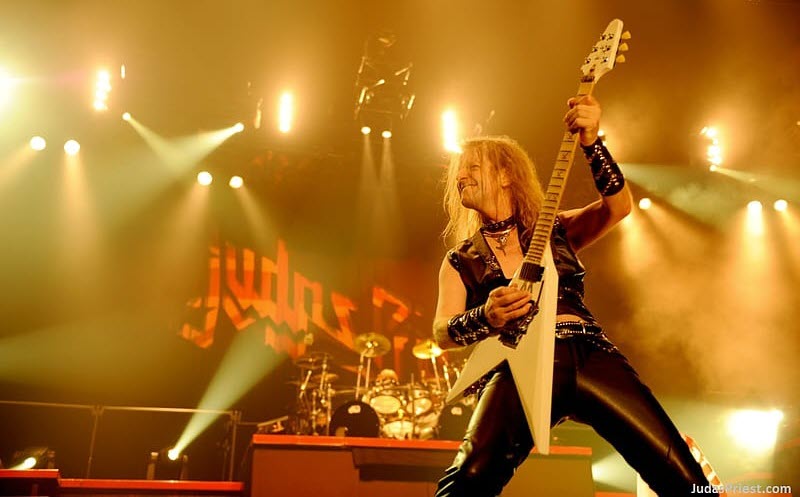
Few bands in the history of heavy metal have left as indelible a mark as Judas Priest. With leather-clad swagger, piercing vocals, and electric riffs that can shake the heavens, this legendary British band has set the standard for headbanging anthems for over five decades. As pioneers of the genre, Judas Priest didn’t just play heavy metal—they redefined it, shaping its sound, attitude, and image for generations to come.
From the searing solos of K.K. Downing and Glenn Tipton to the iconic voice of Rob Halford, Judas Priest has delivered timeless classics that still resonate with fans old and new. Whether you’re a devoted metalhead or a curious newcomer, their music has something for everyone: adrenaline-pumping anthems, dark and mysterious ballads, and rebellious declarations of freedom.
In this article, we’re counting down the top 10 most popular Judas Priest songs of all time. These are the tracks that have electrified arenas, inspired countless bands, and earned their place as pillars of heavy metal history. So crank up the volume, prepare for goosebumps, and join us on a journey through the unforgettable legacy of Judas Priest’s greatest hits!
1. Breaking the Law (1980)
“Breaking the Law” is the quintessential anthem of rebellion and defiance. Released on Judas Priest’s groundbreaking 1980 album British Steel, this track encapsulates the frustration and alienation felt by many during a time of political unrest and economic hardship. From the first scratchy chords of its iconic guitar riff, the song pulls you into a world of discontent and rebellion. Rob Halford delivers the lyrics with raw emotion, telling the story of someone pushed to the edge by a system that offers no hope or justice. The simplicity of the arrangement only amplifies its power—tight, punchy, and direct. At just over two and a half minutes, it’s lean but unforgettable. The music video, featuring the band robbing a bank with guitars, became instantly iconic and sealed the track’s place in metal history. It’s not just a song—it’s a call to arms for the disillusioned, a release valve for pent-up rage. Over the years, “Breaking the Law” has become more than a fan favorite; it’s a cultural symbol of protest and resistance. Whether shouted in a stadium or blasted from a car stereo, this track still hits like a rebellious punch in the gut.
2. Painkiller (1990)
“Painkiller” is Judas Priest firing on all cylinders—aggressive, virtuosic, and downright explosive. The title track of their 1990 album, it marked a dramatic return to heavier, faster roots and became one of their most celebrated achievements. Scott Travis, in his first album with the band, instantly made his mark with a jaw-dropping double-bass drum intro that feels like a war drum announcing the apocalypse. The guitar work by Glenn Tipton and K.K. Downing is equally blistering, with precision riffing and face-melting solos that elevate the track to legendary status. Rob Halford’s vocal performance is nothing short of superhuman—his high-pitched wails cutting through the chaos like a sonic blade. Lyrically, “Painkiller” paints a mythic, almost comic-book-like tale of a metal savior descending to cleanse the world through fire and steel. It’s fast, furious, and unrelenting from start to finish. The song became a defining moment in Priest’s career and a benchmark for speed and power metal. Even decades later, it remains a jaw-dropping showcase of musicianship and intensity. If you ever need to prove how powerful heavy metal can be, “Painkiller” is the song you blast at full volume.
3. You’ve Got Another Thing Comin’ (1982)
“You’ve Got Another Thing Comin’” is a metal anthem that brims with confidence, resilience, and an unwavering sense of determination. Released in 1982 as part of the Screaming for Vengeance album, the song helped Judas Priest break through in the American mainstream and became one of their most enduring hits. Built on a steady, chugging guitar riff and a thumping rhythm section, the song grooves as much as it rocks. Rob Halford’s vocals are fierce but measured, delivering lyrics that practically dare anyone to stand in your way. The message is crystal clear: no matter what life throws at you, you’re not backing down. It’s this blend of swagger and grit that has made the song such a staple at live shows and a personal anthem for many fans. While it lacks the speed or aggression of some of their heavier work, the accessibility and melodic strength of “You’ve Got Another Thing Comin’” helped bring metal to a broader audience. It’s more than a catchy tune—it’s a declaration of self-belief. Whether you’re facing adversity or just need a jolt of motivation, this track hits like a shot of pure confidence.
4. Living After Midnight (1980)
With its infectious chorus and easy-going groove, “Living After Midnight” is Judas Priest’s most unabashed celebration of the rock ‘n’ roll lifestyle. Released in 1980 on the British Steel album, the song captures the joy of letting loose and living life on your own terms. Written after Rob Halford was inspired during a late-night writing session, the lyrics read like a party manifesto—staying up late, hitting the town, and making noise until the sun comes up. Musically, it’s built around a riff that’s as catchy as it is simple, making it a perfect sing-along track for live shows and road trips alike. There’s nothing overly complex about this song, and that’s exactly the point—it’s about fun, freedom, and turning up the volume. While Judas Priest are often associated with darker themes and blistering speed, this song shows their lighter, more playful side. Over time, “Living After Midnight” has become a fan favorite and a classic rock radio staple, proving that heavy metal doesn’t always have to be serious to be powerful. It’s a timeless reminder that sometimes, the best nights start long after midnight.
5. Hell Bent for Leather (1978)
“Hell Bent for Leather” is Judas Priest distilled into two minutes and thirty-eight seconds of raw, relentless metal power. The title track from the U.S. version of their 1978 album Killing Machine, this song helped define both the band’s sound and their image for years to come. With its galloping rhythm, punchy guitar riffs, and an adrenaline-charged vocal from Rob Halford, it’s a sonic embodiment of speed and rebellion. The lyrics portray a leather-clad outlaw tearing down the highway—a symbol of freedom, danger, and independence. Halford’s persona as the leather-and-chains-clad frontman truly took shape with this track, cementing the band’s influence on both the musical and visual aesthetics of heavy metal. Live performances of the song became legendary, especially when Halford rode a Harley-Davidson onto the stage, much to the roaring approval of fans. It’s a song that doesn’t waste time—it kicks in and rockets forward with a fiery sense of purpose. “Hell Bent for Leather” is not just a fan favorite; it’s a statement of identity. For those who live fast, ride hard, and value personal freedom, this track is nothing short of a heavy metal anthem.
6. Electric Eye (1982)
“Electric Eye,” featured on the Screaming for Vengeance album, is a high-octane track that dives headfirst into a world dominated by surveillance and technological control. It begins with the powerful instrumental intro “The Hellion,” a soaring guitar-driven overture that builds tension and sets the stage for what’s to come. As the transition hits, “Electric Eye” launches into a razor-sharp assault of tight guitar riffs and relentless drumming. Rob Halford’s vocals are sharp and commanding as he takes on the voice of an all-seeing, omnipresent observer, watching your every move with cold precision. The lyrics are eerily prophetic, especially in today’s digital world, where privacy often feels like a thing of the past. It’s a song that blends science fiction with social commentary, wrapped in a muscular, fast-paced metal package. The dual guitars of Tipton and Downing are in perfect sync, delivering intricate leads and rhythm work that drive the track’s urgency. More than just a great metal song, “Electric Eye” is a statement about control, power, and resistance. It remains a fan favorite for its energy and its chilling relevance, proving that Judas Priest could be both heavy and thought-provoking at the same time.
7. Turbo Lover (1986)
“Turbo Lover” is perhaps one of Judas Priest’s most adventurous tracks, taken from their 1986 album Turbo. It marked a stylistic shift for the band as they incorporated synthesizers and electronic textures into their sound—a bold move that divided fans but eventually became part of the band’s rich legacy. From the very first notes, “Turbo Lover” delivers a sleek, futuristic vibe. The layered synths and mid-tempo beat create a polished, almost mechanical rhythm, while the guitars still retain that signature Priest crunch. Rob Halford’s vocals are smooth and seductive here, singing about speed, machines, and desire with a mix of power and allure. The lyrics are an extended metaphor, comparing a high-powered motorcycle ride to a passionate love affair—both thrilling, fast, and a little dangerous. While not as aggressive as some of their earlier work, “Turbo Lover” carries an irresistible charm. Over the years, it has grown in stature, now viewed as a classic of the era and a testament to the band’s willingness to evolve. It’s the kind of track that makes you want to hit the open road with the volume cranked all the way up. Bold, sleek, and unforgettable.
8. Victim of Changes (1976)
“Victim of Changes” stands as one of Judas Priest’s earliest and most epic achievements, a progressive metal tour de force from their 1976 album Sad Wings of Destiny. Clocking in at over seven minutes, the song unfolds like a dramatic journey through heartbreak, anger, and emotional release. It begins with a hauntingly bluesy guitar intro that sets a somber tone before building into a series of explosive shifts. The dynamic interplay between Glenn Tipton and K.K. Downing’s guitars keeps the listener on edge, weaving melodic leads with thunderous riffs. Rob Halford’s performance here is legendary—his voice ranges from deep, soulful laments to ear-piercing wails that showcase his astonishing vocal power. The lyrics tell a story of a relationship unraveling, marked by betrayal and self-destruction, making it deeply personal yet universally relatable. The arrangement feels almost operatic in its structure, with tension rising and falling like waves. “Victim of Changes” proved early on that Judas Priest wasn’t just about volume—they had depth, nuance, and a flair for storytelling. It’s often cited by fans and critics alike as one of the greatest heavy metal songs of all time, and for good reason—it’s nothing short of breathtaking.
9. The Sentinel (1984)
“The Sentinel,” from Judas Priest’s 1984 album Defenders of the Faith, is a heavy metal epic that blends mythic storytelling with ferocious instrumentation. It tells the tale of a mysterious warrior who stands alone, delivering justice in a brutal, post-apocalyptic world. The imagery is vivid—metal-clad enemies, bloody battles, and a relentless figure doling out vengeance. Musically, it’s just as intense. From the start, the song is driven by galloping rhythms and intricate twin guitar harmonies courtesy of Glenn Tipton and K.K. Downing. The solos are nothing short of dazzling, weaving complexity into the song’s already rich texture. Rob Halford’s vocal performance is fierce and commanding, bringing the Sentinel character to life with every line he delivers. The lyrics read like a short story, cinematic in scope and full of drama. What makes “The Sentinel” stand out is its perfect balance of storytelling and raw metal energy—it’s got the brains and the brawn. Over time, it’s become a fan favorite for those who love their metal with both narrative flair and a punch to the gut. It’s an essential listen for anyone who wants to experience the band at their most imaginative and intense.
10. Freewheel Burning (1984)
“Freewheel Burning” is Judas Priest at their most turbo-charged and aggressive, kicking off the Defenders of the Faith album with a ferocious burst of speed and energy. Right from the start, the track explodes with a rapid-fire guitar riff that barrels forward like a runaway train. The drumming is relentless, the solos are scorching, and Rob Halford delivers his vocals with machine-gun precision—spitting out lines with an urgency that matches the song’s unyielding momentum. Lyrically, “Freewheel Burning” is all about pushing the limits, living fast, and embracing danger. It captures the thrill of speed, whether on a motorcycle, in a race, or just through the chaos of life. There’s a reckless joy in the way the song unfolds, like a celebration of metal’s wild, untamed spirit. The guitar duel between Tipton and Downing is especially jaw-dropping, filled with whammy bar dives, fluid runs, and ear-piercing harmonics. The song doesn’t just grab your attention—it dares you to keep up. “Freewheel Burning” is pure adrenaline set to music, and it remains one of the band’s most explosive tracks. When it comes to high-speed, no-holds-barred metal, this one is an undeniable classic.

Edward Tomlin is a frequent contributor to Singers Room. Since 2005, Singersroom has been the voice of R&B around the world. Connect with us via social media below.