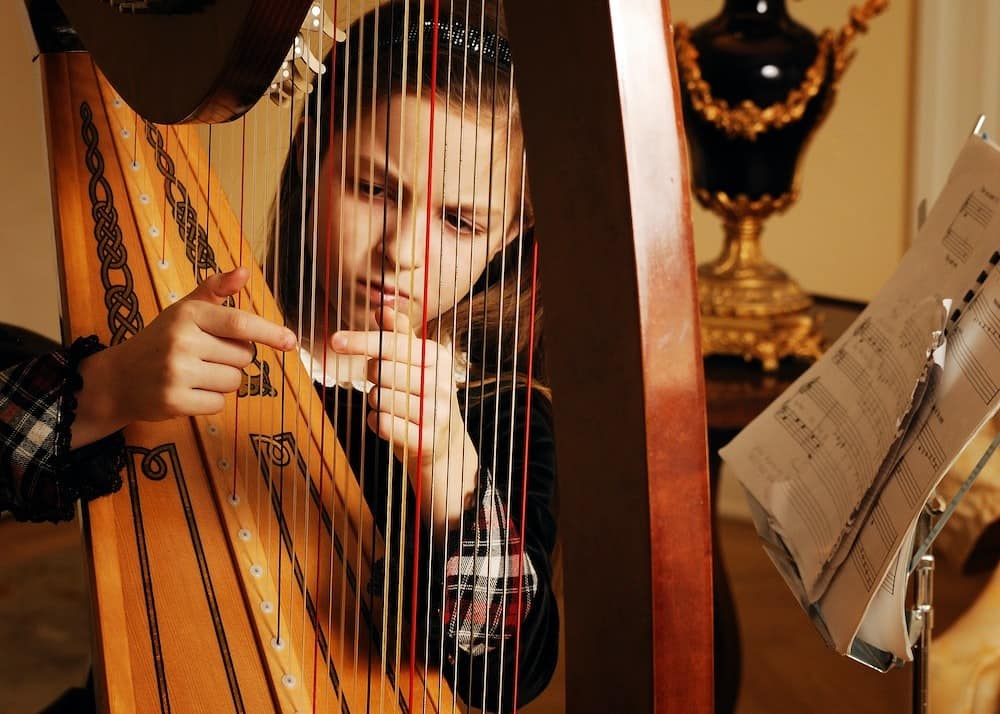
Harp players, the enchanting maestros of ethereal strings, weave a tapestry of mesmerizing melodies that transcend time and genre. With fingers dancing delicately across the strings, harpists evoke a celestial soundscape, transporting listeners to realms of elegance and serenity. Renowned for their mastery of this ancient instrument, harp players navigate the complexities of classical compositions, folk tunes, and contemporary pieces with finesse and grace.
The harp’s rich resonance, coupled with the player’s technique, allows for a wide range of expressive possibilities. Harpists often showcase their virtuosity in orchestral settings, where the instrument adds celestial harmonies and angelic glissandos to the ensemble. In solo performances, harp players captivate audiences with the instrument’s lyrical beauty and the performer’s ability to convey emotion through nuanced phrasing.
Notable harpists, such as Harpo Marx, Carlos Salzedo, and Joanna Newsom, have left an indelible mark on the harp’s legacy, each contributing to its diverse repertoire and expanding its horizons. Harp players are not only ambassadors of classical and orchestral traditions but also explorers, pushing the boundaries of the instrument in contemporary, jazz, and world music. Their dedication to this ancient and evocative instrument ensures that the harp’s celestial tones continue to resonate in the hearts of music lovers around the world.
1. Angelita de Luna
Angelita de Luna is a renowned harp player, who has enthralled audiences with her enchanting melodies and remarkable technique. Her adroitness with the instrument is evident in every note. Let’s delve into the world of Angelita de Luna and discover her remarkable talent.
Angelita de Luna’s incredible ability on the harp has been demonstrated through her extensive background and numerous awards. She has been performing and recording for two decades, which has cemented her status as one of the best harpists of all time. Her ardor for music is audible in every performance, leaving listeners enthralled.
2. Bernard Zighera
Bernard Zighera, a harp virtuoso, is highly regarded for his unique techniques and emotional performances. He is known for his mastery of both classical and contemporary repertoire, setting him apart from others in the field. Zighera’s talent for blending genres and creating captivating musical experiences has established him as a pioneer in the world of harp music.
3. Anna Lelkes
Anna Lelkes (1913–2005) was a Hungarian-American flutist known for her significant contributions to the world of classical music. Born on November 2, 1913, in Budapest, Hungary, she emerged as a prominent flutist and teacher during the mid-20th century.
Lelkes began her studies at the Franz Liszt Academy of Music in Budapest, where she received training in both flute and piano. She continued her education in Paris, studying with renowned flutist Marcel Moyse.
Her career as a flutist included performances with major orchestras and ensembles, and she established herself as a respected chamber musician. Anna Lelkes was known for her expressive and lyrical playing, and she made notable contributions to the flute repertoire.
In addition to her performing career, Lelkes was an influential teacher. She held teaching positions at various institutions, including the Juilliard School in New York City. Her pedagogical approach and expertise influenced many flutists who went on to have successful careers in both performance and teaching.
Anna Lelkes’ legacy is evident not only through her own performances and recordings but also through the impact she had on the next generation of flutists. Her dedication to both artistic expression and education contributed to the continued development of flute playing. Anna Lelkes passed away on January 5, 2005, leaving behind a lasting influence on the world of classical music.
4. Susann McDonald
Susann McDonald (b. 1940) is a distinguished American harpist known for her exceptional artistry, teaching, and contributions to the world of classical music. Born on June 8, 1940, in Joliet, Illinois, McDonald has had a multifaceted career as a performer, educator, and advocate for the harp.
McDonald’s achievements as a harpist include performances with major orchestras, collaborations with renowned conductors and musicians, and recordings that showcase her mastery of the instrument. Her playing is characterized by a rich and expressive tone, as well as a deep musical sensitivity.
In addition to her performing career, Susann McDonald has been an influential figure in harp education. She has held teaching positions at various institutions, including Indiana University’s Jacobs School of Music and the Juilliard School. McDonald has also been involved in organizing and hosting international harp competitions, further promoting the development of young harpists.
One of McDonald’s significant contributions is her work in expanding the harp repertoire. She has collaborated with contemporary composers, commissioning and premiering new works that explore the harp’s capabilities and push its artistic boundaries.
Susann McDonald’s impact on the harp community extends globally, and her influence is evident through the success of her students, many of whom have become accomplished harpists and educators. Her dedication to advancing the harp as a solo and ensemble instrument has left an enduring legacy in the world of classical music.
5. Alice Chalifoux
Alice Chalifoux (1926–2008) was a highly esteemed American harpist known for her exceptional talent, influential teaching, and significant contributions to the world of classical music. Born on January 19, 1926, in Philadelphia, Pennsylvania, Chalifoux became a prominent figure in the harp community.
Alice Chalifoux served as the principal harpist of the Cleveland Orchestra under conductor George Szell from 1931 to 1974, making her one of the longest-tenured principal harpists in the history of major orchestras. Her contributions to the orchestra and collaborations with renowned conductors and musicians solidified her reputation as a preeminent harpist.
Beyond her successful orchestral career, Chalifoux was an influential teacher. She joined the faculty of the Cleveland Institute of Music in 1962 and played a crucial role in shaping the next generation of harpists. Her dedication to teaching extended beyond the United States, as she conducted masterclasses internationally.
Alice Chalifoux’s impact on the harp world was profound, and her legacy endures through the students she mentored and the recordings she left behind. Her artistry and commitment to advancing the harp’s role in classical music have left an indelible mark on the instrument’s history. Alice Chalifoux passed away on January 18, 2008, in Cleveland, Ohio.
6. Sarah Chang
https://youtu.be/7OhhavCOtt0
As of my last knowledge update in January 2022, Sarah Chang is a highly acclaimed American violinist known for her virtuosity, musicality, and expressive performances. Born on December 10, 1980, in Philadelphia, Pennsylvania, Chang began playing the violin at a very young age and quickly gained recognition as a prodigious talent.
Sarah Chang made her debut with the New York Philharmonic at the age of eight and has since performed with major orchestras and conductors worldwide. Her exceptional skills and mature interpretations have made her one of the leading violinists of her generation.
Chang is known for her diverse repertoire, encompassing classical masterpieces, contemporary works, and popular pieces. Her playing is characterized by technical brilliance, a rich and warm tone, and a deep emotional connection to the music.
In addition to her performances, Sarah Chang is committed to education and outreach. She has been involved in various educational initiatives and has mentored young musicians.
Please note that the information provided here is based on my knowledge as of January 2022, and there may have been developments in Sarah Chang’s career or life since then. I recommend checking more recent sources for the latest information about Sarah Chang.
7. Amelia The Human
One interesting fact about Amelia The Human is that she holds the record for the most consecutive hours playing the harp, totaling 36 hours!
8. Mildred Dilling
Mildred Dilling (1894–1982) was an American harpist renowned for her contributions to the world of classical music. Born on October 23, 1894, in Marion, Ohio, Dilling became one of the most prominent harpists of the 20th century.
Dilling’s musical career was extensive, encompassing both performances and teaching. She performed as a soloist with major orchestras, including the New York Philharmonic and the Chicago Symphony Orchestra. Her artistry and technical skill garnered acclaim from audiences and critics alike.
In addition to her solo career, Mildred Dilling was an influential teacher. She held teaching positions at institutions such as the Juilliard School, the Curtis Institute of Music, and the Cleveland Institute of Music. Her contributions to harp education left a lasting impact on generations of harpists.
Dilling’s dedication to the harp extended beyond the classical repertoire. She embraced a diverse range of music, including popular and folk tunes, expanding the instrument’s versatility. Her performances often showcased the harp’s expressive potential in various genres.
Mildred Dilling’s influence on the harp community and the broader world of classical music is significant. Her recordings, educational efforts, and performances contributed to the promotion and appreciation of the harp as a solo and ensemble instrument. Mildred Dilling passed away on September 23, 1982, leaving behind a legacy that continues to inspire harpists.
9. Nicanor Zabaleta
Nicanor Zabaleta (1907–1993) was a Spanish virtuoso harpist renowned for his exceptional artistry, technical prowess, and significant contributions to the world of classical music. Born on January 7, 1907, in San Sebastián, Spain, Zabaleta played a pivotal role in elevating the harp as a solo instrument and contributed extensively to its repertoire.
Nicanor Zabaleta began his musical studies at a young age and quickly gained recognition for his remarkable talent. His international career took off in the mid-20th century, and he became one of the most sought-after harpists of his time. Zabaleta’s playing was characterized by its expressive depth, meticulous technique, and the ability to convey a wide range of emotions through the harp.
Throughout his career, Zabaleta collaborated with many distinguished conductors and orchestras, performing a diverse repertoire that spanned from Baroque to contemporary compositions. He was particularly acclaimed for his interpretations of Spanish and Latin American music, contributing to the popularization of these genres within the classical harp repertoire.
Nicanor Zabaleta’s dedication to expanding the harp’s possibilities led to the commissioning of numerous works by prominent composers, further enriching the instrument’s repertoire. His recordings, including interpretations of Handel, Mozart, and Debussy, showcase his virtuosity and musical sensitivity.
As a teacher, Zabaleta influenced a new generation of harpists through his masterclasses and educational activities. His impact on the harp world is lasting, and his legacy endures through the continued admiration for his contributions to classical music. Nicanor Zabaleta passed away on March 31, 1993, leaving behind a rich and influential musical legacy.
10. Yolanda Kondonassis
Yolanda Kondonassis, born on February 19, 1963, in Norman, Oklahoma, is a highly acclaimed American harpist. Known for her virtuosity, expressive playing, and diverse repertoire, Kondonassis has established herself as one of the leading harpists of her generation.
Kondonassis began her harp studies at a young age and quickly gained recognition for her talent. She has performed as a soloist with major orchestras around the world, collaborating with renowned conductors and composers. Her repertoire spans a wide range of genres, including classical, contemporary, and popular music.
In addition to her successful performing career, Yolanda Kondonassis is committed to harp education and has held teaching positions at institutions such as the Oberlin Conservatory of Music. She has also been involved in commissioning and premiering new works for the harp, contributing to the expansion of the harp repertoire.
Kondonassis has an extensive discography featuring solo and chamber music recordings. Her albums showcase her versatility and artistry, and she has received critical acclaim for her interpretations of both traditional and contemporary works.
Yolanda Kondonassis’ influence extends beyond the concert stage. Her efforts in promoting the harp as a versatile and expressive instrument have contributed to the instrument’s broader recognition in the world of classical music.
11. Judy Loman
Judy Loman (born 1935) is a Canadian harpist celebrated for her exceptional artistry, prolific career, and significant contributions to the world of classical music. Born in London, Ontario, Loman is recognized as one of the foremost harpists of her generation and has played a crucial role in promoting the harp as a solo instrument.
Judy Loman’s musical journey began at an early age, and she continued her studies at the Curtis Institute of Music in Philadelphia. Her talent quickly gained attention, leading to numerous accolades and awards. Loman served as the principal harpist with the Toronto Symphony Orchestra for over three decades, from 1959 to 1990, under the direction of several renowned conductors.
In addition to her orchestral engagements, Judy Loman has established herself as a sought-after soloist and chamber musician. She has premiered numerous works by Canadian composers, expanding the harp repertoire and contributing to the development of contemporary music.
Loman’s extensive discography reflects her versatility and commitment to showcasing the harp’s capabilities across various genres. Her performances encompass a wide range of styles, from classical masterpieces to contemporary compositions.
As an influential teacher, Judy Loman has mentored many aspiring harpists, fostering the growth of new talent and contributing to the legacy of harp playing in Canada and beyond.
Judy Loman’s dedication to her craft, her advocacy for Canadian music, and her contributions to the harp community have solidified her reputation as a prominent figure in the world of classical music.
12. Harpo Marx
Harpo Marx (1888–1964), born Adolph Marx, was an American comedian, actor, and one of the Marx Brothers, a legendary comedy team in the early to mid-20th century. Born on November 23, 1888, in New York City, Harpo gained fame for his silent comedic performances, physical comedy, and musical talents.
Unlike his more vociferous brothers—Groucho, Chico, Zeppo, and later Gummo—Harpo was known for his silent persona. He rarely spoke on screen, instead relying on visual gags, pantomime, and his trademark horn-honking antics. He played the harp, which became a signature element of his performances.
The Marx Brothers achieved success in vaudeville, Broadway, and Hollywood with their irreverent and rapid-fire style of comedy. Some of their most famous films include “Duck Soup,” “A Night at the Opera,” and “Animal Crackers.”
Harpo Marx’s on-screen persona was that of a mischievous and childlike character, dressed in a curly wig and with a penchant for causing chaos in a lovable manner. His unique approach to comedy and his musical talents endeared him to audiences worldwide.
Off-screen, Harpo was known for being a more reserved and private individual than his boisterous stage character. He was married to actress Susan Fleming and had four children.
Harpo Marx passed away on September 28, 1964, leaving behind a comedic legacy that continues to entertain audiences through the enduring popularity of the Marx Brothers’ films.
13. Carlos Salzedo
Carlos Salzedo (1885–1961) was a distinguished harpist, composer, and conductor known for his groundbreaking contributions to the harp’s repertoire and his influential role in the development of harp technique. Born on April 6, 1885, in Arcachon, France, Salzedo’s impact on the world of classical music, particularly the harp, remains profound.
Salzedo studied at the Paris Conservatoire and quickly established himself as a virtuoso harpist. His pioneering efforts in harp playing included the development of a revolutionary method for harp technique, emphasizing precision, speed, and control. This method, known as the Salzedo Method, has become a standard in harp pedagogy.
As a performer, Carlos Salzedo toured internationally, captivating audiences with his technical brilliance and expressive playing. He was also the principal harpist for the Metropolitan Opera in New York from 1919 to 1936, contributing to numerous opera productions.
In addition to his performing career, Salzedo was a prolific composer, creating a significant body of work for the harp, including solo pieces, chamber music, and compositions for harp and orchestra. His compositions often reflect a blend of impressionism and modernism, showcasing the harp’s versatility.
Carlos Salzedo’s legacy extends beyond his own performances and compositions. He co-founded the Salzedo Harp Colony in Camden, Maine, which played a crucial role in advancing harp education in the United States. Many of his students went on to become prominent harpists, continuing his legacy in the field.
Carlos Salzedo passed away on August 17, 1961, leaving an enduring impact on harp playing, pedagogy, and composition. His contributions to the advancement of the harp as a solo instrument and his influence on generations of harpists make him a central figure in the history of the instrument.
14. Pablo Casals
Pablo Casals (1876–1973), born in Catalonia, Spain, was a preeminent cellist and conductor of the 20th century. Revered for his virtuosity, Casals reshaped the perception of the cello, introducing Johann Sebastian Bach’s Cello Suites to a global audience. A prodigy from an early age, his performances displayed unmatched technical brilliance and profound musical insight.
Casals’ impact extended beyond solo performances; he was a champion of chamber music, founding festivals and ensembles. His contributions to orchestral music included conducting prominent orchestras and advocating for musical education.
A fervent defender of human rights, Casals vehemently opposed authoritarian regimes, leading to his exile from Spain during the Franco era. His principled stand against oppression amplified his stature as not only a musical luminary but also a symbol of moral fortitude.
In a career spanning decades, Casals left an enduring legacy, influencing cellists, conductors, and music lovers worldwide. His artistic achievements, coupled with his unwavering commitment to justice, immortalize him as a giant in the pantheon of classical musicians. Pablo Casals’ legacy resonates through his timeless recordings, compositions, and the profound impact he made on the cello and the world of classical music.
15. Marcel Grandjany
Marcel Grandjany (1891–1975) was a French-American harpist, composer, and teacher known for his significant contributions to the world of classical music, particularly for the harp. Born on September 3, 1891, in Paris, Grandjany’s career spanned several decades and encompassed performance, composition, and pedagogy.
Grandjany began his musical studies at the Paris Conservatoire, where he excelled in harp and composition. His talent earned him numerous awards, including the Premier Prix in harp and the Prix Francis Casadesus in composition.
In the early 1920s, Marcel Grandjany emigrated to the United States, where he quickly established himself as a prominent harpist and teacher. He performed with major orchestras, including the Chicago Symphony Orchestra and the New York Philharmonic, and collaborated with renowned conductors.
As a composer, Grandjany created a significant body of work for the harp, including solo pieces, chamber music, and concertos. His compositions are noted for their lyrical beauty and thoughtful exploration of the harp’s expressive capabilities.
Marcel Grandjany was also dedicated to harp education. He served as a professor at various institutions, including the Juilliard School in New York and the Curtis Institute of Music in Philadelphia. His pedagogical influence is evident in the success of his students, many of whom became accomplished harpists and educators.
Grandjany’s commitment to advancing the harp’s role in classical music, both through performance and education, has left a lasting impact on the harp community. His compositions continue to be an integral part of the harp repertoire, and his legacy endures through the students he mentored and the musicians he inspired. Marcel Grandjany passed away on February 24, 1975.

Edward Tomlin is a frequent contributor to Singers Room. Since 2005, Singersroom has been the voice of R&B around the world. Connect with us via social media below.