
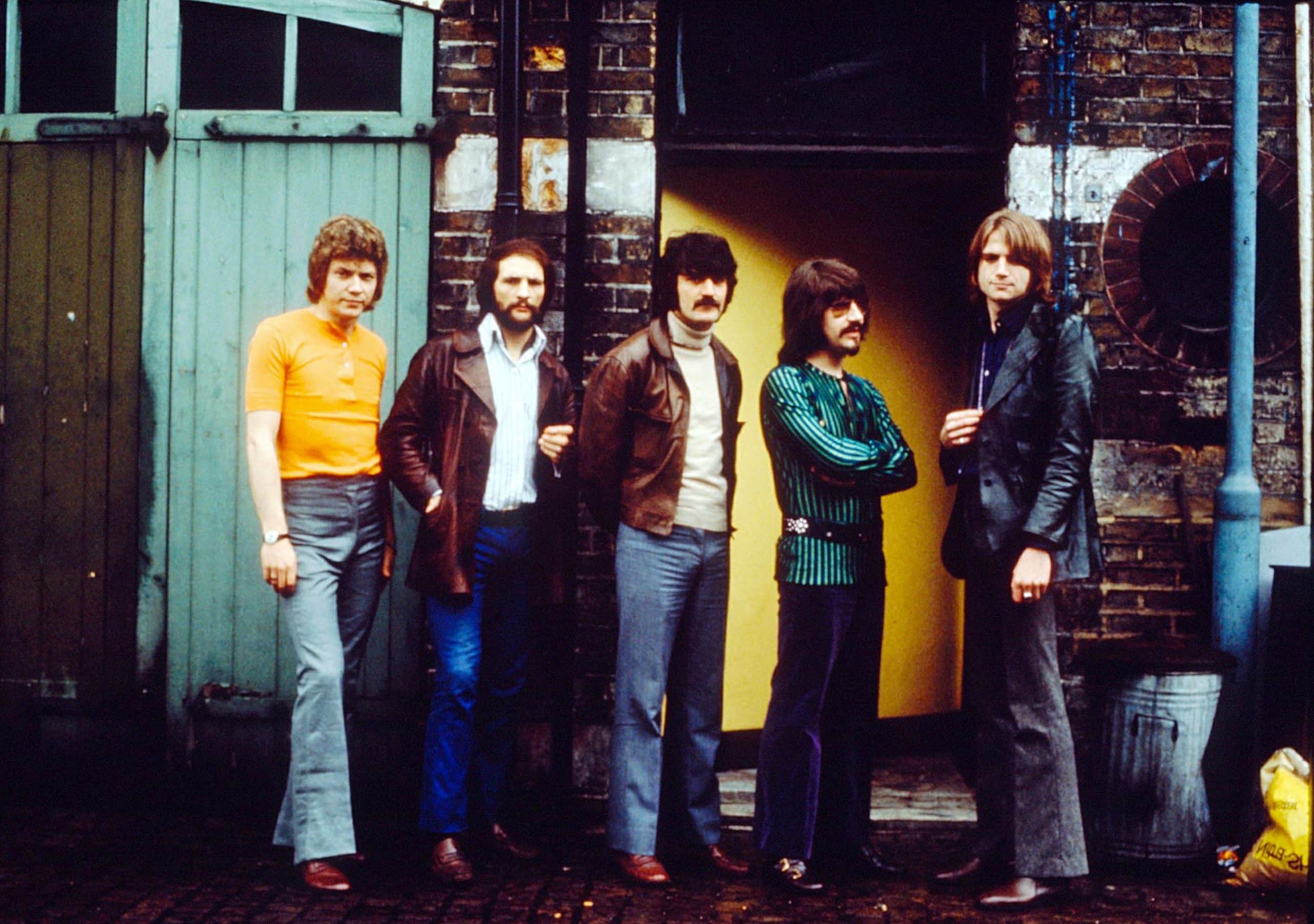
The Moody Blues built a universe where orchestral color meets British rhythm and blues grit, where mystic poetry rides alongside radio ready melody. They created songs that sound like corridors in a dream, each doorway opening to a fresh blend of mellotron haze, chiming guitars, and harmonies that feel like lantern light. From the silver dusk of baroque ballads to the bright push of rock anthems, their catalog invites listening with both heart and curiosity. Here are ten enduring favorites that continue to pull new travelers into the Moodies’ world. Pour some late night tea, dim the room, and let these luminous recordings unfold.
1. Nights in White Satin
A torch song adrift in a cosmic mist, Nights in White Satin remains the band’s great curtain of sound. Justin Hayward’s vocal moves with tender gravity, never forced, never hurried, the ache of a letter unsent folded into each phrase. Mike Pinder’s mellotron is the guiding weather, strings swelling and receding like a tide around the gentle acoustic guitar. What makes this recording feel eternal is its patience. The chord sequence circles as if tracing memory itself, while Graeme Edge keeps a heartbeat pulse that barely lifts above a whisper. Ray Thomas’s flute slips through the arrangement like moonlight at the edge of a window, a gleam that turns melancholy into wonder. Listen to the space between lines, the held breaths that allow resonance to bloom. The production refuses to crowd the center, which lets the lyric sit close to the ear. One hears not only romance, but also the tug of time and the fragile wish to hold beauty steady. The orchestral coda and poem often associated with concert versions feel like an epilogue to a private confession. The single version stands on its own because the song is a world. It invites quiet, then rewards it with a glow that does not dim.
2. Tuesday Afternoon
Tuesday Afternoon captures a stroll that turns into revelation. The lyric reads like a notebook page from a day spent in nature, observations that gradually point toward a larger awakening. Justin Hayward’s acoustic guitar is bright and immediate, while John Lodge’s bass walks with melodic purpose, lifting the verses step by step. The mellotron colors are not merely decorative. They are mood made audible, a gentle haze that draws the listener into the meadow the singer describes. What lingers is the marriage of clarity and dream. The melody is precise, yet it floats, as if the air itself is carrying it forward. The middle section widens the view, harmonies opening like a gate, and Ray Thomas’s vocals add a friendly human warmth. Producer Tony Clarke and engineer Derek Varnals keep the mix spacious, so that small details feel important. A single tambourine shake, a piano figure arriving like sunlight through leaves, a drum fill that turns the path slightly. The song is short by symphonic rock standards, yet it feels expansive because it trusts suggestion. The Moodies were explorers of interior weather, and here the weather is benign, inquisitive, and quietly brave. By the final line, afternoon has turned into insight, and the melody lingers like a smile.
3. Question
Question is urgency wrapped in melody, a song that surges forward with acoustic strums as fierce as any electric riff. Justin Hayward sings as if words are racing to catch up with feeling, the consonants crisp, the vowels opened wide to let air and hope in. The arrangement is a master class in contrast. The verses sprint with bright guitar and insistent percussion, then the tempo eases for a reflective center where harmonies cradle a plea for peace and understanding. That push and release makes the lyric’s search feel lived rather than posed. John Lodge’s bass balances agility with anchor, and Mike Pinder’s keyboards add a shimmering undertow that keeps the whole track buoyant. The drumming is energetic yet musical, driving without ever becoming blunt. What elevates the recording is the sense of collective voice. Even when one singer leads, the band feels like a chorus of citizens asking the same questions with different inflections. The Moodies were often labeled philosophers of pop, but the philosophy here is kinetic. It invites action as much as contemplation. By the time the opening energy returns for the final run, the plea has turned into resolve. The record ends like a raised lantern, bright and insistent against the dusk.
4. The Story in Your Eyes
There is a gleaming momentum to The Story in Your Eyes that still feels fresh. The guitars bite without bitterness, a crisp ring that rides atop a rhythm section built for forward motion. Justin Hayward delivers the melody with effortless lift, shaping lines so that each chorus lands like a promise. Lyrically it is a declaration of faith in connection, the belief that the truth of a person can be read in the light of their gaze. The band underscores that optimism with arrangement choices that sparkle. Mellotron swells are held in check, used for color rather than spectacle, while piano adds quick flashes of brightness that punctuate the beat. John Lodge’s bass is especially musical here, carving countermelodies that increase the sense of travel. Graeme Edge locks the tempo with clean authority, and Ray Thomas’s harmonies arrive like companions on a road. The production favors clarity. Each instrument occupies intelligible space, which makes the choruses feel airborne. What stands out is the balance of muscle and grace. The song pounds in the best sense, but it also smiles. It is a reminder that this band could rock with real attack while keeping their trademark warmth. Play it in the car and watch the horizon lean closer.
5. Go Now
Before mellotron tapes and concept suites, there was the stark and soulful ache of Go Now. This is the Denny Laine era, and the performance is pure British rhythm and blues with a tear in its eye. The piano opens like a door to an empty room, chords ringing with a churchy resonance, then the vocal enters, cracked just enough to sound human rather than heroic. The lyric is direct. It asks for the clean break that will hurt less than the slow fade. That simplicity gives the song its spine. The arrangement is minimal yet perfectly judged. A few chiming guitar figures, a bass that hugs the root with conviction, drums that mark time like a last walk down a hallway. The harmonies arrive as gut responses, a group of friends backing a confession. There is no studio gloss to hide behind and none is needed. The record’s power lies in its honesty and its pacing. Lines are given room to settle, and silences feel loaded. Listening today, one hears the seed of what the band would later become. Even at this early moment, The Moody Blues understood the dramatic potential of restraint. Nothing is wasted, and the plea lands with the dignity of truth told plainly.
6. Ride My See Saw
Ride My See Saw announces itself with an engine roar of electric guitar and a rhythm section eager to sprint. John Lodge penned a lyric about modern life’s dizzying push and pull, and the band answers with a track that balances swagger and precision. The riff is memorable and compact, the kind of figure you can hum after a single pass, yet it carries enough drive to power the verses without fatigue. Graeme Edge plays with athletic snap, and the fills have a drummer’s grin baked in. Mike Pinder keeps the mellotron largely on the sidelines here, letting organ and piano textures add grit while guitars do the heavy lifting. The vocals are classic Moodies, harmonies stacked like stained glass so that even a rocker glows. Listen for the tension between motion and commentary. The music urges forward while the lyric pauses to consider what all this motion means. That friction is the charm. The band was never just about escapism. They wanted the body to move and the mind to stay awake. By the closing section, the title has shifted from carnival image to invitation. Grab hold, balance as best you can, and embrace the ride. The result is exhilarating and utterly alive.
7. Your Wildest Dreams
With Your Wildest Dreams the group found a gleaming eighties sheen that still honored their melodic heart. The synthesizers shimmer like city lights on rain, and the drum programming gives a buoyant pulse that suits a story about memory unexpectedly revived. Justin Hayward sings in a gentle, youthful register, which matches the lyric’s time travel. He wonders about a first love and whether the past ever thinks of him too. The hook is immediate, a chorus that feels like a postcard you once kept in a book. What makes the track special is the emotional balance. It is nostalgic without syrup, reflective without gloom. John Lodge’s harmonies are woven tightly, almost like a second lead, and the arrangement pays close attention to dynamics. Verses are relatively spare, pre choruses widen the frame, and the chorus arrives with a lift that never overpowers. The middle section blooms with additional vocal layers that carry the listener across a soft crest before returning to the central theme. This was a veteran band speaking fluently in a new studio language while keeping their essence intact. The end result is graceful pop that invites sighs and sing alongs in equal measure, a tender letter sent across years.
8. I Know You’re Out There Somewhere
A companion piece to the previous entry, I Know You’re Out There Somewhere expands the search with a wider, more anthemic stride. The opening guitar figure is bright and expectant, the rhythm section moves with steady purpose, and synth textures create a horizon of color that feels cinematic. Justin Hayward’s lyric turns longing into pilgrimage. He is not simply remembering. He is traveling toward the possibility of reunion. The chorus is built for wide spaces, a ladder of melody that climbs without strain. Harmonies are sculpted carefully so that each repetition adds a layer of conviction. John Lodge’s bass gives motion rather than weight, which keeps the tune leaning forward, and Graeme Edge’s drumming accents transitions with tasteful pushes rather than heavy punctuation. The production’s clarity matters. Every instrument sits in air, so the track never turns thick, even when the arrangement swells. You can hear the patience that made the band’s classic work endure, now refracted through late era polish. The song works as romance, but it also reads as a credo for seekers of all kinds. Keep moving, keep listening, the answer may be just beyond the next bend. By the fade, belief has become melody, and melody has become promise.
9. Isnt Life Strange
Isnt Life Strange is a slow turning pageant, grand without pomp, reflective without fog. John Lodge’s composition leans into stately chords that recall classical procession, and the band frames them with luminous care. The verses move like a river viewed from a hill, unhurried, circling themes of chance, choice, and the mysterious pattern that only hindsight reveals. Justin Hayward’s lead vocal is earnest and unforced, with Ray Thomas’s harmonies adding a comforting human chorus. Mike Pinder brings the mellotron forward here, not as a novelty, but as a real orchestra substitute, its grainy tapes producing a glow that suits the lyric’s solemn wonder. The dynamic plan is exquisite. Instruments enter and withdraw so that attention stays on the words, then blossoms in the refrains where emotion swells. Graeme Edge chooses restraint over flash, allowing cymbal lifts and tom rolls to underscore meaning rather than compete with it. The Moodies were always curious about the spiritual weather of everyday life, and this track may be their clearest meditation on that theme. It does not insist on answers. It honors mystery and invites the listener to live comfortably with it. The result is stirring and quietly consoling, like watching clouds reshape the light.
10. The Voice
The Voice marries firm rhythm to luminous melody, a perfect entry point to the group’s early eighties renaissance. The drum groove has spring without stiffness, and the bass line walks with elegant assurance. Over this platform, synths flicker and glow in interlocking patterns, while guitar adds clean strokes that keep the track grounded. Justin Hayward sings an exhortation rather than a lecture, urging the listener to tune their inner compass to the call that leads them onward. The chorus opens like a sky after rain, harmony layers lifting the roof just enough to flood the room with brightness. Arrangements can often overplay the uplift, but here the production feels measured and humane. Verses stay lean so that each return to the hook feels like a true rise. The bridge steps aside for brief instrumental motion, then hands the spotlight back to the melody with renewed shine. It is music of encouragement that still manages to groove. That balance is rare. The Moody Blues had spent years exploring the borderlands between pop craft and spiritual inquiry. With this song they made that blend feel effortless, a clear message delivered through sound that invites both reflection and movement.

David Morrison is a frequent contributor to Singers Room. Since 2005, Singersroom has been the voice of R&B around the world. Connect with us via social media below.









