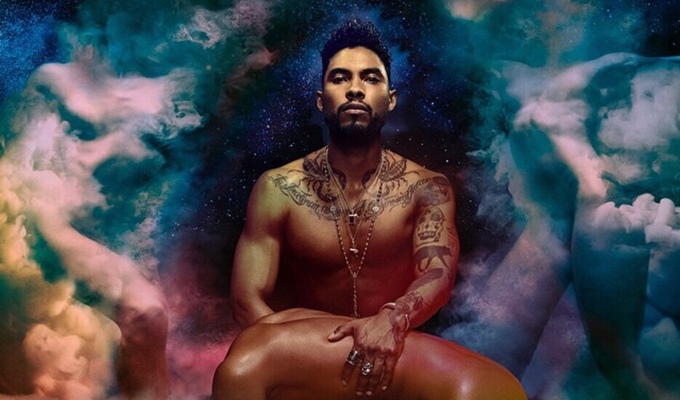
Miguel made a striking visual statement when he revealed the cover art for his album “Wildheart,” a project that quickly drew attention for its bold and unconventional presentation. The artwork features the artist in a stripped down, vulnerable aesthetic that immediately sparked conversation about identity, artistic freedom, and the role of visual imagery in modern music promotion.
The “Wildheart” album cover presents Miguel in a minimalistic and daring composition that emphasizes rawness and emotional openness. Rather than relying on elaborate costumes or staged visuals, the image focuses on simplicity and physical vulnerability as symbolic elements. This approach aligns with the themes often present in Miguel’s music, which frequently explores love, sensuality, personal struggle, and self discovery.
Miguel has long been known for blending rhythm and blues with rock, funk, and alternative influences, creating a sound that resists easy categorization. His willingness to experiment sonically is mirrored in his visual choices, and the “Wildheart” cover reflects that same creative philosophy. By presenting himself in a raw and unfiltered way, he reinforces the idea that the album is intended to be deeply personal and emotionally direct.
The reaction to the album cover was immediate and widespread. Fans and critics alike engaged in discussions about its meaning and artistic intent. Some praised the boldness of the imagery, viewing it as a powerful expression of authenticity and artistic courage. Others debated its provocative nature, questioning how far visual presentation should go in conveying artistic themes. Regardless of perspective, the cover succeeded in capturing attention and generating dialogue, which is often a key objective in contemporary album marketing.
“Wildheart” as a title suggests themes of untamed emotion, instinct, and personal freedom. The visual representation of the album reinforces this concept by stripping away external layers and focusing on the core identity of the artist. In this sense, the cover art functions not only as a promotional image but also as a conceptual extension of the music itself.
Miguel’s career has been defined by his ability to merge sensuality with introspection. His earlier work established him as a standout voice in modern rhythm and blues, known for crafting songs that balance emotional vulnerability with confident expression. With “Wildheart,” he appears to push further into that duality, exploring the tension between control and release, structure and spontaneity.
The decision to present a more exposed visual identity can also be seen as part of a broader trend in music where artists use album art as a form of storytelling. In an era dominated by digital streaming, album covers often serve as the first point of engagement between an artist and listener. As a result, visual impact has become increasingly important in shaping audience expectations and interpretations.
Critics analyzing Miguel’s artistic direction have noted that his work often challenges conventional ideas of masculinity and emotional expression. The “Wildheart” cover continues this exploration by presenting vulnerability as strength rather than weakness. This interpretation aligns with the lyrical content of many of his songs, which frequently address emotional honesty, desire, and personal transformation.
The album itself, supported by the striking cover image, was positioned as a significant moment in Miguel’s discography. It represented a continuation of his evolution as an artist willing to take creative risks both musically and visually. By embracing a more stripped down aesthetic, he invites listeners to focus on the emotional core of his work rather than external spectacle.
Ultimately, the unveiling of the “Wildheart” album cover stands as a defining example of how visual art and music intersect in modern culture. Miguel’s choice to present himself in such a bold and minimalistic way reinforces the themes of authenticity and emotional exploration that run through his music. The image continues to resonate as a statement about artistic freedom, vulnerability, and the power of simplicity in storytelling.

Founder and Creator of Singersroom.com and IncredibleWork.com. Follow me on Instagram at @gary.gentles.