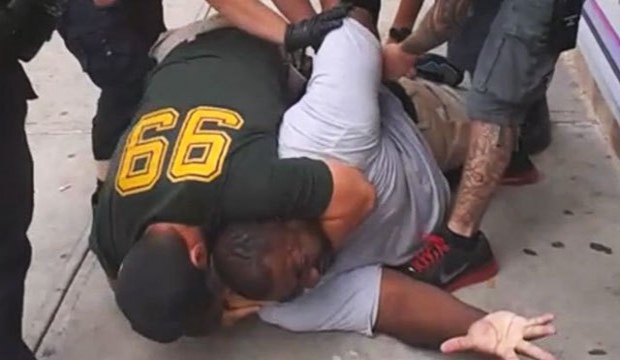
The family of the Staten Island man, who died after a group of New York Police Department officers tackled him, with one putting him in a chokehold, announced that they plan to name the city, police department and eight individual officers in a $75 million 'wrongful death' lawsuit.
Eric Garner’s wife Esaw Snipes, their six children and his mother, Gwen Carr, announced the pending lawsuit to city Controller Scott Stringer yesterday. The civil suit will include claims that police violated 43-year-old Garner’s civil rights by "negligently and recklessly" placing him in an NYPD-banned chokehold while arresting him in July for selling bootleg cigarettes (July 17). The suit also lists the NYPD’s “negligent” hiring and training practices partly responsible for Garner’s death, which has since been ruled a homicide. Stringer has said his office received the lawsuit and it’s currently under review.
Officer Daniel Pantaleo, whose hands were around Garner’s neck in the chokehold, has since been striped of his badge and gun, but he along with his partner Justin D'Amico as well as Officers Craig Furlani, Christopher Maldonado, William Meems, Mark Ramos and two yet-to-be-identified cops will be named as defendants in the suit. Pantaleo and D'Amico have also been taken off the street and put on modified duty.
The chokehold is considered an illegal move to use in an arrest in New York and is defined by the NYPD as "any pressure to the throat or windpipe, which may prevent or hinder breathing or reduce intake of air," but according to new reports, the move has been used more this year than in a decade.
In related news, attorney Sanford Rubenstein will no longer represent the family — he stepped down after a woman accused him of rape. How convenient!?!
Rubenstein, who denies any criminal conduct, has not been arrested or charged, but pulled out because he wanted to make sure the Garner family pushed case forward without any outside interference.
Are you familiar with the case of Eric Garner?
Well, outside of the music world, his family is now taking legal action against the city of New York. In a lawsuit seeking justice and accountability, Garner’s family is suing NYC for a staggering $75 million.
This article will delve into the reasons behind their decision and shed light on their pursuit of compensation for the pain and suffering they have endured.
When it comes to police accountability and justice, this case has garnered significant attention. The family firmly believes that the city should be held responsible for Eric Garner’s wrongful death at the hands of law enforcement officers.
With an unwavering determination, they are seeking not only financial retribution but also demanding answers as to why such tragedy occurred in the first place. By filing this lawsuit, they hope to bring about systemic changes within law enforcement practices and prevent future incidents from happening.
While many know Eric Garner through his tragic encounter with police captured on video, there is more to his story than meets the eye.
Join us as we explore how his family’s pursuit of justice extends beyond just music and into a fight for accountability in our society. Delve into their journey as they seek compensation for their pain and suffering amidst a larger battle against injustice.
Lack of Police Accountability and Justice
You might think that the lack of police accountability and justice is something that only happens to other people, but let me tell you, it’s a problem that could affect anyone.
The case of Eric Garner is a prime example of this. Garner, an African American man, was killed by a New York City police officer in 2014 during an arrest for selling untaxed cigarettes. Despite video evidence clearly showing excessive force being used against him, no charges were brought against the officer involved. This lack of accountability sends a dangerous message to both law enforcement and the general public.
When police officers aren’t held accountable for their actions, it creates an atmosphere where abuse of power can thrive. It erodes trust between law enforcement and the communities they serve. People begin to fear those who are meant to protect them, leading to further tension and potential conflicts.
In the case of Eric Garner, his family has been fighting for justice for over six years now. Their lawsuit against the city seeks $75 million in damages for their loss and the pain caused by the lack of accountability.
The lack of police accountability also highlights systemic issues within our criminal justice system. It raises questions about racial bias and unequal treatment under the law. If someone like Eric Garner can be killed without consequences, what does that say about how our society values black lives? It’s a stark reminder that we still have a long way to go in achieving true equality and justice for all. We must demand change and hold those responsible for these injustices accountable if we want to see any progress in addressing this ongoing problem.
Seeking Compensation for Pain and Suffering
Imagine being the family of Eric Garner, seeking $75 million in compensation for the pain and suffering they’ve endured.
It’s unimaginable to fully comprehend the magnitude of loss and anguish that this family has experienced since his tragic death at the hands of law enforcement.
The decision to pursue such a substantial amount in damages reflects not only the deep emotional scars left by this tragedy but also serves as a powerful statement against police brutality and the urgent need for accountability.
The pain and suffering caused by Eric Garner’s death can’t simply be measured in monetary terms. No amount of money can bring back their beloved family member or ease their heartache.
However, seeking compensation is an important step towards holding those responsible accountable for their actions. It sends a clear message that no one should be above the law, especially those entrusted with protecting and serving the community.
Moreover, seeking such substantial damages highlights the systemic issues within our society that perpetuate police violence and lack of accountability. By demanding a significant financial penalty, it forces authorities to acknowledge that there are consequences for their actions.
It puts pressure on institutions to reevaluate their policies, procedures, and training methods to prevent similar tragedies from occurring in the future.
While no amount of money can ever truly compensate for the pain and suffering endured by Eric Garner’s family, seeking $75 million in damages is an important step towards justice.
It represents a fight against police brutality and a call for greater accountability within our society. By taking legal action and pursuing compensation, they’re not only standing up for themselves but also advocating for change so that no other family has to experience such devastating loss again.
Conclusion
Overall, the family of Eric Garner is seeking justice and accountability for his tragic death at the hands of police officers. They’re taking legal action against New York City, demanding $75 million in compensation for their pain and suffering.
This lawsuit highlights the ongoing issue of police violence and the need for systemic change. It serves as a reminder that no amount of money can bring back a loved one or undo the trauma experienced by families affected by these incidents.
The Garner family’s fight for justice is an important step towards holding law enforcement accountable and preventing similar tragedies from occurring in the future. The lack of police accountability is a pressing concern that affects communities across the country.
The Garner family’s decision to file this lawsuit sends a powerful message that they won’t let their loved one’s death be forgotten or swept under the rug. By seeking compensation, they hope to not only receive some form of redress but also shed light on the injustices faced by countless others who’ve lost their lives at the hands of law enforcement.
Their courage and determination should inspire us all to demand transparency, fairness, and true accountability within our criminal justice system.