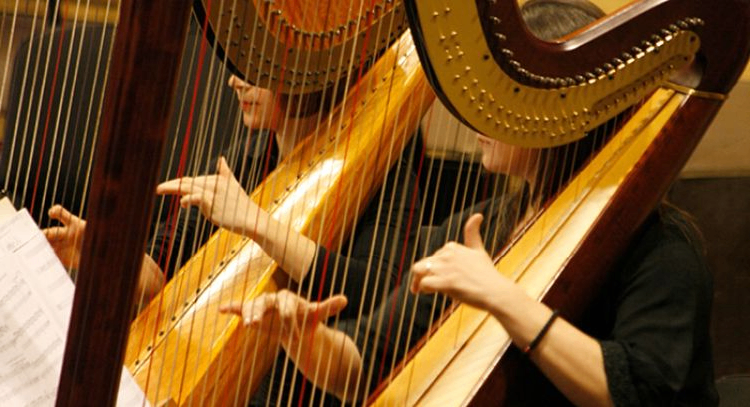
Graceful, mesmerizing, and instantly enchanting, the harp has long been associated with beauty, mystery, and emotional depth. Its shimmering strings can create delicate dreamlike textures or powerful waves of dramatic sound, making it one of the most expressive instruments in music history. Across centuries, extraordinary harp players transformed the instrument from a symbol of elegance into a breathtaking solo voice capable of commanding concert halls, jazz clubs, folk traditions, and modern recordings alike. From classical virtuosos to groundbreaking innovators, these musicians pushed the limits of technique and creativity while revealing the harp’s incredible range of emotion. Their performances continue to captivate audiences and prove why the harp remains one of the most magical instruments ever created.
1. Harpo Marx
Harpo Marx is remembered first by many as the silent, wild haired comic genius of the Marx Brothers, but his harp playing deserves serious admiration on its own. In films and stage performances, he turned the harp into a source of wonder, sudden tenderness, and unexpected musical poetry. His famous harp solos gave audiences a striking contrast to the surrounding comedy. One moment he was chasing chaos with slapstick timing, and the next he was seated at the harp, drawing out graceful melodies with surprising delicacy. Pieces such as Alone, Blue Moon, and his filmed classical inspired solos showed that he had a genuine musical touch, even if his persona was built around mischief and silence. Harpo made the harp lovable to mainstream audiences in a way few classical performers ever could. His playing was not about academic perfection. It was about charm, feeling, and cinematic magic. He made the instrument feel approachable without robbing it of beauty. For generations who discovered the harp through old Hollywood, Harpo Marx remains an unforgettable figure, proof that comedy and musicianship can live side by side in the same dazzling performer.
2. Joanna Newsom
Joanna Newsom transformed the modern image of the harp by placing it at the center of imaginative indie folk songwriting. Her song The Sprout and the Bean introduced many listeners to her unusual musical world, where intricate harp figures, literary lyrics, and a singular voice combine into something instantly recognizable. Newsom does not use the harp as decorative background. She treats it as a storytelling engine, plucking patterns that feel ancient, childlike, baroque, and wildly personal all at once. Albums such as The Milk Eyed Mender, Ys, Have One on Me, and Divers expanded her reputation as one of the most ambitious songwriters of her generation. Songs like Emily, Only Skin, Sapokanikan, and Good Intentions Paving Company reveal an artist who can make the harp sound intimate one moment and symphonic the next. Newsom gave the harp a new literary and emotional language. Her music is dense with imagery, shifting rhythms, and unusual melodic turns, yet it remains deeply human. She made the harp feel not like a relic of classical refinement, but like a living instrument for modern myths, private memories, and strange beautiful dreams.
3. Alice Coltrane
Alice Coltrane brought the harp into spiritual jazz with a depth and intensity that changed the instrument’s place in improvisational music. Her landmark piece Journey in Satchidananda remains one of the most hypnotic recordings in jazz history, built on modal grooves, meditative atmosphere, and a harp sound that feels both earthly and transcendent. Coltrane had already established herself as a pianist and composer, but her harp playing opened a new dimension in her music. The instrument gave her work a luminous, prayerful quality, weaving through bass lines, percussion, and saxophone with shimmering force. Albums such as Journey in Satchidananda, Ptah, the El Daoud, Universal Consciousness, and World Galaxy reveal her gift for blending jazz, Indian devotional influence, gospel feeling, and cosmic orchestration. Alice Coltrane made the harp sound spiritual without becoming fragile. Her playing could be delicate, but it also carried rhythmic strength and visionary purpose. She did not simply add harp to jazz. She created an entirely new sound world where the instrument became a portal into meditation, grief, healing, and ecstatic search. Her influence continues to grow across jazz, ambient music, hip hop, and experimental traditions.
4. Dorothy Ashby
Dorothy Ashby was a groundbreaking jazz harpist who proved that the harp could swing, groove, improvise, and speak fluently in modern Black music. Her album Afro Harping remains a landmark, with tracks such as Soul Vibrations, Action Line, Little Sunflower, and Afro Harping showing the instrument in a completely fresh light. At a time when the harp was often associated with orchestral elegance or salon music, Ashby placed it inside jazz, soul, funk, and rhythm rich arrangements. Her touch was clean and rhythmically alert, allowing the harp to function as both melodic lead and harmonic color. Dorothy Ashby made the harp sound cool, urban, and deeply soulful. She faced enormous barriers as a Black woman playing an instrument that many in the jazz world did not take seriously, yet she built a catalog that has only grown in stature. Her recordings have been rediscovered by producers, beat makers, jazz collectors, and younger harpists who hear in her work a fearless originality. Ashby did not simply adapt the harp to jazz. She expanded what jazz instrumentation could be, giving the harp a voice full of elegance, bite, rhythm, and imagination.
5. Yolanda Kondonassis
Yolanda Kondonassis is one of the most admired classical harpists of the modern era, known for her polished sound, technical mastery, and dedication to expanding the instrument’s repertoire. Her performance of Wildflower, a work written for her by Arturo Sandoval, shows the lyrical warmth and expressive clarity that define her artistry. Kondonassis has built a distinguished career as a soloist, recording artist, educator, and advocate for new music. Her repertoire includes works by Debussy, Ginastera, Ravel, Handel, and contemporary composers, and she has consistently presented the harp as a serious concert instrument with emotional range and intellectual depth. Her playing is graceful, precise, and full of color, never relying only on the harp’s natural beauty. She shapes phrases with purpose, draws attention to structure, and brings clarity to even the most shimmering textures. Albums such as Quietude, Air, and her environmentally inspired projects demonstrate an artist who thinks beyond display and toward meaning. Kondonassis has also influenced generations of harp students through teaching and writing. Her career represents the modern classical harp at its finest, combining elegance, discipline, advocacy, and a deep belief in the instrument’s expressive future.
6. Nicanor Zabaleta
Nicanor Zabaleta was one of the most important classical harpists of the twentieth century, a musician who helped bring the harp to major concert stages around the world. His performance of Handel’s Harp Concerto in B Flat Major reveals the elegant clarity and noble phrasing that made him a towering figure. Zabaleta had a refined tone and a deep understanding of style, allowing him to move through baroque, classical, romantic, and Spanish repertoire with authority. He did not present the harp as merely decorative or atmospheric. He treated it as a full solo instrument capable of architecture, drama, and expressive depth. His recordings of Handel, Mozart, Rodrigo, Bach transcriptions, and Spanish classics gave harp listeners a rich catalog that remains historically important. Zabaleta elevated the harp’s international reputation. His playing was tasteful, controlled, and deeply musical, marked by clarity rather than excessive sentiment. He also inspired composers and audiences to take the instrument more seriously as a concert voice. In his hands, the harp sounded aristocratic, lyrical, and strong. Zabaleta’s legacy belongs to the great classical instrumentalists who changed expectations around their instrument, making the harp not a special effect, but a commanding presence in serious music.
7. Lily Laskine
Lily Laskine was one of the great French harpists of the twentieth century, admired for her luminous tone, elegance, and role in shaping the modern French harp tradition. Her performance of Saint Saens’s Fantaisie captures the refinement that made her so beloved. Laskine played with a graceful touch, allowing melodies to unfold with natural charm while maintaining exquisite control over texture and color. She was closely associated with French repertoire, where the harp often becomes a source of perfume, light, and delicate harmonic motion. Yet her artistry was never merely decorative. She brought emotional poise and structural intelligence to works by Saint Saens, Debussy, Ravel, Fauré, Mozart, and many others. Laskine made the harp sound unmistakably French in the finest sense: elegant, transparent, lyrical, and filled with subtle nuance. Her collaborations with flutist Jean Pierre Rampal, especially in Mozart and French chamber music, became treasured examples of refined ensemble playing. She also helped inspire later generations of harpists who sought beauty without heaviness and expression without exaggeration. Lily Laskine remains one of the instrument’s great poetic voices, a performer whose sound seems to shimmer with grace, restraint, and timeless musical taste.
8. Marcel Grandjany
Marcel Grandjany was a foundational figure in modern harp history, celebrated as a performer, composer, teacher, and architect of harp technique. His influence reaches far beyond individual performances because his studies, transcriptions, and original works remain central to harp education. Pieces such as Rhapsodie, Aria in Classic Style, The Fountain, Automne, and Children’s Hour show his deep understanding of the instrument’s voice. Grandjany knew how to write music that allowed the harp to sparkle, sing, and move with natural idiomatic grace. His playing and teaching emphasized clarity, beautiful tone, and musical purpose. After training in the French tradition, he became a major influence in the United States, shaping generations of harpists through his work at institutions and through his published music. Grandjany gave harpists a language of technique and expression. He understood that the instrument’s beauty must be supported by discipline, hand position, articulation, and refined musical imagination. His legacy is especially strong because so many harp students encounter his music early and continue returning to it as they mature. Marcel Grandjany remains one of the great builders of the harp world, a musician whose artistry became a school of thought.
9. Catrin Finch
Catrin Finch is one of the most celebrated harpists of the contemporary era, known for her dazzling technique, Welsh musical identity, and adventurous collaborations across genres. Her piece 13 shows the modern breadth of her artistry, combining clarity, lyricism, and a personal compositional voice. Finch first gained wide recognition as a classical prodigy and later as royal harpist to the Prince of Wales, but her career has moved far beyond ceremonial prestige. She has performed classical repertoire, Welsh traditional music, original compositions, and cross cultural collaborations that place the harp in vibrant new settings. Her work with kora master Seckou Keita is especially acclaimed, revealing a deep musical dialogue between Welsh harp and West African string tradition. Finch makes the harp feel both rooted and borderless. She can play Debussy with refined color, then turn to folk inspired or global fusion music with rhythmic vitality and openness. Albums such as Clychau Dibon, SOAR, and her solo projects demonstrate an artist who respects tradition while constantly seeking fresh horizons. Catrin Finch has helped redefine the modern harpist as not only a classical performer, but also a collaborator, composer, cultural ambassador, and imaginative musical explorer.
10. Lavinia Meijer
Lavinia Meijer has become one of the most distinctive modern harpists through her elegant interpretations of contemporary and minimalist music. Her performance of Ólafur Arnalds’s Saman reveals her gift for intimacy, atmosphere, and emotional restraint. Meijer is especially known for bringing the music of Philip Glass to the harp, transforming pieces originally written for piano and ensemble into shimmering, hypnotic works that feel completely natural on the instrument. Her playing values space as much as sound. Every note seems carefully placed, allowed to ring, fade, and interact with silence. Meijer has helped bring the harp into the world of modern classical and ambient listening. She does not rely on romantic flourishes or traditional grand gestures. Instead, she focuses on pulse, resonance, repetition, and subtle emotional accumulation. Her albums connected to Glass and other contemporary composers have introduced the harp to listeners who might not normally follow classical harp music. She also explores electronic textures, theatrical ideas, and interdisciplinary projects, giving her career a fresh and modern profile. Lavinia Meijer’s artistry proves that the harp can be meditative, architectural, cinematic, and deeply moving without ever needing to shout.
11. Brandee Younger
Brandee Younger is one of the most important harpists in contemporary jazz, soul, and improvised music, carrying forward the legacy of Dorothy Ashby and Alice Coltrane while building a powerful voice of her own. Her performances reveal a musician who understands the harp’s history but refuses to be trapped by it. Younger blends jazz harmony, spiritual feeling, groove, hip hop awareness, and lush melodic phrasing into a sound that feels both classic and current. Her Tiny Desk performance introduced many listeners to her warm stage presence and the rich ensemble language surrounding her harp. Albums such as Soul Awakening, Somewhere Different, and Brand New Life show her deep connection to the Black harp tradition while also expanding it into new territory. Younger makes the harp sound alive inside modern rhythm. She can create clouds of resonance, lock into a groove, or deliver lyrical improvisation with emotional honesty. Her collaborations across jazz, soul, and popular music have broadened the instrument’s reach. Brandee Younger stands as a vital modern figure because she honors the harp’s pioneers while proving that its next chapters can be bold, soulful, and culturally resonant.
12. Alan Stivell
Alan Stivell is one of the most influential Celtic harp players of all time, a musician whose work helped revive interest in Breton and Celtic musical traditions on an international scale. His piece Ys, from Renaissance of the Celtic Harp, is a landmark recording, filled with mythic atmosphere, modal beauty, and a sense of ancient music being awakened for modern ears. Stivell did not approach the harp merely as a historical artifact. He treated it as a living cultural voice, capable of carrying memory, identity, and innovation at once. His music blends Breton tradition, Celtic folk, progressive textures, and sometimes rock energy, giving the harp a broader stage than it had previously occupied in popular folk culture. Stivell helped make the Celtic harp a symbol of revival and imagination. Songs and pieces such as Tri Martolod, Brian Boru, Gaeltacht, and Ys connect listeners to landscapes of legend, sea, language, and cultural pride. His influence can be heard throughout modern Celtic music. Alan Stivell made the harp sound ancient and revolutionary at the same time, proving that tradition can be a source of creative fire.
13. Mary Lattimore
Mary Lattimore is one of the most distinctive experimental and ambient harpists of the contemporary music world, known for creating spacious soundscapes that feel cinematic, personal, and quietly luminous. Her piece Wawa by the Ocean is a beautiful example of her style, using harp patterns, looping, and atmosphere to build a landscape of memory and motion. Lattimore’s music often feels less like a conventional song and more like a place the listener can enter. She draws from classical training, indie music, ambient texture, improvisation, and subtle electronic processing, allowing the harp to shimmer in unexpected ways. Albums such as At the Dam, Hundreds of Days, Silver Ladders, and Goodbye, Hotel Arkada have made her a favorite among listeners who love instrumental music with emotional depth and open space. Lattimore gives the harp a modern dream language. Her playing is not about virtuoso display in the traditional sense, though her command is clear. It is about mood, resonance, patience, and the mysterious way repeated figures can gather feeling. Mary Lattimore has helped bring the harp into indie, ambient, and experimental spaces with rare sensitivity and imagination.
14. Zeena Parkins
Zeena Parkins is one of the most important experimental harpists of the modern era, renowned for expanding the instrument through electric harp, extended techniques, improvisation, electronics, and avant garde composition. Her performances often challenge expectations of what a harp should sound like. Instead of only shimmering arpeggios and graceful glissandos, Parkins explores buzzes, attacks, preparations, loops, distortion, and unexpected textures. She has worked across downtown New York experimental music, contemporary composition, dance, film, and improvisational scenes, collaborating with artists who value risk and invention. Parkins turned the harp into a laboratory of sound. Her music asks listeners to hear the instrument not as a fixed symbol of beauty, but as a flexible machine for rhythm, noise, melody, and architecture. Albums and projects such as Nightmare Alley, Isabelle, and her many collaborations show a creative mind constantly reimagining the instrument’s physical and sonic limits. For traditional listeners, her work can be startling. For experimental audiences, it is essential. Zeena Parkins matters because she expanded the harp’s future, proving that an ancient instrument can still behave like an invention waiting to be discovered.
15. Nancy Allen
Nancy Allen is one of the most respected orchestral and classical harpists in the United States, long admired for her refined tone, musical authority, and distinguished role as principal harp of the New York Philharmonic. Her performance of Debussy’s Arabesque No. 1 highlights the elegance and transparency that make her playing so compelling. Debussy’s music suits the harp beautifully because it depends on color, atmosphere, and flowing harmonic motion, and Allen brings those qualities forward with clarity and taste. Her sound is polished without being cold, delicate without being weak, and expressive without losing control. Allen represents the highest level of orchestral harp artistry. In a major symphony orchestra, the harpist must shift between subtle color, exposed solo moments, rhythmic precision, and lush accompaniment, often within highly complex textures. Allen has done this with remarkable consistency across decades. Beyond performance, she has influenced younger harpists through teaching and masterclasses, shaping the standards of professional playing. Her artistry reminds listeners that the harp’s magic is not only found in showpieces. It also lives in refinement, discipline, and the ability to illuminate a musical texture with one perfectly placed sound.

Edward Tomlin is a frequent contributor to Singers Room. Since 2005, Singersroom has been the voice of R&B around the world. Connect with us via social media below.