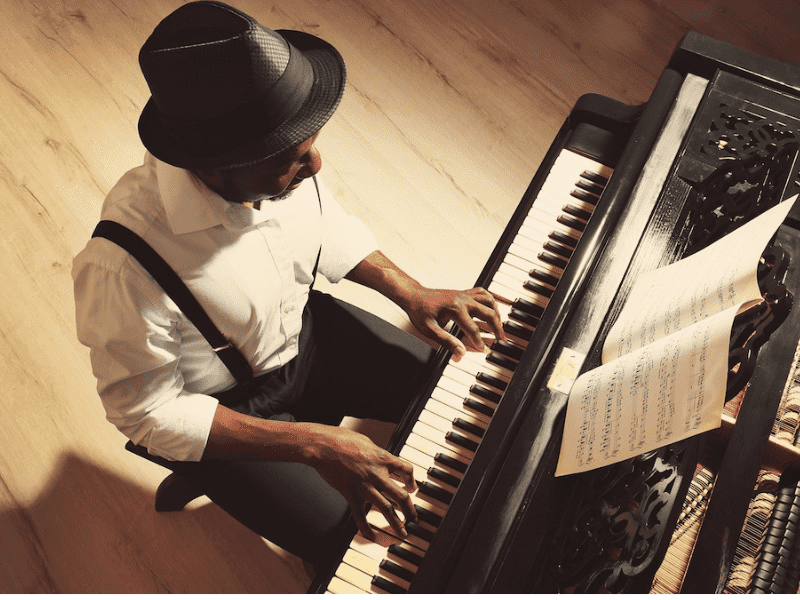
From grand concert halls to smoky jazz lounges and sold out rock arenas, the piano has remained one of the most powerful instruments in modern music. Its rich sound can deliver elegance, heartbreak, joy, and explosive energy all within a single performance. The greatest piano players of all time did far more than master technique. They transformed genres, inspired generations of musicians, and created timeless songs that continue to captivate listeners around the world. Whether through dazzling classical compositions, soulful ballads, fiery jazz improvisations, or unforgettable pop melodies, these legendary artists turned eighty eight keys into a limitless form of musical expression that still resonates today.
1. Elton John
Elton John stands among the most beloved piano players in popular music because he turned the instrument into a vessel for theater, tenderness, and arena sized emotion. Born Reginald Dwight, he developed a style rooted in gospel, rock and roll, classical training, and grand pop showmanship. His partnership with lyricist Bernie Taupin produced some of the most enduring songs of the modern era, including Your Song, Rocket Man, Tiny Dancer, Goodbye Yellow Brick Road, Levon, and Candle in the Wind. What makes Elton remarkable is how instantly recognizable his piano voice is. He can open a song with gentle, conversational chords, then build toward a chorus that feels massive without losing intimacy.
Your Song remains one of his defining achievements because it captures the beauty of simplicity. The piano does not overpower the lyric. It frames it, giving every phrase a warm emotional glow. In later classics like Bennie and the Jets and Philadelphia Freedom, Elton brought funk, soul, and theatrical flair into pop songwriting, proving that the piano could groove as powerfully as a guitar driven band. His best music feels personal yet universal, polished yet deeply human. Elton John did not merely play piano on hit records. He made the piano the emotional center of global pop culture.
2. Billy Joel
Billy Joel earned the nickname Piano Man because few artists have so completely built their identity around the instrument. His playing carries the storytelling warmth of a barroom performer, the sophistication of a classically aware songwriter, and the punch of a rock musician who knows how to command a stage. Born in the Bronx and raised on Long Island, Joel turned everyday characters, city memories, romantic regrets, and working class scenes into songs that felt cinematic. His greatest works include Piano Man, New York State of Mind, Just the Way You Are, Scenes from an Italian Restaurant, Only the Good Die Young, Vienna, and Uptown Girl.
Piano Man remains his signature because it sounds like a whole world gathered around one instrument. The melody has the pull of a singalong, but the lyric is full of finely observed loneliness, humor, and longing. Joel’s piano part gives the song its heartbeat, moving with the ease of someone who understands both showmanship and emotional restraint. On New York State of Mind, he leans into jazz colored elegance, while Scenes from an Italian Restaurant reveals his gift for shifting moods and tempos without losing narrative focus. Billy Joel made piano based songwriting feel conversational, dramatic, and deeply American, creating a catalog that continues to resonate across generations.
3. Stevie Wonder
Stevie Wonder is one of the most extraordinary keyboard artists in music history, not only because of his technical command, but because of the joy, rhythm, and harmonic imagination he brought to every performance. A child prodigy signed to Motown, Wonder grew into a visionary songwriter, singer, producer, and multi instrumentalist whose piano and keyboard work helped reshape soul, funk, pop, and rhythm and blues. His essential songs include Superstition, Sir Duke, Isn’t She Lovely, Living for the City, You Are the Sunshine of My Life, Higher Ground, and Overjoyed.
Although Superstition is famous for its clavinet groove, it reflects the same keyboard genius that made Wonder such a towering pianist. His left hand could lock into funk with astonishing precision, while his right hand decorated the harmony with flashes of gospel, jazz, and pop color. On ballads like Overjoyed and Lately, his keyboard touch becomes tender and luminous, supporting melodies that feel both effortless and spiritually rich. Wonder’s music often sounds spontaneous, but beneath that ease is a deep understanding of chord movement and emotional pacing. Stevie Wonder expanded what a keyboard player could be in popular music. He made the instrument dance, preach, smile, grieve, and celebrate, sometimes all within the same song.
4. Ray Charles
Ray Charles changed the language of popular music by bringing gospel fire, blues feeling, jazz sophistication, and rhythm and blues power to the piano. Known as The Genius, Charles had a touch that could be elegant one moment and fiercely percussive the next. His playing was never just accompaniment. It was a conversation with his voice, a rhythmic engine, and a spiritual force. His most famous songs include Hit the Road Jack, What’d I Say, Georgia on My Mind, I Got a Woman, Unchain My Heart, and Hallelujah I Love Her So.
Hit the Road Jack captures Charles at his most commanding. The piano and rhythm section move with irresistible snap, while his vocal delivery carries humor, authority, and swagger. Yet his greatness becomes even clearer in Georgia on My Mind, where he uses restraint and phrasing to turn a familiar melody into something sacred. Charles understood space. He knew when to strike a chord sharply, when to let it linger, and when to let silence intensify the emotion. His piano style influenced generations of soul singers, rock performers, jazz musicians, and blues artists. Ray Charles did not simply blend genres. He made those boundaries feel unnecessary, proving that the piano could carry the full weight of American feeling.
5. Jerry Lee Lewis
Jerry Lee Lewis turned the piano into a weapon of pure rock and roll excitement. Nicknamed The Killer, he brought a wild, physical, almost reckless energy to the instrument, pounding the keys with a mixture of country rhythm, boogie woogie drive, blues grit, and gospel heat. In an era when the electric guitar was becoming the visual symbol of rock rebellion, Lewis proved that a piano could be just as explosive. His best known recordings include Great Balls of Fire, Whole Lotta Shakin’ Goin’ On, Breathless, High School Confidential, and What Made Milwaukee Famous.
Great Balls of Fire remains his most famous performance because it captures everything dangerous and thrilling about early rock and roll. The piano does not politely support the song. It attacks it, drives it, and practically dares the listener to sit still. Lewis’s right hand throws out bright, ringing figures while his left hand hammers the rhythm with relentless force. His voice, full of mischief and heat, matches the intensity of the playing. Even when he later moved deeper into country music, his piano style retained that unmistakable fire. Jerry Lee Lewis made the piano feel untamed. His performances were bold, theatrical, and sometimes chaotic, but they helped define the raw spirit of rock and roll itself.
6. Little Richard
Little Richard was one of the foundational architects of rock and roll, and his piano playing was central to the storm he created. Born Richard Penniman, he fused gospel shouting, rhythm and blues intensity, boogie woogie piano, and flamboyant showmanship into a sound that felt revolutionary. His greatest songs include Tutti Frutti, Long Tall Sally, Good Golly Miss Molly, Lucille, Rip It Up, and Keep A Knockin’. Each one seemed to burst out of the speakers with unstoppable force.
Tutti Frutti remains one of the great opening blasts in rock history. The piano pounds with a driving rhythmic insistence, pushing the band forward while Richard’s voice erupts above it with gospel fueled abandon. His playing was not built around delicate complexity. It was about propulsion, excitement, and release. He understood that the piano could be a rhythm instrument as much as a harmonic one, and he used it to create a thrilling foundation for his explosive vocals. The influence is enormous. The Beatles, The Rolling Stones, Prince, Elton John, and countless others drew from his style, spirit, and fearless performance energy. Little Richard made the piano shout. He turned it into a platform for liberation, style, and joyous musical rebellion.
7. Fats Domino
Fats Domino brought warmth, bounce, and New Orleans charm to the piano, helping shape the sound of early rock and roll with an easygoing brilliance that remains instantly lovable. His rolling left hand, bright chord patterns, and relaxed vocal delivery created a style that felt both deeply rooted and widely accessible. Domino was not as wild as Jerry Lee Lewis or as explosive as Little Richard, but his influence was just as important. His biggest songs include Ain’t That a Shame, Blueberry Hill, I’m Walkin’, Blue Monday, Walking to New Orleans, and Whole Lotta Loving.
Ain’t That a Shame showcases the irresistible balance of his music. The piano rolls forward with a gentle swing, the melody is simple but unforgettable, and Domino’s voice carries a friendly sadness that makes heartbreak sound almost comforting. His playing drew heavily from New Orleans rhythm and blues, where groove mattered as much as flash. He had a remarkable gift for making sophisticated rhythmic feel sound natural. Blueberry Hill became one of his signature songs because it paired nostalgia with a soft, swaying piano style that welcomed listeners in. Fats Domino made piano based rock and roll feel generous, melodic, and deeply human. His music helped bring New Orleans rhythm to the world.
8. Duke Ellington
Duke Ellington was more than a pianist. He was one of the greatest composers, bandleaders, and musical thinkers of the twentieth century. Still, his piano playing was essential to his artistic identity. Ellington used the instrument with elegance, wit, and architectural intelligence, often placing perfectly chosen chords and phrases inside the larger sound of his orchestra. His major works and songs include Take the A Train, In a Sentimental Mood, Mood Indigo, Sophisticated Lady, It Don’t Mean a Thing, Caravan, and Solitude.
Take the A Train, closely associated with the Ellington orchestra, represents the polish and swing of his musical world. The piece moves with urban elegance, capturing the energy of Harlem and the sophistication of big band jazz. As a pianist, Ellington did not need to dominate every measure. His greatness came from taste, color, and placement. He knew how to use the piano as a composer’s tool, shaping harmonies that allowed horns, reeds, and rhythm to glow. On ballads like In a Sentimental Mood, his harmonic imagination becomes especially clear, offering shades of longing and refinement that never feel sentimental in a cheap way. Duke Ellington elevated the piano into a painter’s palette, using it to design some of the richest soundscapes in American music.
9. Thelonious Monk
Thelonious Monk remains one of the most distinctive piano players in jazz history because no one sounded quite like him. His style was angular, spacious, humorous, mysterious, and deeply personal. At first listen, Monk could seem strange or even awkward to those expecting smooth virtuosity. Yet every note had purpose. His rhythms leaned and lurched in surprising ways, his chords carried sharp edges, and his melodies had a quirky inevitability that made them unforgettable. His most famous compositions include Round Midnight, Blue Monk, Straight No Chaser, Well You Needn’t, Ruby My Dear, and Epistrophy.
Round Midnight is perhaps his most celebrated piece, a ballad of haunting beauty and shadowed elegance. The melody unfolds like a private thought, full of unusual turns that reveal deeper emotion with each listen. Monk’s piano approach was never about filling space for the sake of display. He used silence as powerfully as sound. A single chord could feel like a question, a joke, or a revelation. His influence on modern jazz is immeasurable because he opened the door to a more individual kind of expression. Thelonious Monk proved that originality could be more powerful than conventional polish. His piano playing remains a reminder that genius often arrives with its own accent, its own rhythm, and its own rules.
10. Herbie Hancock
Herbie Hancock is one of the most versatile and forward thinking piano and keyboard players of all time. He emerged as a brilliant young jazz pianist, became a key member of Miles Davis’s great second quintet, then went on to reshape jazz fusion, funk, electronic music, and popular instrumental music. His catalog includes Watermelon Man, Cantaloupe Island, Chameleon, Maiden Voyage, Actual Proof, Rockit, and Dolphin Dance. Few musicians have moved across styles with such intelligence and imagination.
Chameleon is one of Hancock’s most recognizable pieces, driven by a deep funk groove that made jazz feel futuristic and streetwise at the same time. His keyboard work on the track is rhythmically infectious, harmonically sharp, and full of playful invention. Earlier pieces like Maiden Voyage reveal a more lyrical side, where spacious chords create a floating, oceanic atmosphere. Hancock’s genius lies in his openness. He could honor acoustic jazz tradition, explore electric textures, embrace synthesizers, and still sound unmistakably like himself. His playing balances intellect and groove, precision and curiosity. Herbie Hancock expanded the vocabulary of the piano and keyboard, showing that a great player can evolve constantly without losing artistic identity.
11. Oscar Peterson
Oscar Peterson is widely regarded as one of the most technically dazzling jazz pianists of all time. His playing combined breathtaking speed, blues feeling, swing, harmonic sophistication, and a clean, powerful touch that made even the most difficult passages sound effortless. Born in Montreal, Peterson became an international giant through recordings, concerts, and collaborations with many of jazz’s greatest names. His best known performances include interpretations of Hymn to Freedom, C Jam Blues, Night Train, Tenderly, Georgia on My Mind, and Sweet Georgia Brown.
Hymn to Freedom is especially important because it reveals the soul beneath Peterson’s virtuosity. The piece carries a gospel like dignity, moving with grace and quiet strength. While Peterson could astonish listeners with fast runs and complex improvisations, he was never merely showing off. His phrasing had warmth, and his sense of swing was magnificent. In trio settings, he created a full orchestral effect at the keyboard, using rich chords, fleet melodic lines, and a commanding left hand. His recordings remain essential studies in jazz piano mastery. Oscar Peterson represented excellence at the highest level. He made the piano sparkle, thunder, sing, and swing with a fluency that continues to inspire serious musicians around the world.
12. Glenn Gould
Glenn Gould became one of the most famous classical pianists of the twentieth century through a combination of extraordinary technique, intense individuality, and a deeply analytical musical mind. Best known for his interpretations of Johann Sebastian Bach, Gould approached the piano not as a romantic showpiece, but as an instrument of clarity, structure, and intellectual drama. His most celebrated recordings include Bach’s Goldberg Variations, Well Tempered Clavier, and various keyboard concertos, along with notable performances of Beethoven, Brahms, and Schoenberg.
The Goldberg Variations became Gould’s signature because his performance made Bach feel alive in a startlingly modern way. His articulation was crisp, his tempos often surprising, and his sense of counterpoint almost architectural. Every voice in the music seemed to speak with independent purpose. Gould’s playing could be controversial because he rejected many traditional romantic expectations. He favored precision, inward intensity, and structural insight over grand public theatrics. Yet that very independence made him unforgettable. His recordings invite repeated listening because they reveal layers of intelligence and imagination with each return. Glenn Gould transformed the role of the classical pianist into something deeply personal and investigative. He made the piano a laboratory of thought, beauty, and disciplined wonder.
13. Vladimir Horowitz
Vladimir Horowitz was one of the most legendary classical pianists ever to sit at the keyboard, known for his electrifying power, dazzling technique, and almost supernatural command of color. Born in Kyiv, he became a global concert phenomenon, captivating audiences with performances that could shift from whispering delicacy to volcanic intensity within a single phrase. His repertoire included works by Chopin, Liszt, Rachmaninoff, Scriabin, Schumann, and Scarlatti, along with famous showpieces that highlighted his astonishing control.
Horowitz’s performances of Liszt and Rachmaninoff are often remembered for their dramatic force, but his artistry was not only about speed or volume. He had an extraordinary ability to make the piano sound orchestral, producing layers of tone that seemed larger than the instrument itself. In lyrical passages, his touch could be fragile and intimate. In climactic moments, it could feel overwhelming. His interpretations often carried a sense of danger, as if the music were being created in the instant rather than merely reproduced. This unpredictability became part of his mystique. Vladimir Horowitz embodied the idea of the piano virtuoso as a dramatic storyteller. His recordings and performances remain monuments to technical brilliance, emotional intensity, and the thrilling power of classical performance.
14. Alicia Keys
Alicia Keys brought classical piano training, soul tradition, rhythm and blues songwriting, and contemporary pop sensibility into a powerful modern blend. From the moment she emerged with Fallin’, it was clear that the piano was not an accessory in her music. It was the foundation of her identity. Her major songs include Fallin’, If I Ain’t Got You, No One, Diary, Unthinkable, A Woman’s Worth, and Empire State of Mind Part II. She helped reintroduce piano centered soul to a mainstream audience at a time when much popular music was becoming increasingly digital.
Fallin’ remains one of her defining songs because it combines gospel weight, classical discipline, and raw emotional directness. The piano figure is simple but memorable, creating a dramatic frame for a vocal performance full of conflict and longing. On If I Ain’t Got You, Keys delivers one of the great modern piano ballads, using elegant chords and a sweeping melody to express devotion without excess decoration. Her best work often feels both polished and personal, rooted in tradition but clearly contemporary. Alicia Keys made the piano feel vital for a new generation of soul and pop listeners. Her artistry proves that emotional sincerity and musicianship can still command the center of popular music.
15. Liberace
Liberace was one of the most famous piano entertainers of all time, a performer who turned classical technique, popular melody, comedy, glamour, and showmanship into a dazzling public persona. Born Władziu Valentino Liberace, he became a household name through television, recordings, concerts, and Las Vegas performances. While critics sometimes focused on his extravagance, his success came from a real ability to connect with audiences. He made the piano feel approachable, theatrical, and spectacular. His repertoire included romantic standards, classical adaptations, film themes, popular songs, and crowd pleasing medleys.
A performance such as Chopsticks or one of his lavish interpretations of romantic standards shows how Liberace could transform familiar material into entertainment. He understood pacing, visual drama, and audience psychology. His playing was often ornamented with flourishes, sparkling runs, and sentimental phrasing, but the larger achievement was his ability to make listeners feel invited into the performance. He blurred the line between concert pianist and show business icon. In doing so, he helped expand the public image of what a piano player could be. Liberace made the piano glamorous. He turned recitals into spectacles, brought keyboard music into living rooms across America, and proved that popularity, personality, and musicianship could combine into a uniquely enduring legacy.

Edward Tomlin is a frequent contributor to Singers Room. Since 2005, Singersroom has been the voice of R&B around the world. Connect with us via social media below.