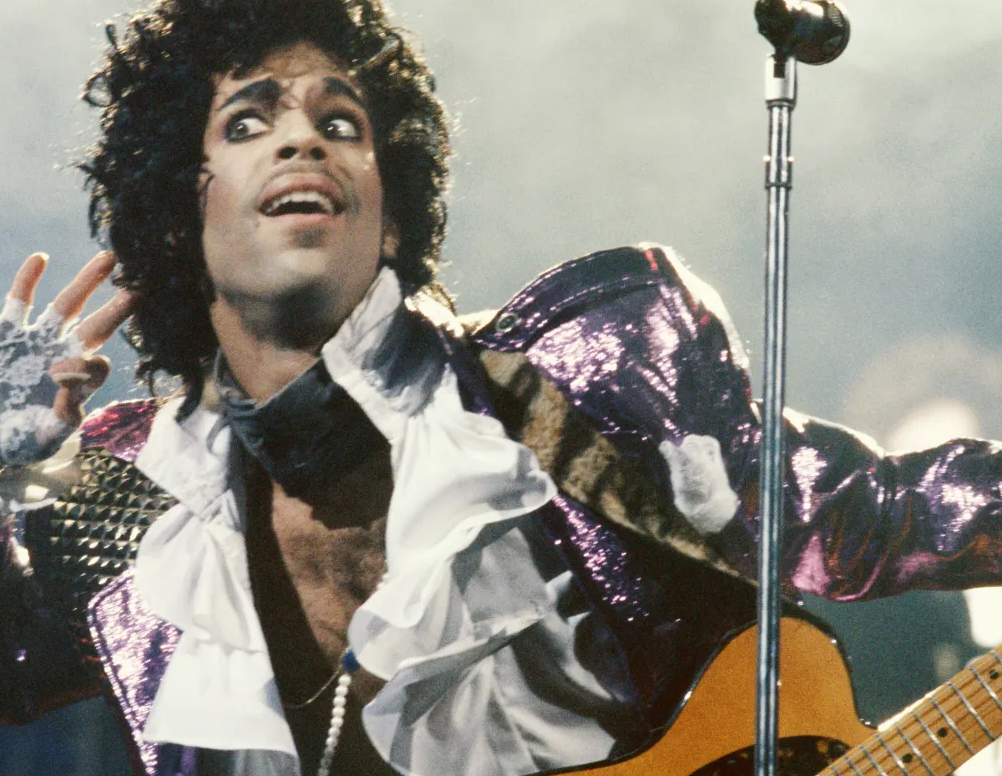
Electric, enigmatic, and endlessly inventive, Prince reshaped popular music with a style that refused to sit still. Blending funk, rock, pop, and soul into something unmistakably his own, he turned every song into a statement of identity, desire, and artistic freedom. His music could be seductive one moment, spiritual the next, always driven by fearless creativity and masterful musicianship. From explosive anthems to intimate ballads, his catalog pulses with originality and emotion. This collection explores the songs that defined his legacy, capturing the sound of an artist who didn’t just follow trends—he created his own universe.
1. Purple Rain
Purple Rain is Prince at his most majestic, vulnerable, and spiritually overwhelming. The song feels less like a standard rock ballad and more like a ceremony, slowly gathering emotional force until it becomes almost impossible to separate music from catharsis. Its opening chords carry a churchlike stillness, while Prince’s vocal enters with aching restraint. He does not rush the feeling. He lets every phrase hang in the air, as if each line is being offered rather than performed.
The genius of Purple Rain is its ability to feel deeply personal and enormous at the same time. It is a song of regret, forgiveness, longing, and release, all wrapped in a glow that seems to belong to no single genre. The arrangement draws from rock, gospel, soul, and arena grandeur, yet the final shape is unmistakably Prince. His guitar solo is not merely decorative. It becomes the emotional voice of the song, rising where words can no longer carry the weight.
What makes the recording endure is the sense that Prince is reaching beyond romance into something more mysterious. The purple rain itself feels symbolic, a vision of healing, sorrow, and transformation. The Revolution’s presence gives the track depth and atmosphere, allowing it to build with patience and grace. Purple Rain remains one of Prince’s most beloved songs because it creates a world where heartbreak becomes beautiful, grief becomes communal, and a guitar can sound like a soul leaving the body.
2. When Doves Cry
When Doves Cry is one of Prince’s boldest and most psychologically charged masterpieces. What immediately sets the song apart is what it refuses to do. In a decade filled with lush pop production and heavy bass lines, Prince removed the bass entirely, leaving behind a stark, nervous, almost skeletal groove. That absence gives the track its haunting tension. The music feels exposed, as if the emotional conflict in the lyric has stripped the arrangement down to bone.
Prince’s vocal performance is extraordinary because it contains several emotional states at once. He sounds wounded, seductive, angry, confused, and strangely calm. The song is not simply about romantic conflict. It is about inherited patterns, family wounds, desire, pride, and the terrifying intimacy of seeing yourself reflected in someone else. Few pop songs have ever made relationship turmoil feel this interior and cinematic.
The guitar opening cuts like a flash of lightning, then the track settles into that drum machine pulse, cold yet sensual. The keyboard textures add color without softening the unease. Prince’s voice moves between confession and accusation, giving every line a dramatic charge. Even the title image is unforgettable: doves, symbols of peace and love, crying in a space where tenderness has become pain.
When Doves Cry remains popular because it sounds unlike anything around it. It is minimal but explosive, intimate but strange, and emotionally direct while still mysterious. Prince turned absence into power and made pop music feel dangerously personal.
3. Kiss
Kiss is Prince at his most economical, playful, and devastatingly funky. The song is built from space as much as sound. The guitar is clipped and sharp, the rhythm snaps with dry precision, and Prince’s falsetto floats above the track with mischievous confidence. There is no excess here. Every sound feels chosen for maximum impact. The result is a record that proves funk does not need heaviness to be powerful. Sometimes all it needs is tension, timing, and a singer who understands exactly when to leave room for the body to move.
Lyrically, Kiss is flirtatious, witty, and disarmingly direct. Prince rejects status symbols, glamour, and superficial perfection in favor of chemistry. The song’s seduction lies in its confidence, not in decoration. He sounds amused by conventional standards of attraction, as though he knows desire operates by stranger and more electric rules.
The vocal performance is full of character. Prince moves from airy falsetto to teasing spoken accents, treating the song like a private joke shared on the dance floor. The arrangement’s sparseness makes every gesture more vivid. The handclaps, guitar scratches, and rhythmic stops all become part of the seduction.
Kiss remains one of Prince’s most popular songs because it is instantly recognizable and endlessly fresh. It manages to be minimalist and extravagant at once, proof that Prince could dominate pop music not only through grandeur, but through the elegant power of restraint.
4. 1999
1999 is Prince turning apocalypse into a party, and that contradiction is exactly what makes the song brilliant. Rather than respond to nuclear anxiety and end of the world dread with solemn despair, Prince answers with celebration. The opening voices create a communal feeling, as though several witnesses are stepping forward to announce the same strange philosophy: if the future is uncertain, the present must be lived with intensity. It is fatalism transformed into dance music.
The groove is bright, synthetic, and irresistible, shaped by the electronic textures that helped define Prince’s early eighties sound. The song’s genius lies in the way it treats partying not as escapism, but as defiance. Dancing becomes a refusal to be paralyzed by fear. Joy becomes resistance. Prince understood that pleasure could carry philosophical weight when placed against the shadow of catastrophe.
Vocally, the shared lead approach gives the song a democratic spirit. It does not feel like one star commanding the room so much as a whole scene erupting into motion. The keyboard lines shimmer, the rhythm programming keeps the track sleek, and the melody is immediate enough to feel timeless.
1999 remains popular because it captures a feeling that never really disappears: the awareness that the world is unstable, paired with the need to keep living anyway. Prince made that tension sound glamorous, urgent, and unforgettable. It is one of pop’s great invitations to dance at the edge of uncertainty.
5. Little Red Corvette
Little Red Corvette is one of Prince’s great crossover triumphs, a song that blends rock polish, pop melody, and erotic metaphor with astonishing elegance. At first listen, it feels sleek and accessible, carried by a smooth tempo and a chorus that opens beautifully. But beneath the surface is a complex emotional story about desire, danger, vulnerability, and self preservation. Prince uses the image of the Corvette as both attraction and warning, turning a car into a symbol of speed, beauty, risk, and emotional unavailability.
The vocal is one of his finest early performances. He sings with tenderness and caution, sounding fascinated by the woman at the center of the song but also aware that the encounter carries consequences. What makes Little Red Corvette so compelling is that it treats seduction as both thrilling and bruising. Prince does not merely celebrate desire. He studies it.
The arrangement is immaculate. The drum machine gives the song a clean pulse, while the guitar textures add rock atmosphere without overwhelming the melody. The chorus is expansive, but the verses retain an intimate, almost confessional mood. That balance helped the song reach listeners across musical boundaries.
Little Red Corvette remains popular because it shows Prince mastering ambiguity. It is sensual without being simple, catchy without being shallow, and stylish without losing emotional depth. The song announced that Prince could build pop hits as sophisticated as short stories, full of implication, mood, and unforgettable imagery.
6. Let’s Go Crazy
Let’s Go Crazy begins like a sermon and erupts into one of Prince’s most exhilarating rock statements. The spoken introduction immediately establishes the song’s strange and powerful mixture of spirituality, humor, and rebellion. Prince addresses life, death, temptation, and survival before the band detonates into motion. Once the music kicks in, the track becomes pure adrenaline, driven by guitar, drums, synthesizer, and a vocal performance that sounds like joy racing against mortality.
The brilliance of Let’s Go Crazy is that it turns existential pressure into celebration. Prince does not deny darkness. He tells the listener to dance through it, resist it, laugh at it, and refuse to be spiritually crushed. The song’s famous references to elevators and the afterworld give it a symbolic charge that runs deeper than ordinary party rock. The party here is not empty pleasure. It is a declaration of life.
Musically, the track is a showcase for Prince’s command of rock energy. The guitar work is fierce, the arrangement is tight, and the final soloing carries a sense of ecstatic release. The Revolution gives the song its communal punch, but Prince’s presence is electric from start to finish.
Let’s Go Crazy remains beloved because it feels like an opening door, a command, and a celebration all at once. It is one of his clearest examples of how funk, rock, gospel urgency, and pop spectacle could merge into something uniquely his.
7. Raspberry Beret
Raspberry Beret is Prince in one of his most colorful and melodic moods, a song that turns youthful romance into a miniature pop painting. The arrangement is bright, quirky, and full of psychedelic charm, with strings and guitar textures creating a sense of playful nostalgia. Unlike the darker sensuality of some of his other classics, this song feels breezy and storybook like, yet it still carries Prince’s unmistakable wit and sensual undercurrent.
The lyric begins with ordinary workday boredom and quickly opens into fantasy, memory, and desire. The woman in the raspberry beret becomes less a conventional love interest than a flash of color in a dull world. Prince makes attraction feel like sudden weather, a strange burst of style and possibility that changes the emotional temperature of everything around it. His vocal is relaxed, amused, and affectionate, giving the story a conversational warmth.
Musically, the song shows his gift for pop construction. The chorus is instantly memorable, but the details around it are what make the track special. The arrangement feels handmade, full of personality and unexpected color. It belongs to the more psychedelic side of his catalog, but it never drifts away from accessibility.
Raspberry Beret remains popular because it captures Prince’s ability to make pop music feel both light and distinctive. It is charming, odd, romantic, and beautifully arranged. Few songs turn a single image into such a vivid world, and fewer still do it with this much grace.
8. Sign O’ The Times
Sign O’ The Times is Prince at his most observant and unsparing, a song that strips away glamour to confront the anxieties of its era with chilling clarity. The arrangement is spare, almost skeletal, built around a lean beat, dry guitar, and a vocal that delivers disaster with unsettling calm. Instead of overwhelming the listener with production, Prince leaves space around the words, allowing each image to land with documentary force.
The song moves through social crisis, disease, violence, addiction, poverty, and spiritual confusion without becoming a speech. Its power comes from Prince’s refusal to dramatize what is already dramatic. He sings like a witness, not a preacher. That restraint makes the track even more haunting. The groove is minimal but gripping, giving the song a pulse that feels both streetwise and exhausted.
What separates Sign O’ The Times from many topical songs is its precision. Prince does not flatten the world into slogans. He offers fragments, scenes, warnings, and questions. The result is a portrait of modern life that feels fractured by design. His voice remains controlled throughout, which makes the moments of emotional implication even sharper.
The song remains one of his most respected works because it proves how much he could do with very little. No grand chorus is needed. No ornate solo is required. Prince lets rhythm, language, and atmosphere carry the weight. Sign O’ The Times is stark, brilliant, and still unnervingly relevant.
9. I Would Die 4 U
I Would Die 4 U is one of Prince’s most fascinating blends of devotion, spirituality, and dance floor momentum. On the surface, it can sound like a bright synth pop declaration of love, but the deeper one listens, the more mysterious it becomes. The lyric moves beyond ordinary romance into something messianic and symbolic, with Prince presenting love as sacrifice, transcendence, and identity. He sings with an almost weightless intensity, letting the track’s speed and shimmer carry the feeling forward.
The production is sleek and propulsive, powered by drum machine precision and bright keyboard textures. The song’s brilliance lies in how it makes spiritual surrender feel danceable. Prince often blurred the boundaries between sacred and sensual, and this track is one of his most compact examples of that fusion. The melody is immediate, the rhythm is irresistible, yet the meaning remains open and strange.
His vocal performance is controlled and luminous. He does not sing the title as melodrama. He delivers it with certainty, as though sacrifice is not a tragic gesture but a natural expression of higher love. That calm conviction gives the song a unique emotional charge.
I Would Die 4 U remains popular because it functions on multiple levels. It can be heard as a pop hit, a spiritual statement, a romantic vow, or a piece of Prince mythology. Few artists could make something so concise feel so layered. It is bright, urgent, enigmatic, and completely alive.
10. Cream
Cream is Prince at his most self assured, flirtatious, and sharply styled. The song rides a slinky glam funk groove that feels both retro and distinctly early nineties, with Prince using swagger as a musical instrument. It is playful, teasing, and full of self invention. Rather than hiding behind metaphorical distance, he steps into the spotlight with complete confidence, turning desire, charm, and performance into one continuous motion.
The track’s appeal lies in its effortless cool. The guitar line has a polished strut, the rhythm section moves with supple control, and Prince’s vocal sits perfectly between seduction and mischief. He makes confidence sound like choreography. Every phrase feels posed, but never stiff. The song understands the art of display, the pleasure of being seen, and the humor required to keep sensuality from becoming heavy handed.
What makes Cream more than a simple flirtation is Prince’s command of style. He draws from funk, rock, soul, and pop, then compresses everything into a sleek radio ready form. The song is catchy, but its personality is what keeps it alive. It sounds like an artist fully aware of his powers and amused by how easily he can use them.
Cream remains one of Prince’s most popular later hits because it captures him in a mode of dazzling ease. It is sensual, witty, and musically polished, proof that even after redefining the eighties, Prince could enter a new decade with his charisma fully intact.

Samuel Moore is a frequent contributor to Singers Room. Since 2005, Singersroom has been the voice of R&B around the world. Connect with us via social media below.