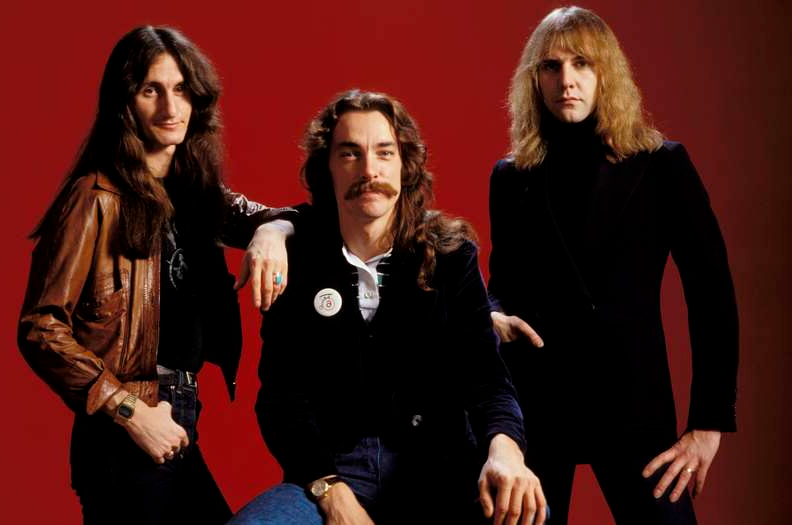
Precision, power, and poetic ambition define the legacy of Rush, a trio that turned progressive rock into an intellectual and sonic adventure. Blending intricate musicianship with thought-provoking lyrics, their songs move effortlessly between hard-driving riffs and expansive storytelling. From philosophical epics to radio-friendly anthems, Rush crafted a catalog that rewards both casual listening and deep exploration. This collection dives into the band’s most celebrated tracks, highlighting the songs that captured their fearless creativity and cemented their place among rock’s most innovative and enduring acts.
1. Tom Sawyer
Tom Sawyer is the song that most perfectly captures Rush as both a technical marvel and a mainstream rock force. From the first sweep of synthesizer, the track announces itself with confidence, mystery, and unmistakable authority. Geddy Lee’s vocal is sharp and animated, delivering Neil Peart’s portrait of the modern individual with a mix of defiance and cool detachment. The lyrics are compact but loaded with character, presenting Tom Sawyer not simply as a rebel, but as a symbol of independence in a world eager to define him.
Musically, the song is astonishingly precise without ever feeling cold. Alex Lifeson’s guitar work is lean and textured, adding bite without overcrowding the arrangement. Geddy Lee’s bass moves with athletic intelligence, while Neil Peart’s drumming turns every transition into a dramatic event. The genius of Tom Sawyer is that its complexity feels natural. Listeners can admire the shifting meters and intricate instrumental design, or simply surrender to the force of the groove.
What makes the song endure is its balance of intellect and impact. It is progressive rock with a radio hook, philosophical but immediate, polished but muscular. Tom Sawyer remains Rush’s signature song because it condenses the band’s entire identity into one electrifying statement: fearless musicianship, restless thought, and a sound that still feels futuristic.
2. Limelight
Limelight is one of Rush’s most emotionally revealing songs, a graceful yet powerful meditation on fame, privacy, and the strange distance between performer and audience. Written from the perspective of musicians who had become deeply admired while remaining personally reserved, the song captures a tension rarely explored with this much honesty in classic rock. Neil Peart’s lyrics are thoughtful and vulnerable, examining what it means to live under public attention while still craving authenticity and solitude.
The music mirrors that emotional complexity beautifully. Alex Lifeson’s guitar tone is luminous, especially in the opening figure, which seems to shimmer with both confidence and unease. Geddy Lee sings with unusual warmth, softening the intellectual edge of the lyric and giving it a human ache. His bass lines remain fluid and inventive, but they serve the song’s emotional contour rather than drawing attention for its own sake. Neil Peart’s drumming is disciplined, expressive, and architecturally precise.
Limelight succeeds because it turns self awareness into anthem. The chorus is broad and memorable, yet the song never becomes simple celebration. It questions the very spotlight it occupies. That duality gives the track lasting depth. It can be heard as a rock classic, a confession, or a philosophical reflection on identity. In Rush’s catalog, Limelight stands as one of the clearest examples of the band’s ability to combine technical brilliance with emotional clarity.
3. The Spirit of Radio
The Spirit of Radio is Rush’s great tribute to the promise and contradiction of broadcast music. It begins with one of Alex Lifeson’s most sparkling guitar introductions, a rush of movement that sounds like signal waves bursting through the air. The opening feels joyous, almost airborne, and it immediately establishes the song as a celebration of connection. Yet beneath the brightness is a pointed critique of commercial pressure and artistic compromise, making the track both affectionate and skeptical.
Geddy Lee’s vocal carries the song with enthusiasm and agility, capturing the thrill of discovering music through the radio while also acknowledging how easily that magic can be packaged and sold. The rhythm section is dazzling. Lee’s bass is nimble and melodic, while Neil Peart’s drumming moves with both precision and lift. The song shifts through multiple textures, including a reggae touched passage that reveals Rush’s growing curiosity about rhythm and arrangement beyond traditional progressive rock forms.
What makes The Spirit of Radio so beloved is its sense of motion and idealism. It celebrates music as a living exchange between artist, listener, and moment. At the same time, it refuses to ignore the business machinery surrounding that exchange. The result is one of Rush’s most accessible yet intelligent songs, a track that can energize a crowd while quietly asking what happens when freedom becomes format.
4. Subdivisions
Subdivisions is one of Rush’s most haunting and socially perceptive songs, capturing the emotional architecture of suburban alienation with remarkable precision. The track is built around synthesizer textures that feel cold, geometric, and spacious, perfectly matching the lyric’s vision of planned neighborhoods, social pressure, and quiet adolescent exile. Neil Peart’s words cut deeply because they avoid melodrama. He does not caricature suburban life. He observes its rituals, exclusions, and invisible rules with an almost documentary eye.
Geddy Lee’s vocal is controlled and poignant, giving voice to the outsider without turning the song into simple complaint. His keyboard work dominates the atmosphere, but the band never loses its rock identity. Alex Lifeson’s guitar enters with carefully placed force, adding emotional warmth and tension to the synthetic landscape. Peart’s drumming remains exact and dynamic, guiding the song through its shifting moods with masterful restraint.
Subdivisions remains powerful because it understands conformity as both social structure and emotional weather. The famous refrain about being cool or being cast out resonates because it names a truth many listeners recognize immediately. The song speaks to anyone who has felt measured by a group they never wanted to join, or trapped in a place that promised comfort but delivered isolation.
In the Rush catalog, Subdivisions is a major achievement. It is cerebral, atmospheric, deeply human, and still painfully relevant.
5. Closer to the Heart
Closer to the Heart is one of Rush’s most concise and uplifting classics, proving that the band could compress a grand philosophical idea into a song of striking melodic clarity. Unlike some of their longer progressive works, this track moves with directness and grace. The acoustic guitar opening is instantly recognizable, carrying a gentle brightness before the full band enters with warmth and conviction. It feels inviting, almost communal, yet it never sacrifices the intelligence that defines Rush’s best music.
The lyric presents a vision of responsibility shared across society, from leaders to artists to ordinary people. Rather than preaching, the song suggests that meaningful change begins with values, imagination, and personal commitment. Geddy Lee’s vocal is earnest and clear, delivering the message with sincerity rather than theatrical grandeur. Alex Lifeson’s guitar work gives the track its delicate shimmer and later its rock energy, while Neil Peart’s drumming supplies momentum without overpowering the song’s natural elegance.
The beauty of Closer to the Heart lies in its accessibility. It is philosophical, but not abstract. It is idealistic, but not naive. Its chorus feels like an invitation to align action with conscience, which explains why it has remained such a cherished part of Rush’s live legacy.
The song endures because it captures a hopeful side of the band. It is thoughtful, melodic, and deeply human, a compact anthem with a surprisingly large emotional reach.
6. Freewill
Freewill is Rush at their most intellectually fiery, a song that turns a philosophical argument into a high velocity rock performance. The central theme is choice, not as a casual idea, but as a defining human responsibility. Neil Peart’s lyrics challenge fatalism and passive belief, insisting that the act of choosing is unavoidable even when one claims not to choose. It is a bold topic for a rock song, yet Rush handles it with urgency, wit, and musical excitement.
The arrangement is filled with tension and release. Geddy Lee sings with piercing conviction, navigating dense lyrical passages while keeping the song emotionally alive. His bass playing is remarkably agile, darting through the structure with melodic intelligence. Alex Lifeson’s guitar solo is one of his most thrilling, moving from wild abstraction into controlled fire. Neil Peart’s drumming gives the song its intellectual muscle, matching the lyric’s complexity with rhythmic precision and explosive accents.
Freewill works because it makes thought feel physical. The listener does not simply consider the idea of choice. The song makes that struggle feel urgent in the body, through tempo, rhythm, and instrumental force. It is progressive rock with philosophical teeth, but it is also a powerful and memorable performance.
The song remains popular among fans because it represents Rush’s fearless willingness to put serious ideas at the center of rock music. It is challenging, energetic, and unmistakably alive with conviction.
7. YYZ
YYZ is one of the most celebrated instrumental pieces in rock, and it shows Rush operating with astonishing unity. Without a sung lyric, the band communicates identity, motion, humor, tension, and exhilaration entirely through musicianship. The opening rhythm, inspired by the airport code for Toronto, immediately gives the track a distinctive signature. From there, Rush launches into a display of precision that never feels like empty technical exhibition. Every part has personality.
Geddy Lee’s bass work is central to the song’s character. It is aggressive, nimble, and melodic, often functioning as both rhythm and lead voice. Alex Lifeson responds with guitar lines that add color, bite, and atmospheric contrast. Neil Peart’s drumming is extraordinary, not merely because of its difficulty, but because of its compositional intelligence. He shapes the piece, giving it narrative movement without words.
The brilliance of YYZ is that it feels playful and architectural at the same time. The band moves through sections with almost impossible tightness, yet there is joy in the performance. It sounds like three musicians challenging one another and delighting in the result. The track has become a benchmark for instrumental rock because it demonstrates virtuosity with purpose.
YYZ remains popular because it distills Rush’s chemistry into pure form. It is complex, exciting, and instantly recognizable, a song that turns technical mastery into a thrilling language of its own.
8. 2112 Overture and The Temples of Syrinx
2112 Overture and The Temples of Syrinx represents Rush at their most ambitious, theatrical, and defiantly progressive. This piece is the gateway into one of the band’s most famous conceptual works, presenting a future world ruled by authoritarian control and spiritual emptiness. From the opening instrumental surge, Rush creates a sense of scale that feels almost cinematic. The music is grand, forceful, and dramatic, announcing that the listener has entered a fully imagined universe.
The overture showcases the trio’s ability to build tension through shifting riffs, changing dynamics, and tightly controlled instrumental power. Alex Lifeson’s guitar is massive and commanding, Geddy Lee’s bass drives the architecture forward, and Neil Peart’s drumming gives the piece its heroic momentum. When The Temples of Syrinx arrives, Lee’s vocal becomes fierce and theatrical, embodying the voice of oppressive authority with startling intensity.
What makes this piece so important is its sheer conviction. Rush does not treat science fiction as decoration. They use it as a framework for questions about individuality, creativity, control, and resistance. The music is unapologetically grand because the ideas are grand. For many listeners, this was the song cycle that confirmed Rush as more than a hard rock band.
Its popularity endures because it captures the thrill of artistic risk. 2112 is bold, intense, and immersive, a monument to the band’s refusal to shrink their imagination for easy approval.
9. Time Stand Still
Time Stand Still is one of Rush’s most emotionally resonant songs, a reflective meditation on aging, memory, and the ache of life moving too quickly. Unlike the band’s more fantastical or philosophical pieces, this song feels deeply personal and grounded. Neil Peart’s lyric captures a feeling that becomes sharper with time: the desire to pause ordinary moments before they disappear. It is not sentimental in a shallow sense. It is clear eyed, mature, and quietly devastating.
Geddy Lee’s vocal performance is unusually tender, allowing vulnerability to come through without losing the band’s characteristic precision. Aimee Mann’s guest vocal adds a haunting counterpoint, giving the chorus a sense of dialogue and emotional depth. The arrangement reflects Rush’s 1980s sound, with synthesizers, polished textures, and carefully shaped dynamics, but beneath the production is a song of remarkable human warmth.
Time Stand Still endures because it speaks to the listener differently at different stages of life. Younger fans may hear it as thoughtful and melodic. Older listeners often hear it as almost painfully accurate. The images of summers passing, children growing, and old friends aging are simple, but they land with profound force.
In the Rush catalog, this song reveals the band’s emotional maturity. It is not about escape into fantasy or triumph through complexity. It is about paying attention before the present becomes memory. That honesty gives it lasting power.
10. Working Man
Working Man is the sound of early Rush in its rawest and most direct form, before the band fully entered the progressive universe that would define much of its legacy. The song is heavy, blues based, and built around a riff that feels both simple and enormous. It speaks from the perspective of an ordinary laborer whose life is shaped by routine, exhaustion, and the need for release. That plainspoken quality gives the track a different kind of power from the band’s later epics.
Geddy Lee’s vocal has youthful bite, delivering the lyric with a mix of resignation and grit. Alex Lifeson’s guitar dominates the track with thick riffing and extended soloing, showing the influence of hard rock giants while already hinting at a more individual voice. The rhythm section locks into a steady drive, creating the feeling of machinery, repetition, and stubborn endurance.
Working Man became important because it connected immediately with listeners who recognized themselves in it. There is no elaborate mythology, no grand philosophical system, no futuristic setting. There is just the daily grind and the desire to get through it. That directness helped introduce Rush to a wider audience and gave the band one of its earliest defining songs.
The track remains popular because it captures a foundational truth about Rush: even before the complex arrangements and conceptual ambition, they understood force, identity, and the emotional charge of a great riff. Working Man still sounds rugged, honest, and built to last.

Samuel Moore is a frequent contributor to Singers Room. Since 2005, Singersroom has been the voice of R&B around the world. Connect with us via social media below.