
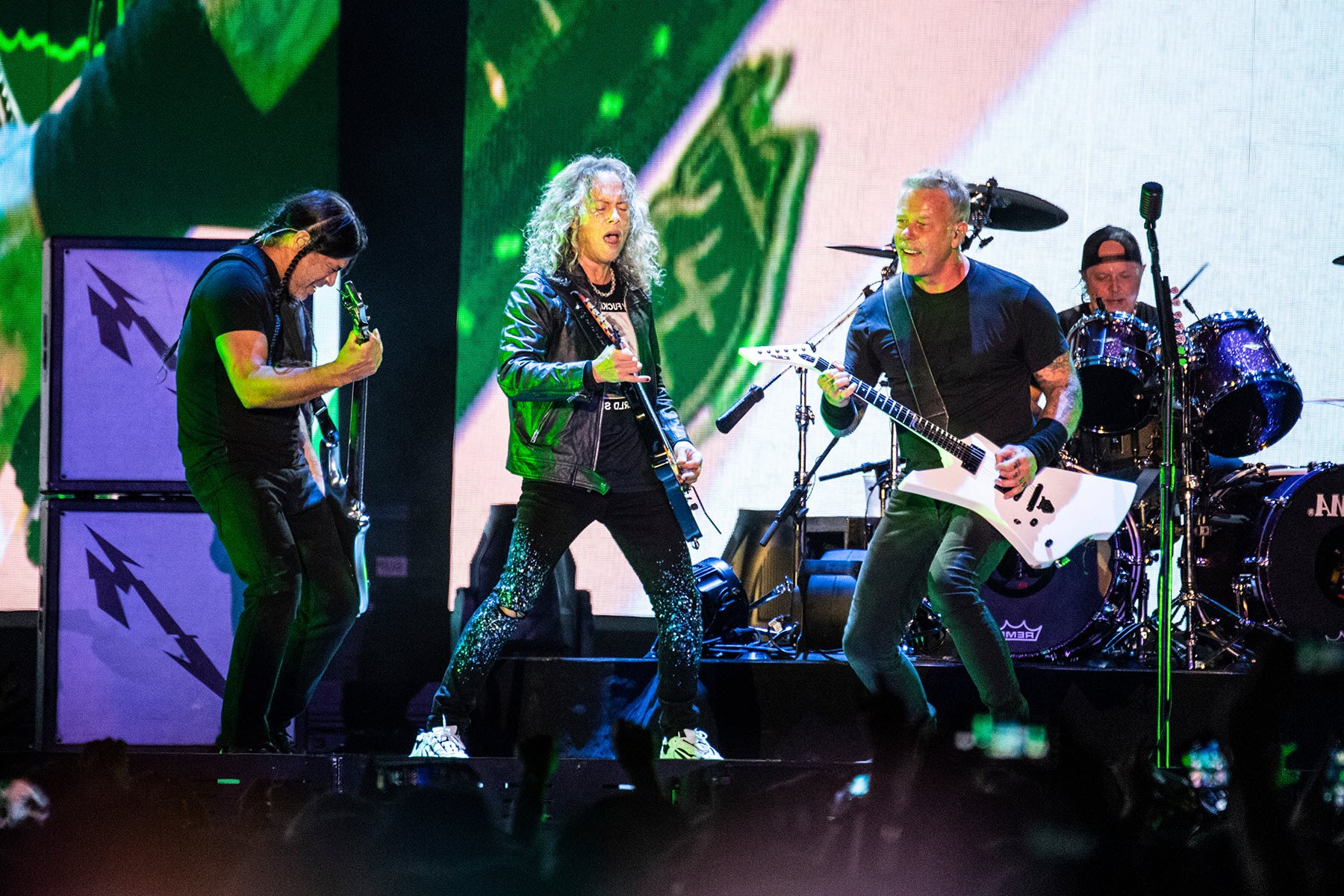
Riff by riff, hook by hook, the legend of Metallica was forged in stadiums, garages, bedrooms, and the imaginations of listeners who craved power with purpose. This list revisits ten fan magnets that turned four relentless players into a global institution. Expect midnight lullabies that feel like nightmares, power ballads that smolder into infernos, and epic suites that prove heavy can also be nuanced. Whether you came for the palm mutes or stayed for the melodies, each track below earns its space by shaping how heavy music feels, moves, and endures. Crank the volume, clear some space, and let the classics breathe fire.
1. Enter Sandman
There is a reason Enter Sandman still causes an instinctive reach for the volume knob. The song is a master class in ominous mood building. Kirk Hammett’s coiled main riff creeps in like a shadow at the edge of the room, then James Hetfield’s vocal strides forward with a storyteller’s control, relishing every syllable. The arrangement rewards attention. Those palm muted steps between lines feel like held breath, and Lars Ulrich punctuates each phrase with crisp tom figures that never overplay the drama. The lyric works as a modern cautionary tale, a prayer and a threat at once. When the whisper section breaks the storm, you can feel the band’s sense of theater. By the time the chorus lands, the hook feels inevitable, the kind of earworm that welds itself to memory. Enter Sandman also reveals the secret of Metallica’s broad appeal. The riff is heavy yet hummable, the groove is stern yet danceable, and the production lets the edges show without sacrificing clarity. If you are mapping the gateway moments that turned casual listeners into lifers, this is one of the brightest signposts. It is menace delivered with a wink, and it never dulls with age.
2. Nothing Else Matters
Nothing Else Matters is the ballad that opened a new corridor in the Metallica universe without abandoning the band’s identity. The famous open string figure is disarmingly simple, which is part of its genius. Every note rings with air and intention, a kind of confession set to six strings. Hetfield’s vocal is intimate but resolute, and the melodic arc climbs with patience rather than brute force. Listen to how the arrangement blooms. Clean guitars braid around the vocal, then harmonized leads and orchestral colors expand the frame while the rhythm section anchors the heartbeat. The lyric avoids florid language in favor of direct statements about trust and distance, which is why the chorus lands with such universal clarity. In a catalog defined by speed, precision, and weight, this song reminds you that restraint can be heavier than distortion. The solo does not shred for its own sake. It sings, almost like a second voice answering the first. That conversational quality is the song’s secret. Nothing Else Matters does not beg for validation from rock orthodoxy or pop radio. It stands on the confidence of its craft, proving that vulnerability and strength can share the same stage and that a quiet line can shake an arena.
3. Master of Puppets
Master of Puppets is a suite disguised as a single, an eight minute journey that demonstrates how structure can be a weapon. The opening riff is a kinetic machine that locks the listener into forward motion, then the band keeps reshaping the terrain beneath your feet. The verse cadence snaps with martial precision, the pre chorus surges with a lifted melody, and the chorus pounds like a hammer strike that somehow still invites you to sing along. In the center section, the harmony guitars create a cathedral of melody, giving the piece room to breathe before the final charge resumes. That contrast between menace and lyricism is crucial. It shows how Metallica uses harmony not as decoration but as narrative. The lyric examines manipulation and addiction through imagery that feels personal and systemic at once. You can hear echoes of classic metal, punk toughness, even prog level attention to detail, yet the song never feels academic. It is visceral storytelling in riff form. Pay attention to the drum figures that pull and release tension without clutter. Pay attention to the right hand stamina that makes the downpicking feel like a living engine. Master of Puppets is not only a benchmark. It is a blueprint for ambition in heavy music.
4. One
One threads a chilling narrative through evolving dynamics. The clean arpeggios at the start suggest fragile memory. Hetfield’s restrained vocal reads like a diary entry delivered from isolation, and the lyric paints sensory absence with unnerving specificity. Then the snare cracks a little harder, the guitars gain teeth, and the song reveals its architecture. The first solo is pleading, almost vocal in its phrasing, while the second accelerates into a flurry that mirrors panic. When the signature machine gun rhythm arrives, guitar and drums lock into a call and response that feels like a physical jolt. What makes this piece endure is the way its parts serve the story. Every tone choice, every tempo shift, carries narrative weight. The production leaves room for the guitars to chime and for the rhythm section to punch without swallowing the details. The final section does not simply race to the finish. It spirals, stacking intensity until the only sensible exit is abrupt silence. One shows how Metallica marries cinematic vision to songcraft. It is heavy, yes, but heavy because it cares deeply about what its weight is doing. Few songs capture despair and defiance with such economy and force.
5. Fade to Black
Fade to Black marks a pivotal evolution, the moment Metallica expanded the palette to include introspective atmosphere without losing bite. The intro’s clean guitar lines feel like cold air entering a room. They linger, letting harmonics and resonance set the emotional weather before the gain arrives. Hetfield’s vocal walks a knife edge between exhaustion and resolve, and the lyric uses plain speech to sketch profound weariness. What keeps the track from collapsing into gloom is the writing discipline. Each section develops the last. The pre chorus lifts, the chorus stretches into a chant that listeners carry with them, and the bridge prepares the ground for one of the band’s most singable solos. Hammett’s lead is a lesson in contour. It starts conversational, ascends in measured arcs, then finally lets the bends cry out. Beneath it all, the rhythm section is patient, offering space and then power at exactly the right moments. The final acceleration proves the point. The band can sprint when it wants to, but here speed is a climax rather than a starting point. Fade to Black endures because it treats darkness with honesty and craft, transforming private doubt into communal catharsis.
6. For Whom the Bell Tolls
For Whom the Bell Tolls is the sound of inevitability. The opening bell and bass motif do not simply introduce the song, they establish a landscape where every accent feels like a footstep toward something unavoidable. Cliff Burton’s distorted lead bass carries a melodic authority that still surprises new listeners, and the guitar harmonies that follow feel like steel beams being set in place. The tempo is mid stride, which is deliberate. Instead of sprinting, the band chooses weight and placement, letting each chord crush forward while the drums carve a simple but irresistible march. Hetfield’s vocal takes on the role of town crier, delivering lines with clipped emphasis that heightens the dread. The lyric references battlefield imagery yet reads like a meditation on fate and power. There is no wasted motion. The break sections reset tension without resorting to flash. The lead figures are memorable, the kind you can hum after one listen, and the final passages lean into repetition as a statement of endurance. For Whom the Bell Tolls remains a setlist anchor because it transforms restraint into domination. It proves that the heaviest feeling is not always about speed. Sometimes it is about gravity and the patience to let it do the work.
7. The Unforgiven
The Unforgiven turns the usual power ballad formula inside out. Instead of bright verses and heavy choruses, the band opts for brooding verses framed by acoustic textures, then unleashes distorted guitars when the refrain arrives. That inversion gives the chorus a defiant authority. Hetfield’s vocal sits close to the mic, almost confessional, and the lyric narrates a life conditioned by expectation and regret. The horn like figure at the start sets a cinematic tone, then the rhythm guitars breathe with a measured swing that feels almost folk in its pulse. Kirk Hammett’s solo is one of his most melodic statements. It winds through the progression with a singer’s logic, never racing past its own story. Lars Ulrich accents transitions with strategically placed fills that nudge the song forward without crowding the space. What makes The Unforgiven special is the way it fuses intimacy and force. You can feel the walls closing in during the verses, then the chorus knocks them down with a single open chord. The production keeps the edges intact. Acoustic strums retain their grain, and the electric crunch still has air around it. Few tracks capture both vulnerability and defiance with such compositional clarity.
8. Sad But True
Sad But True is weight personified. The down tuned stomp lands with the confidence of a giant boot, and every rest amplifies the next hit. The guitar tone achieves a satisfying chew that invites head nods from the first measure. Hetfield’s lyric explores the voice of temptation speaking from inside your own skin, which suits the groove. He sings from the perspective of the force you try to resist, a choice that makes the chorus feel like a mirror you cannot avoid. The beauty here is in negative space. Lars sets up each phrase with uncluttered authority, and the bass doubles the riffs in a way that fattens the attack without smearing the edges. The call and response between vocal and guitar in the verse is pure craft. It gives the lines room to ring and turns the riff into a character. Hammett’s solo chooses texture over fireworks, leaning into bends and slides that match the song’s swagger. Sad But True proves that slow does not mean simple. It is deceptively precise music that feels primal because the choices are so clear. Turn it up on a good system and you will hear the mix breathe, a reminder that heaviness is as much about air as it is about volume.
9. Seek and Destroy
Seek and Destroy captures the band’s formative ferocity and converts it into anthem. The main riff is pure street energy, a simple pattern that begs for a crowd shout. Hetfield’s vocal has a grin in it, a swagger that makes the threat feel like an invitation to join the charge. The lyric speaks in mission terms, but the real story lives in the groove. The drumming is brisk and direct, pushing the guitars without tripping over them. The pre chorus tightens the screws, and the chorus releases with a chant that even first time listeners grasp in seconds. Live, the middle section turns arenas into giant choirs as the band toys with tempo and silence, then slams back into the theme. What keeps Seek and Destroy fresh is its lack of fuss. There is no overthinking here, only the confidence to do the simple thing with conviction. The guitar breaks nod to classic rock tradition while the rhythm section keeps the punk spirit humming. You can hear the DNA of later triumphs in this early statement. It is a snapshot of hunger, a reminder that precision and attitude can coexist and that a great riff is a passport that never expires.
10. Wherever I May Roam
Wherever I May Roam opens with a sitar like guitar figure that bends the ear before the main riff even arrives. That detail signals the song’s central theme. This is a traveler’s creed, restless and proud. When the rhythm guitars hit, the groove strides with an almost regal confidence, and Hetfield’s vocal plants flags on every downbeat. The lyric celebrates motion as identity. Home becomes a moving target rather than a fixed point, and the chorus turns that idea into a singalong motto. The arrangement is a study in layering. Percussive ornaments flicker at the edges, harmony guitars sketch wide vistas, and the bass locks to the kick in a way that makes each step feel deliberate. Hammett’s solo speaks in long lines and modal flavors that echo the intro’s exotic color without becoming a gimmick. What makes Wherever I May Roam endure is its balance of toughness and poise. It stomps, but it also glides. It is a road song that refuses nostalgia, preferring the thrill of the next horizon. Press play and you can almost feel the dry heat rising from asphalt, the blur of mile markers, the sense that identity is not a destination. It is a practice, and this riff is part of it.

David Morrison is a frequent contributor to Singers Room. Since 2005, Singersroom has been the voice of R&B around the world. Connect with us via social media below.









