
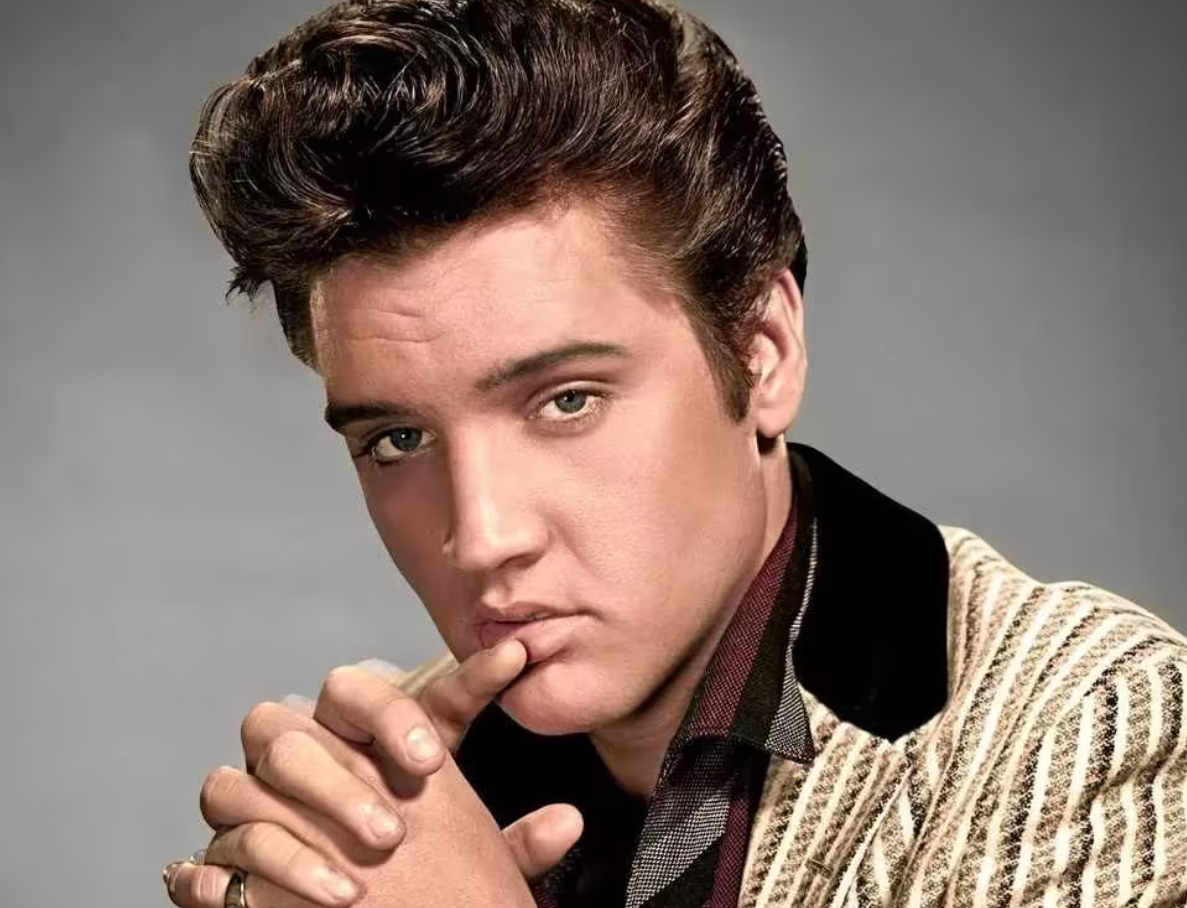
Few voices have altered popular culture as completely as Elvis Presley’s. He could make a love song feel like a private confession, turn heartbreak into theater, and ignite a dance floor with little more than a breath, a curled phrase, and an irresistible rhythm. His finest recordings brought country, blues, gospel, soul, and rhythm and blues into a thrilling new language that crossed generations and borders. The ten songs below capture the extraordinary range of the man called the King, from the dangerous electricity of his early hits to the emotional grandeur of his mature performances.
1. Suspicious Minds
There is an almost cinematic intensity to “Suspicious Minds” , a song that transforms romantic mistrust into a full scale emotional crisis. Written and originally recorded by Mark James, it found its definitive interpreter when Elvis Presley entered American Sound Studio in Memphis in 1969. Producer Chips Moman surrounded him with a muscular rhythm section, dramatic strings, urgent horns, and backing singers who seem to echo the troubled thoughts circling inside the narrator’s mind.
Elvis delivers the verses with remarkable control. He begins as a man attempting to reason with someone he loves, but desperation gradually overtakes diplomacy. Every return to the chorus raises the emotional pressure. His voice shifts between tenderness, frustration, accusation, and pleading without ever losing the song’s melodic elegance. That combination makes the performance feel human rather than theatrical. The relationship may be collapsing, yet Elvis still sounds convinced that love can rescue it.
The recording’s famous fading and returning ending adds another layer of psychological drama. Just when the song appears to be disappearing, it surges back into view, mirroring a couple unable to escape the same argument. The effect was controversial within the production process, but it became one of the record’s most recognizable features.
Released during Elvis’s great artistic resurgence, “Suspicious Minds” became his final number one single on the American pop chart during his lifetime. More importantly, it demonstrated that the mature Elvis remained a commanding contemporary artist. Restless, soulful, and emotionally combustible , the song still sounds like two people trying to save their love while trapped inside the very fears destroying it.
2. Can’t Help Falling in Love
“Can’t Help Falling in Love” is one of the rare romantic songs that feels both intensely personal and almost universal. Recorded for the 1961 film Blue Hawaii , its melody was adapted from the eighteenth century French composition “Plaisir d’amour.” Elvis Presley and his collaborators transformed that old melodic foundation into a modern declaration of devotion, creating a recording that has become inseparable from weddings, proposals, films, and intimate moments around the world.
The arrangement is restrained and exceptionally graceful. Gentle instrumentation establishes a dreamlike atmosphere, while the delicate backing voices frame Elvis without crowding him. His vocal performance is notable for its patience. Rather than displaying his full power, he sings with soft authority, allowing each phrase to settle naturally. The slight vibrato in his voice suggests vulnerability beneath the certainty of the message.
What gives the song its lasting emotional force is the tension between wisdom and surrender. The narrator understands that caution has value, yet recognizes that genuine love does not always obey reason. Elvis communicates that conflict without exaggeration. He sounds neither reckless nor naive. Instead, he sounds like someone who has accepted that a profound emotional truth is carrying him somewhere he willingly intends to go.
The song later became a traditional closing number in Elvis’s concerts, giving it an additional layer of meaning for his audiences. It was no longer simply a romantic ballad. It became a farewell, a blessing, and an expression of affection between performer and listener. Elegant without being ornate and sentimental without becoming sugary , “Can’t Help Falling in Love” remains one of the most beautifully controlled performances in Elvis Presley’s catalog.
3. Jailhouse Rock
Few recordings capture the unruly excitement of early rock and roll as vividly as “Jailhouse Rock.” Written by Jerry Leiber and Mike Stoller for the 1957 motion picture of the same name, the song is a miniature world populated by prisoners, musicians, dancers, and colorful characters. Its premise is playful, but the recording itself carries tremendous rhythmic force. From the opening guitar figure onward, everything feels immediate, physical, and slightly dangerous.
Elvis Presley attacks the vocal with extraordinary confidence. His phrasing is sharp and percussive, frequently locking into the drumbeat as though his voice were another part of the rhythm section. He does not merely sing about a party inside a jail. He creates the entire scene through changes in tone, timing, and attitude. His pronunciation gives individual lines a conversational snap, while sudden bursts of power keep the performance unpredictable.
The instrumental arrangement is lean but explosive. Guitar, bass, piano, and drums create a compact wall of rhythm, leaving enough open space for every accent to land. The result is a recording that feels much larger than its actual components. It embodies the economy of great rock and roll, where a memorable riff and an inspired performance can generate more excitement than an elaborate orchestration.
The film sequence strengthened the song’s cultural impact. Dressed in prison clothing and moving through stylized choreography, Elvis produced one of the defining visual images of his career. That performance helped establish a vocabulary later absorbed by music videos and televised pop spectacles.
“Jailhouse Rock” remains irresistible because it never sounds carefully preserved or historically distant. It still bursts from the speakers with youthful swagger , reminding listeners that Elvis at his most electrifying could turn a humorous story into a declaration of musical freedom.
4. Burning Love
“Burning Love” returned Elvis Presley to the center of hard driving rock music with a performance fueled by urgency, heat, and physical desire. Written by Dennis Linde, the song was recorded by Elvis in 1972 and became one of the biggest hits of his later career. At a time when his public image was increasingly associated with grand ballads and Las Vegas spectacle, this recording proved that he could still command a fierce contemporary groove.
The track begins with a guitar part that immediately establishes forward motion. Its rhythm is tough, tightly wound, and built to support the escalating imagery of the lyric. The narrator is not describing calm affection. He is overwhelmed by a sensation that appears to consume both body and mind. Elvis responds to that language with a vocal that grows more animated as the song progresses. He starts with measured confidence, then steadily increases the pressure until the closing passages erupt into ecstatic release.
One of the recording’s great strengths is the contrast between its direct construction and Elvis’s richly expressive delivery. The melody is accessible, the chorus is instantly memorable, and the central metaphor is uncomplicated. Yet Elvis fills the performance with vocal textures, from clipped phrases to soaring cries. The backing singers amplify the excitement, particularly near the end, when the record begins to feel less like a studio performance and more like a revival meeting devoted to romantic obsession.
“Burning Love” also captures the gospel foundation beneath much of Elvis’s rock singing. Its closing repetitions use accumulation, call and response, and rising intensity to push the music toward transcendence. Passion becomes combustion, and combustion becomes celebration. The result is a late period Elvis classic that sounds powerful, playful, and gloriously alive.
5. Love Me Tender
“Love Me Tender” revealed a remarkably gentle side of Elvis Presley at the height of the excitement surrounding his early career. Introduced in 1956 and featured in his first motion picture, the song drew its melody from the nineteenth century tune “Aura Lee.” Its older musical roots give it the character of a folk memory, while Elvis’s intimate delivery makes it feel like a confession spoken in the present moment.
The arrangement is deliberately simple. Acoustic guitar and soft backing vocals create an uncluttered setting in which every shade of Elvis’s voice can be heard. He avoids the rhythmic attack and playful vocal decorations associated with many of his early rock performances. Instead, he sings with clarity, warmth, and extraordinary stillness. That restraint is central to the song’s effect. Nothing distracts from the promise at its heart.
Elvis possessed a rare ability to make familiar sentiments sound newly discovered. In “Love Me Tender,” declarations of loyalty and lasting affection could easily have become conventional. His performance prevents that by introducing small traces of fragility. He sounds sincere but not invulnerable, as though the promise matters precisely because love can be lost. The listener hears confidence and need existing together.
The song also played an important role in expanding public understanding of Elvis as an artist. His explosive television appearances had made him a symbol of rebellion and youthful sexuality. “Love Me Tender” presented someone capable of quiet romantic sensitivity, broadening his appeal without diminishing his mystique.
Its continued popularity comes from its emotional directness. There are no complicated scenes or dramatic confrontations. There is simply a request to love deeply and remain close. In Elvis’s hands, simplicity becomes intimacy , and intimacy becomes something timeless enough to belong to countless couples while still sounding like one person singing to one beloved listener.
6. Heartbreak Hotel
“Heartbreak Hotel” was the record that announced Elvis Presley as a national phenomenon, but its enduring fascination extends far beyond its commercial importance. Released in 1956, the song creates a strange and desolate location where abandoned lovers gather in permanent isolation. Rather than offering a conventional account of lost romance, it constructs an entire emotional landscape. Loneliness has an address, a lobby, and rooms filled with people who cannot escape their sorrow.
The recording sounds remarkably spacious. Echo surrounds Elvis’s voice, giving the impression that he is singing from inside the enormous empty building described in the lyric. The piano strikes with bluesy authority, the guitar provides spare punctuation, and the rhythm section moves with a heavy, deliberate gait. Every musical choice contributes to the atmosphere. Silence becomes almost as important as sound.
Elvis’s vocal is a masterclass in dramatic phrasing. He bends notes, stretches words, and moves between a low murmur and sudden emotional cries. His influences are audible, particularly blues, country, and gospel, but the final performance belongs entirely to him. It was unfamiliar enough to sound radical on mainstream radio, yet emotionally clear enough to reach an enormous audience.
The song’s darkness is especially striking when placed against the popular image of youthful optimism associated with much of the 1950s. “Heartbreak Hotel” offers no easy comfort. Its characters are surrounded by others, yet remain fundamentally alone. That paradox gives the song psychological depth and explains why it still feels modern.
Brooding, theatrical, and unmistakably strange , “Heartbreak Hotel” did more than produce a star. It introduced a new vocal presence capable of making private anguish feel mythic and turning a lonely street corner into one of popular music’s most unforgettable destinations.
7. In the Ghetto
“In the Ghetto” stands among Elvis Presley’s most socially conscious and narratively ambitious recordings. Written by Mac Davis and released in 1969, the song follows a child born into poverty in Chicago, tracing the conditions that shape his life and ultimately perpetuate a tragic cycle. Its power comes from the refusal to treat that cycle as an abstract issue. The story remains focused on individual lives, giving social inequality a human face.
Elvis sings with unusual restraint. He does not overwhelm the narrative with vocal spectacle, even when the arrangement expands around him. His tone is compassionate, solemn, and observant. That measured approach allows the listener to absorb each stage of the story. When his voice rises, it feels motivated by grief rather than performance. He is not presenting himself as the central character. He serves the people inside the song.
The production carefully balances intimacy and scale. Acoustic textures and a steady rhythm establish the storytelling foundation, while strings and backing vocals gradually deepen the emotional weight. The arrangement never loses sight of the lyric. Each added element makes the situation feel more consequential without turning suffering into melodrama.
The circular construction is especially devastating. A death occurs as another child is born into the same conditions, suggesting that personal tragedy will repeat unless the surrounding society changes. Elvis communicates this return with weary clarity. The ending does not resolve the story because the problem itself remains unresolved.
“In the Ghetto” arrived during a period of artistic renewal for Elvis, when he was recording material of greater emotional and thematic complexity. Its empathy remains its greatest achievement. The song asks listeners to look beyond easy judgments and consider the forces that shape desperation, making it both a memorable story and a serious moral appeal.
8. Blue Suede Shoes
“Blue Suede Shoes” is a foundational rock and roll anthem built from rhythm, attitude, and one unforgettable boundary. Written and first recorded by Carl Perkins, the song was given a distinct interpretation by Elvis Presley for his 1956 debut album. Elvis respected the essential architecture of Perkins’s composition while bringing his own vocal charisma and kinetic energy to the material.
The opening count feels like a starting pistol. Once the band enters, the performance rarely relaxes. Scotty Moore’s guitar work gives the recording bite and momentum, while Bill Black and D. J. Fontana supply the springy rhythmic foundation that defined Elvis’s early sound. The music draws from country and rhythm and blues, yet the combination feels like a new language designed for teenage movement.
Elvis understands the humor of the lyric. The narrator is willing to tolerate a remarkable list of insults and inconveniences, but touching his prized shoes crosses an absolute line. That exaggerated priority gives the song its personality. Elvis delivers the warning with enough swagger to sound convincing and enough playfulness to keep it entertaining. His voice leaps, dips, and snaps against the beat, demonstrating how naturally he treated rhythm as part of vocal expression.
The shoes themselves became a perfect symbol of early rock and roll style. They represented individuality, appearance, pride, and the right to establish one’s own rules. For young listeners, that mixture carried a subtle rebellious charge.
Decades later, “Blue Suede Shoes” remains instantly recognizable because its central idea is so clean and its performance so alive. It is less a complicated narrative than a burst of identity. The record captures Elvis at the moment when confidence, fashion, humor, and musical innovation combined to create an enduring cultural archetype.
9. Always on My Mind
“Always on My Mind” is a song of remorse rather than uncomplicated romance. Elvis Presley recorded it in 1972, bringing deep emotional ambiguity to a lyric about affection that was felt sincerely but expressed inadequately. The narrator insists that his beloved remained present in his thoughts, yet he also admits that his behavior failed to communicate that devotion. The result is a confession in which love and regret are impossible to separate.
Elvis approaches the melody with tenderness, but his performance never becomes emotionally passive. Small changes in volume and emphasis reveal the tension beneath the apology. He sounds like a man reviewing his failures in real time, hoping that honesty might achieve what neglect did not. His voice contains both dignity and vulnerability, qualities that make the narrator sympathetic without erasing his responsibility.
The arrangement provides a warm, spacious frame. Piano, restrained percussion, and gentle backing vocals support the melody while leaving Elvis at the emotional center. The production avoids unnecessary drama because the lyric already carries enormous weight. Each admission arrives plainly, allowing the listener to imagine the history behind it.
The circumstances surrounding Elvis’s life at the time have encouraged listeners to hear the recording as autobiographical, particularly in relation to the end of his marriage. Whether interpreted that way or not, the vocal possesses the specificity of lived experience. It does not sound like a generalized apology. It sounds directed toward one person whose absence has transformed memory into pain.
The brilliance of “Always on My Mind” lies in what it cannot repair. The narrator finds the right words only after they may have lost their power. Elvis turns that belated realization into a performance of extraordinary tenderness, making the song a lasting expression of love recognized too late.
10. A Little Less Conversation
“A Little Less Conversation” demonstrates how effortlessly Elvis Presley could inhabit a tough, rhythm driven arrangement. Written by Mac Davis and Billy Strange, the song originally appeared in the 1968 film Live a Little, Love a Little . Its initial release attracted limited attention, but its later rediscovery introduced the recording to a vast new audience and confirmed how modern Elvis could sound when paired with the right groove.
The lyric is direct and impatient. The narrator has grown tired of explanations, hesitation, and empty promises. He wants action, emotional commitment, and immediate connection. Elvis delivers that demand with a mixture of charm and authority. His phrasing is conversational without becoming casual, and he places sharp accents precisely where the rhythm needs them. Even in the original recording, one can hear why later producers recognized its potential.
Musically, the track carries elements of funk, soul, and late 1960s pop. The guitar figure has a clipped, insistent character, while the percussion creates a strutting pulse beneath the vocal. Backing singers answer and reinforce Elvis, helping the performance build toward a chorus designed for instant recognition. The arrangement gives him space to sound commanding without relying on grand orchestration.
The song achieved extraordinary international popularity decades later through a remix by JXL. That transformation tightened its rhythmic impact and connected Elvis’s original vocal to contemporary dance culture. Unlike many archival recordings adapted for a newer era, the voice never sounded out of place. Its timing, power, and personality remained completely convincing.
“A Little Less Conversation” survives because its central demand is timeless. It is witty, physical, and impatient with empty gestures. Elvis turns that impatience into pure momentum, delivering a performance that continues to invite movement rather than discussion.